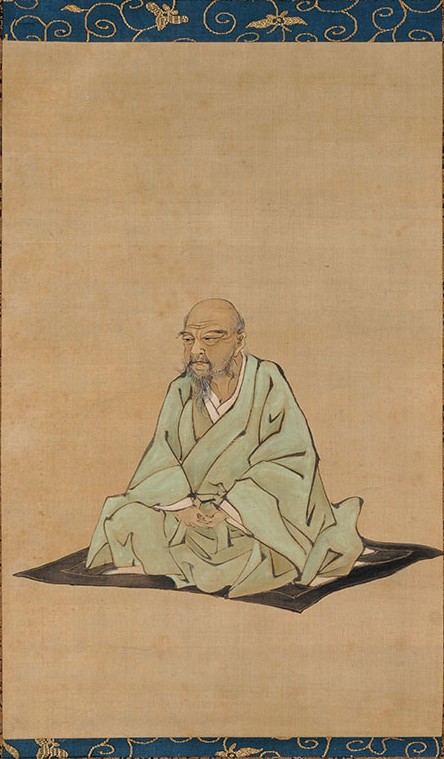

Kubota Beisen, Portrait of Ito Jakuchu, Meiji period. Shokoku-ji, Kyoto, public domain · Portrait of Ito Jakuchu by Kubota Beisen (1852-1906), one hanging scroll, colour on silk, Meiji period (Commons gives 1885, which the holder's exhibition listings do not confirm), in the collection of Shokoku-ji, Kyoto, exhibited at its Jotenkaku Museum. A posthumous portrait made about eighty-five years after his death, so shown as a later depiction and not as a likeness from life. The file is a promotional photograph of the scroll, used at its native 444 x 759 size with no resizing or upscaling; the temple site offers no item record or rights statement for it. · Public domain (a Meiji-period painting by an artist who died in 1906)
화가 · 근세
이토 자쿠추
1716–1800
주요 업적 분야
아직 성격 매칭에 포함되지 않았습니다 — 기록된 근거가 성격 모델 전체를 다루기에는 충분하지 않습니다. 이 페이지의 다른 모든 내용은 자유롭게 확인하실 수 있습니다.
핵심 특성
주요 업적
1757년부터 1766년까지 『동식채회(動植綵繪)』 30폭을 그렸다. 새와 식물, 물고기, 곤충을 촘촘히 그려 낸 이 작품은 국보로 지정되었으며, 그는 이를 쇼코쿠지에 기증했다.
닭 그림으로 유명한 짙은 채색의 화조화 양식을 만들었다. 일본의 사전류는 그의 그림을 관찰한 형태와 세밀한 묘사를 상상력 넘치는 화면으로 재구성한 것이라고 설명한다.
교토 청과 도매상의 장남으로 태어나 마흔에 가업을 동생에게 넘기고 그림에 전념했으며, 1788년 대화재로 작업실과 가게를 잃은 뒤에도 세키호지 곁에서 작업을 이어 갔다.
삶의 장면들
가노파의 분본(粉本) 위주 방식에 만족하지 못한 그는 송·원·명 시대의 그림을 베껴 그리고 주변의 동식물을 사생하는 쪽으로 나아갔으며, 집에서 닭을 기르고 때로는 이국의 새를 들여와 관찰했다.
이는 물려받은 유파의 방식보다 직접 연구를 택하는 태도와 일치한다. 독립적 사고
리핏은 그가 1757년부터 1766년까지 해마다 대작 세 점 정도의 속도로 『동식채회』를 쉬지 않고 그렸으며, 값비싼 재료와 비단 뒷면에 칠하는 배채(背彩) 기법을 썼다고 설명한다.
이는 10년에 걸친 지속적이고 공들인 노력과 일치한다. 끈기
전환점
마흔 살에 집안의 청과 도매업에서 물러나 동생에게 넘기고 쇼코쿠지로 옮겨 『동식채회』를 시작했다.
이는 안정적인 가업을 내려놓고 전업 화가로 일하려는 선택과 일치한다. 자율성 욕구
비슷한 인물
전체적인 프로필이 이 사람과 닮은 사람들이에요.
출처
- Itō Jakuchū (Q1240575), verified live via the Wikidata API (2026-11-05): English label 'Itō Jakuchū', description 'Japanese artist (1716-1800)', Korean label 이토 자쿠추, birth 1716-03 and death 1800-10-27. Orientation only; not used as support for any row.
- Kotobank (Japanese reference aggregator) entry for Ito Jakuchu, reproducing Shogakukan's Digital Daijisen and Nipponica (entry by Kobayashi Tadashi), Heibonsha's World Encyclopedia (entry by Suzuki Hiroyuki), Britannica Japan, Heibonsha's Mypedia and Kodansha's Japanese biographical dictionary, read in the original Japanese. CANONICAL SIGNIFICANCE SOURCE: a Kyoto painter, eldest son of a Nishikikoji greengrocer, who studied the Kano school but was dissatisfied with its copybook practice and turned to copying Song, Yuan and Ming paintings and sketching the animals and plants around him; handed the family business over at 40 and devoted himself to painting; made an unusual style of rich-colour bird-and-flower painting and ink painting; best known for the thirty-scroll Colourful Realm of Living Beings (1757-66) given to Shokoku-ji, and for his chickens; unusual stone-rubbing prints; lost his house in the 1788 Tenmei fire and lived out his last years near Sekiho-ji; contrasted by Suzuki with Maruyama Okyo's plain realism (his paintings recompose observed forms into a strongly subjective, imaginative picture); Nipponica records the tale that he painted chickens for anyone for a measure of rice. Japanese scholarly reference; independent of the English press sources.
- Sarah Fleming, 'Ito Jakuchu: The Greatest Fullness', Tricycle: The Buddhist Review (read as the visible part of the page, which covers the whole profile before the subscription notice). A popular profile: eldest son of a Kyoto greengrocer, trained under Ooka Shunboku of the Kano school but found it too strict and learned from vegetables, fish and the fowl he raised, sometimes importing exotic birds to observe; took over the shop after his father's death in 1739 but had little interest in it, quoting his friend the Rinzai monk Daiten; retired at 40 to his younger brother and moved to Shokoku-ji to paint the Colorful Realm of Living Beings; the series' donation to the temple in 1765 with his dedication; the studio and family shop burned in the 1788 Tenmei fire, after which he funded the Five Hundred Arhats stone garden at Sekiho-ji by selling ink paintings for rice. Admiring; relies in part on Daiten and Baisao, who were friends, and tells at least one tale it calls perhaps apocryphal.
- Harvard Magazine, 'A Blossoming Centennial' (2012), an article built on interviews with Professor Yukio Lippit, guest curator of the National Gallery of Art exhibition 'Colorful Realm: Japanese Bird-and-Flower Paintings by Ito Jakuchu', read in full. A modern scholar's account: he began the Colorful Realm in 1757 and worked on it continuously until 1766 at about three paintings a year; initially perhaps individual works or a smaller set, later conceived under Daiten as a backdrop to a Shokoku-ji ritual, with a Shakyamuni triptych making 33; the paintings are highly crafted polychrome works on silk using expensive materials and laborious techniques, including verso coloration; the later works are more experimental; he retired at 40 from a prospering family business; Shokoku-ji gave the paintings to the Imperial Household in 1889 for funds. The article is an exhibition-promotion piece that also describes the curator; admiring.
- Canon Tsuzuri Project, 'Colorful Realm of Living Beings (Doshoku sai-e)' work page (Japanese), read in full. A cultural-heritage reproduction project's catalogue note on the Imperial Collections Museum's thirty hanging scrolls (National Treasure, 2021): painted by the former Nishikikoji greengrocer over about ten years, centred on chickens, with an overwhelming density of detail and bold compositions not seen in other painters; given by Jakuchu himself to Shokoku-ji, where it was used in ceremonies with his Shakyamuni triptych; presented to the Imperial family by the temple in 1889. Short institutional text; consistent with, but not independent of, the museum descriptions on which it draws.