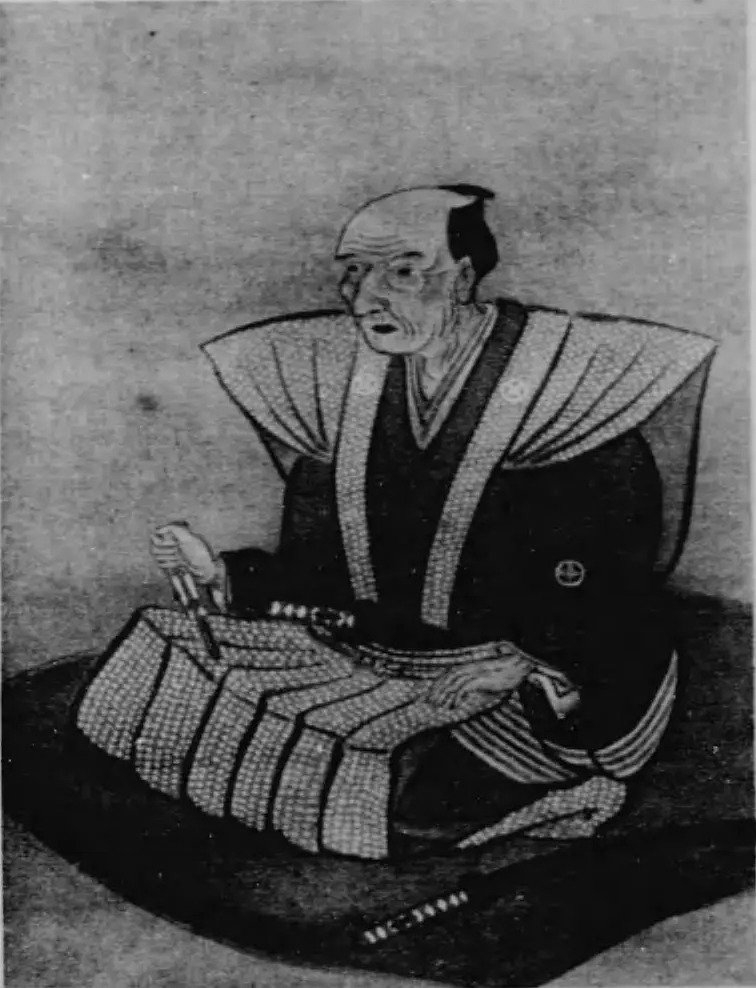

Painting probably by Aoki Katsujiro (c. 1821, attributed by the Ino Tadataka Memorial Museum, Katori); plate in Otani Ryokichi (ed.), Ino Tadataka, Iwanami Shoten, 1917; digitised by the National Diet Library, Japan (https://dl.ndl.go.jp/pid/956854) · Printed plate captioned 'Portrait of Ino Tadataka' in Otani Ryokichi (ed.), Ino Tadataka (Tokyo: Iwanami Shoten, 1917), as digitised by the National Diet Library (NDL Digital Collections item 956854, page image R0000004). It reproduces the painted portrait of about 1821 kept by the Ino Tadataka Memorial Museum in Katori, which the museum says is his only portrait and was probably painted by his disciple Aoki Katsujiro after his death. The file is the plate cropped from the library's 4064 x 2848 pixel scan of the book spread (756 x 988 pixels), black-and-white halftone, with no upscaling. · Public domain (National Diet Library item-level Public Domain Mark; a 1917 Japanese publication reproducing a painting of about 1821)
핵심 특성
주요 업적
1800년 55세에 시작해 1816년까지 열 차례의 측량을 이끌며 홋카이도에서 규슈까지의 해안을 도보와 천문 관측으로 측량한 일본의 측량가이다. 그가 세상을 떠난 뒤 제자들이 1821년 대일본연해여지전도(이노 지도)를 완성했으며, 재팬 서치는 이를 실제 측량 기법으로 만든 일본 최초의 지도로 설명한다.
막부는 지도를 비밀로 했고 공식 정본은 1873년 화재로 소실되었지만, 사본은 1870~80년대 일본 정부 지도의 바탕이 되었고 지볼트가 가지고 나간 사본은 1840년 유럽에서 출판되었다. 학자들은 그가 삼각측량이 아닌 도선법을 썼고 경도가 위도보다 덜 정확했다고 지적한다.
측량에 나서기 전에는 양가의 양조·상업을 운영했고, 49세에 은퇴해 다카하시 요시토키에게 천문학을 배웠으며, 자오선 1도의 길이를 28.2리(약 110.75km)로 측정해 랄랑드 천문학서의 수치에 가까운 값을 얻었다. 2010년 그와 관련된 자료 2,345점이 국보로 지정되었다.
삶의 장면들
1800년 막부는 북방 방어에 도움이 된다는 이유로 에조 측량을 허가했지만 이노와 스승이 가장 관심을 둔 것은 위도 1도의 길이였고, 지원금이 적어 그는 사비를 보탰다.
이는 과학적 목표를 국가의 실용적 관심과 연결하고 사비를 보태 허가와 재원을 확보할 방법을 찾아낸 사람의 면모와 일치한다. 자원 활용 성향
이후 측량에서 그는 천식을 앓고 말라리아에 걸려 병이 도질 때마다 측량 기구를 내려놓아야 했지만 측량은 17년간 이어졌고, 마지막 두 차례에는 거의 참여하지 못했으며 지도는 그의 사후 제자들이 완성했다.
이는 나이와 병이라는 한계 속에서도 목적을 잃지 않고 여러 해 노력을 이어간 모습과 일치한다. 끈기
전환점
1803년 그는 에도성에서 쇼군 도쿠가와 이에나리 앞에 동일본 지도를 펼쳐 보였고, 쇼군은 그를 가신으로 삼아 정부 비용으로 서일본을 측량하도록 명했으며 측량대에는 역국(曆局)의 전문가들이 합류했다.
이는 구체적인 성과를 보여준 뒤 개인 사업이 공식 사업으로 바뀐 전환과 일치한다. 주도 성향
비슷한 인물
전체적인 프로필이 이 사람과 닮은 사람들이에요.
출처
- Inō Tadataka (Q1240937), verified live via the Wikidata API (2026-11-04): English label 'Inō Tadataka', description 'Japanese surveyor and cartographer (1745-1818)', Korean label 이노 다다타카, born 11 February 1745, died 17 May 1818, citizenship Japan. Orientation only; not used as support for any row.
- Wikipedia, 'Inō Tadataka' (English article, read as orientation only). Not counted as a substantive source and not used as support for any row or card.
- Geospatial Information Authority of Japan (national mapping agency), exhibition page 'The Ino Maps: the origin of modern maps, commemorating 200 years since the completion of the Dai Nihon Enkai Yochi Zenzu' (2021), read in full (Japanese). CANONICAL SIGNIFICANCE SOURCE: Ino Tadataka began surveying Ezo in 1800 at 55 and carried out ten surveys to 1816, producing a surveyed map from Hokkaido to Kyushu; he died in 1818, his disciples took the work on, and the Dai Nihon Enkai Yochi Zenzu (the Ino maps) was completed in 1821 and submitted to the shogunate, with large (1:36,000, 214 sheets), medium (1:216,000, 8 sheets) and small (1:432,000, 3 sheets) scales; the official copy burned in the palace fire of 1873 and the Ino family copy given to the government was lost in the 1923 earthquake; the exhibition presents how the Ino maps influenced later Japanese mapping. The page prints his birth year as 1754, a typographical slip against every other source (1745).
- Hoshino Yoshihisa, 'Mapping a Nation: Japan's Most Famous Cartographer, Inō Tadataka', Nippon.com, Shapers of Japanese History series (30 January 2020), read in full: a detailed narrative of his life and surveys (merchant and village headman, retirement at 49, study with Takahashi Yoshitoki, the 1800 Ezo survey, the 1803 presentation to the shogun, asthma and malaria on later trips, the 1821 completion by his students, the loss of the originals), with a candid closing paragraph on his sternness with people and the limits on his longitude accuracy.
- 'Inō, Tadataka', Complete Dictionary of Scientific Biography (Charles Scribner's Sons, 2008; the entry text as reproduced by Encyclopedia.com), read in full: a scholarly entry that explains the meridian-length problem, the 1800 survey and the western surveys, and the maps' later use, and that also lists his scientific limits (traverse method rather than triangulation, a spherical earth, no allowance for refraction, parallax or nutation, longitudes fixed by measured distances) and the secrecy that limited the maps' influence. Its bibliography names Otani Ryokichi's 1917 biography as the standard life.
- Japan Search (National Diet Library portal), 'Tadataka Ino' (person page with a biographical note), read: a short institutional note recording his adoption by the Ino family, his revival of its sake-brewing and rice-trading business, retirement at 50, study under Takahashi Yoshitoki in Edo, ten surveys over 18 years, and the explanation given to the shogunate that the Ezo survey mattered for northern defence while the master and pupil first wanted the distance of a degree of latitude; it also records that Mamiya Rinzo surveyed the rest of Ezo and that Takahashi Kageyasu and others completed the Ino maps.
- BRUTUS magazine web article on the 'Ino Walk' (Japanese, undated; the guide quoted is a walking-trip specialist), read in full: popular, partly promotional account of the ten surveys, the shift from largely self-funded surveys to an official project from the fifth survey, the devised bearing-compass instrument, his illness in later years, and the statement that his work involved no compromise; the article itself marks the 'forty million steps' figure as legend.
- National Research Institute for Cultural Properties, Tokyo, news item 'Report on Important Cultural Properties Designation Submitted' (March 2010), read: records the Council for Cultural Affairs' report designating 2,345 materials pertaining to Inō Tadataka (maps, documents and surveying instruments, Katori City) as National Treasures. A short factual notice; used only for the 2010 designation.
- Katori City, Ino Tadataka Memorial Museum, object page 'Portrait of Ino Tadataka' (Japanese), read: the museum describes it as Ino Tadataka's only portrait painting and says it was probably painted by his disciple Aoki Katsujiro when his grandson presented the Dai Nihon Enkai Yochi Zenzu to the shogunate after his death; file 1244 x 3352 px. The city's site policy page states that copyright in the site's text and images belongs to the city or the content provider and that reuse needs permission; the object page itself gives no licence.
- National Diet Library Digital Collections, Otani Ryokichi (ed.), Inō Tadataka (Tokyo: Iwanami Shoten, 1917), item-level Public Domain Mark: the printed plate captioned 'Portrait of Ino Tadataka' near the front of the book. Opened for the portrait only; the book text was not read.