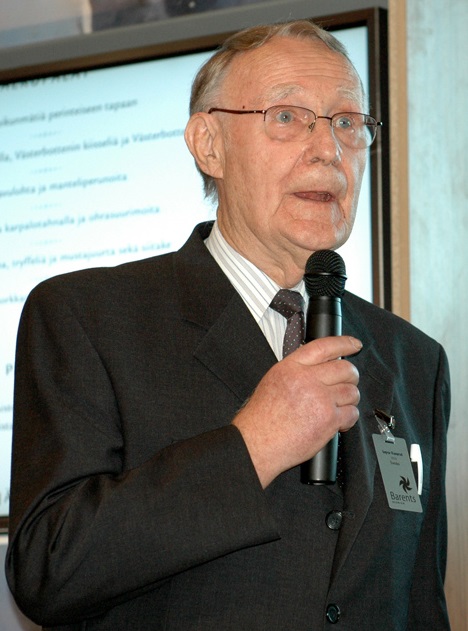

Photo: Sandra Baqirjazid / Ministry of Enterprise, Energy and Communications of Sweden, 2010, CC BY 2.0 · Wikimedia Commons, 'Ingvar Kamprad Haparanda June 2010.jpg' -- photograph by Sandra Baqirjazid for the Swedish Ministry of Enterprise, Energy and Communications at the Haparanda 'Midnight Ministerial' meeting, 16 June 2010, published on the ministry's Flickr photostream 'Haparanda Midnight Ministerial June 2010' under CC BY 2.0 and imported to Commons with a Flickr-review stamp (8 May 2013, uploaded by Commons user Kaiketsu). The Flickr page was opened and shows CC BY 2.0 and the credit 'Foto: Naringsdepartementet/Sandra Baqirjazid' with no conflicting copyright notice. Original 468 x 631 pixels (SHA-1 7176673094ea227ce94352d1c4e4c08b9736ac2e, 92455 bytes, matches the downloaded file); saved unchanged, never upscaled. Rejected: the Commons 'Ingvar Kamprad (cropped).jpg' (the Wikidata P18 file), tagged only 'Copyrighted free use' with no named licence or creator and sourced to a university press page statement. Residual gap: the Flickr account is a ministry event album; the Swedish government site's own photo terms were not separately opened. · CC BY 2.0
사업가 · 20세기
잉그바르 캄프라트
1926–2018
주요 업적 분야
아직 성격 매칭에 포함되지 않았습니다 — 기록된 근거가 성격 모델 전체를 다루기에는 충분하지 않습니다. 이 페이지의 다른 모든 내용은 자유롭게 확인하실 수 있습니다.
핵심 특성
주요 업적
그는 1943년 IKEA를 우편 주문 사업으로 등록했고 1958년 엘름훌트에 첫 매장을 열었다. 디진은 IKEA가 2016년 49개국에서 약 360억 유로의 매출을 올린 세계 최대 가구 소매업체가 되었다고 전한다. 그는 2013년 인터 IKEA 회장직에서 물러났으며, AP는 그가 만든 재단이 IKEA를 소유한다고 보도한다.
그는 낮은 가격을 중심으로 회사를 키웠다. 고객이 직접 조립하는 가구, 셀프서비스 매장, 도시 밖의 저렴한 부지, 더 싼 나라로 옮긴 생산이 그 바탕이었다. 디진은 IKEA가 현대 디자인을 대중에게 가져왔다고 평가한다.
1950년대 스웨덴 가구 상인들은 IKEA를 박람회에서 배제하고 공급업체를 압박했다. 캄프라트는 자체 공간과 별도 구매 회사를 세웠고, 1961년부터는 폴란드에서 조달했는데, IKEA 박물관은 그 가격이 스웨덴 제조비보다 거의 50% 낮았다고 설명한다.
삶의 장면들
폴란드 대외무역장관의 스톡홀름 방문 소식을 읽은 캄프라트는 1960년 그에게 편지를 보냈고, 1961년 1월 바르샤바로 가서 처음에는 공장 출입을 거절당했지만 결국 의자, 탁자, 직물을 구매했다.
이는 공급 문제를 스스로 나서서 해결하려는 주도성과 부합한다. 선제적 행동력
스톡홀름 박람회에서 배제되자 그는 드로트닝가탄에 자신의 공간을 빌리고, 직접 공장을 찾아다녔으며, 공급업체 보이콧을 우회하기 위해 구매 회사 이카노를 세웠다.
이는 막혔을 때 현실적인 우회로를 찾아내는 면모와 부합한다. 자원 활용 성향
전환점
1950년대 보이콧으로 제품이 부족해지자 IKEA는 자체 가구를 디자인하고 해외 공급처를 찾게 되었고, 1961년부터 폴란드가 핵심 조달처가 되어 경쟁사가 따라오지 못한 가격 우위를 얻었다.
이는 외부의 제약을 지속적인 사업 강점으로 바꾸는 면모와 부합한다. 기회 감지
비슷한 인물
전체적인 프로필이 이 사람과 닮은 사람들이에요.
출처
- Ingvar Kamprad (Q216932) -- verified live via the Wikidata API (2026-10-24): English label 'Ingvar Kamprad', description 'Swedish business magnate (1926-2018)', Korean label '잉그바르 캄프라트', born 30 March 1926, died 27 January 2018, citizenship Sweden. Orientation only; not used as support for any row.
- IKEA Museum (Älmhult), 'Price wars' (ikeamuseum.com), read in full: in 1950 Kamprad showed at the S:t Eriksmässan trade fair in Stockholm, advertised the fair and marked consumer prices on his goods, which other exhibitors saw as against fair norms, and the organisers later barred IKEA; from 1952 the furniture retailers' association threatened suppliers that sold to IKEA; in 1954 he reportedly got into the Gothenburg furniture fair hidden in a car boot; sales rose from one to six million kronor in three years but the boycott left IKEA short of products; the Swedish pricing and cartel authority documented the episode in a 1957 publication; Kamprad rented his own premises on Drottninggatan in Stockholm, visited factories himself, paid invoices promptly, set up the purchasing company Ikano to get round the boycott, and later called the period a 'non-crisis'; the boycott pushed IKEA to design its own furniture. Museum run by the IKEA group's own heritage side, so a company-curated narrative, though it cites a dated official Swedish report; not independent of IKEA.
- IKEA Museum (Älmhult), 'IKEA's Turn to Poland (1960-1966)' (ikeamuseum.com), read in full: during the mid-1950s boycott most Swedish suppliers stopped supplying IKEA; in 1959 Kamprad, until then the only person in purchasing, hired Ragnar Sterte; after a small Danish supplier network proved too small, Kamprad wrote in 1960 to Poland's foreign trade minister, who invited him, and in January 1961 he travelled to Warsaw with his father, Sterte and designer Bengt Ruda (initially refused factory access, then admitted via a Polish manager and a visit to a chair factory in Radomsko); IKEA bought chairs, tables and fabrics, the ODGLA chair among the first; the page says suppliers trusted IKEA because decisions were made by one person without lengthy negotiations, that IKEA gave long-term contracts, introduced new technology and worked with suppliers to cut costs, and that Polish prices were almost 50% below equivalent Swedish manufacturing costs. Company-affiliated museum text; the reasons suppliers gave are the museum's own account.
- Dezeen (design magazine), 'IKEA founder Ingvar Kamprad dies aged 91', 28 January 2018, read in full as extracted: IKEA grew from a mail-order start to the world's largest furniture retailer (about 36 billion euro sales in 49 countries in 2016); the article credits it with bringing contemporary design to the masses and reshaping product design, manufacturing and distribution; first store in Almhult in 1958; self-assembly furniture began with a side table designed by employee Gillis Lundgren in 1956; stores spread abroad from the 1960s and beyond Europe from the 1980s; the 1996 British 'Chuck out your Chintz' campaign; criticism of a dull cheap image and of exploitation accusations, with more recent focus on quality and sustainability. CANONICAL SIGNIFICANCE SOURCE (with the Irish Times and AP obituaries). Design-press obituary, broadly admiring; it gives his age at founding as 18 where others say 17, and dates differ across sources for flat-pack, so no flat-pack date or first-claim is made here.
- Associated Press obituary, 'Ikea founder Ingvar Kamprad dies at 91', PBS NewsHour, 28 January 2018, read in full as extracted: born 30 March 1926; launched IKEA at 17 selling goods by mail; added furniture around 1950; first store 1958; a flat-pack design invented by an employee in 1956 made home-assembled items easier to ship; he flew economy, drove an older Volvo and built stores on cheap land, often outside cities; stepped down as CEO in 1988 and as chairman of Inter IKEA Group in 2013; IKEA is owned by a foundation he created whose statute requires profits to be reinvested or given to philanthropic causes; he moved to Switzerland in the 1970s for tax reasons and returned in 2011; wire-service account of the youthful far-right affiliation, which he said he 'bitterly regret[ted]' (not scored or carded). CANONICAL SIGNIFICANCE SOURCE (with Dezeen and the Irish Times). Wire obituary; short; mixed admiration and criticism.
- The Irish Times, obituary 'Ikea billionaire who turned small Swedish business into behemoth', 3 February 2018 (no named author), read in full as extracted: registered IKEA in 1943 as a mail-order business; first million kronor by 1951; first store 1958; after a 1971 fire at the Kungens Kurva store the reopened store introduced self-service; production moved to Poland and later other countries to cut costs; he undercut rivals on price, angering competitors; the 1950s-60s boycott by producers and retailers under the furniture dealers' association and his bar from fairs; Habitat bought in 1992 and sold in 2009; a 1986 move to franchising; accusations of design copying, of tax avoidance through a complex corporate structure (EU investigation January 2018) and criticism of cheap disposable goods; his quote 'no one has had as many fiascos as I have'; frugal habits including flea-market clothes. Critical-leaning independent obituary; the passage on his Nazi-era associations was not used for scoring.
- Katherine Burns Olson, 'IKEA founder Ingvar Kamprad passes at age 91', Business of Home, 1 February 2018, read in full as extracted: he launched a first furniture line in 1950 made by manufacturers near his home; the business centred on low-priced flat-pack furniture assembled by customers; after rivals got him banned from trade fairs he started his own trade fair; his 1976 manifesto 'The Testament of a Furniture Dealer' set out principles of simple living, courtesy and humility and creating 'a better everyday life for the many people'; he reportedly planned the company's direction for the century after his death; the furniture dealers' boycott and the bar from fairs. Trade-press obituary, partly relaying IKEA's own narrative; passages on his youthful political affiliation were not used.
- Encyclopedia.com entry 'Torekull, Bertil 1931-' (Contemporary Authors), read in full, with its summary of Torekull's authorised biography 'Leading by Design: The IKEA Story' (1998; based on IKEA documents and long conversations with Kamprad) and its quoted reviews: James R. Hagerty in the Wall Street Journal found the author 'too chummy' with Kamprad and too awed by his energy and the translation clumsy; Booklist said it reads like a memoir with long first-person passages in Kamprad's voice; Inc. said it was too much about Kamprad and too little about the business; Library Journal called it a vivid and insightful view of the company and its founder. Used only as an assessment of how reliable the authorised biography is as a source; the biography itself and the reviews' full texts were not opened.
- Wikimedia Commons file page 'Ingvar Kamprad Haparanda June 2010.jpg' (wikitext and API record) and the original Flickr photo page 'Haparanda Midnight Ministerial June 2010' (flickr.com/photos/haparanda/4708804470) -- checked for the portrait: photograph credited 'Foto: Naringsdepartementet/Sandra Baqirjazid' (Swedish Ministry of Enterprise, Energy and Communications) at the Haparanda 'Midnight Ministerial' meeting, 16 June 2010; Flickr page shows Creative Commons Attribution 2.0 and no other copyright statement; Commons carries CC BY 2.0 with a Flickr-review stamp by a Commons reviewer on 8 May 2013. Rights-basis pages; no person-specific claim rests on them.