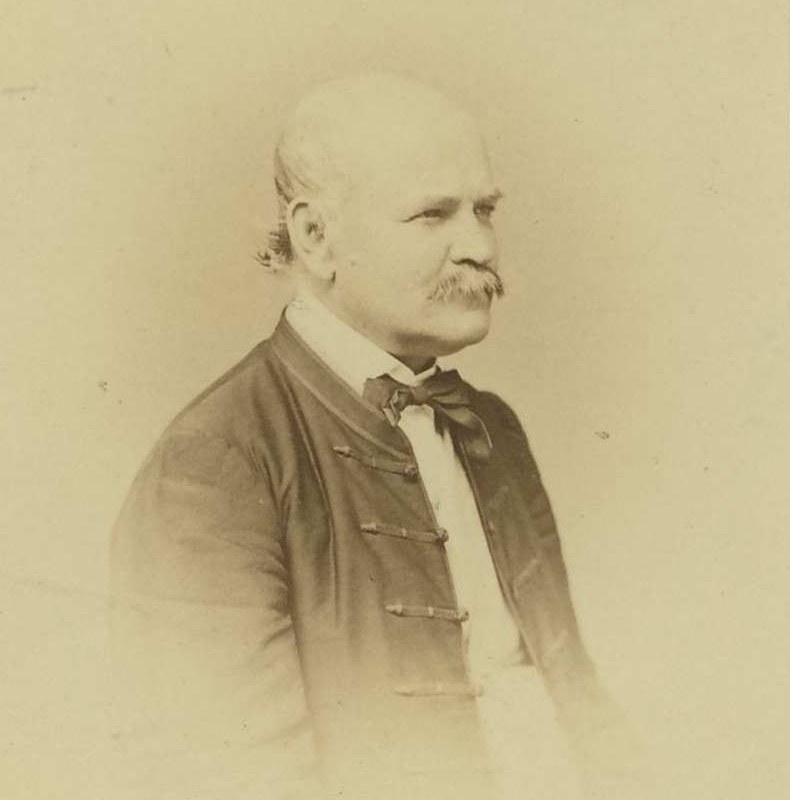

József Borsos and Albert Doctor (Borsos és Doctor studio), 'Semmelweiss Ignácz', carte-de-visite photograph, 1860; National Széchényi Library, Manuscript Collection; Wikimedia Commons file 'Borsos & Doctor Semmelweis Ignác.jpg' (authors died 1883 and 1888) · Borsos és Doctor studio carte-de-visite, 1860, National Széchényi Library (OSZK) Manuscript Collection, via Wikimedia Commons (hand crop of the 1000 x 1580 scan, no upscaling) · Public domain
핵심 특성
주요 업적
1847년 빈 종합병원 제1산과 병동의 조수였던 제멜바이스는 이 병동에서 산욕열로 숨지는 산모가 많은 이유를 해부실에서 곧바로 분만실로 오는 의사와 학생들과 연결지었다. 그는 1847년 5월 말부터 산모를 진찰하기 전에 모두가 염화석회 용액으로 손을 씻도록 했고, 4월에 18퍼센트를 넘었던 월별 사망률은 6월에 2.38퍼센트, 7월에 1.20퍼센트로 떨어졌다.
제멜바이스는 의대생이 실습하는 제1산과 병동과 조산사가 실습하는 제2산과 병동을 비교했다. 1841~46년의 사망률은 제1병동이 9.92퍼센트, 제2병동이 3.38퍼센트였다. 그는 이 차이와 1847년 이후의 감소를 근거로 당시 통설이던 '유행성 영향' 설명에 반박했으며, 1861년에는 통계표와 비판자들에 대한 답변을 담은 543쪽 분량의 『산욕열의 원인, 개념, 예방』을 펴내 시신과 살아 있는 환자에게서 나온 부패 물질을 원인으로 제시했다.
삶의 장면들
1861년 제멜바이스는 산과 의사 슈패트, 스칸초니, 지볼트에게 보내는 공개서한으로 비판자들에게 답했다. 그는 자신이 침묵하지 않았다면 1847년 이후 죽지 않았을 수천 명의 산모와 영아가 죽었다고 썼고, 1847년부터 친구였던 지볼트에게는 자신의 견해에 동의하지 않는 것은 살인자가 되는 것과 같다고 말했으며, 모든 독일 의사가 납득할 때까지 모인 의사들을 가르치겠다고 제안했다. 지볼트는 1862년에 사후 출간된 서간집에서 친구 제멜바이스를 용서한다고 적었고, 제멜바이스의 업적을 높이 평가한 쿠겔만은 1861년 7월에 지볼트를 더 너그럽게 대해 달라고 청했다.
이는 이 프로필의 높은 갈등 내성과 맥이 닿는다. 그는 오랜 침묵 끝에 지위 높은 반대자들과 공개적으로 맞서는 쪽을 택했고, 지볼트와 쿠겔만의 반응은 그의 성과를 존중하던 사람들 사이에서도 이런 어조가 호의를 잃게 했을 가능성을 시사한다. 갈등 감내
1847년 10월, 자궁경부에 고름이 나는 암이 있는 산모가 회진의 첫 침상에 입원했다. 제멜바이스와 학생들은 평소처럼 비누와 물로 손을 씻은 뒤 다른 산모들을 진찰했고, 그 뒤에 진찰받은 산모 열두 명 가운데 열한 명이 산욕열에 걸렸다. 그는 시신뿐 아니라 살아 있는 환자에게서 나온 물질도 이 병을 일으킬 수 있다고 결론짓고 오염된 진찰 뒤에는 염화석회로 손을 씻도록 했으며, 11월에 비슷한 집단 발생이 있자 병동 공기도 매개가 될 수 있다는 생각을 덧붙였다.
이 일화는 이 프로필의 신념 갱신 점수가 중간 수준에 머무는 이유를 설명하는 데 도움이 된다. 결과가 기존 설명과 어긋나자 그는 기전을 수정했지만, 1861년의 글에서는 자신의 학설을 이미 결론이 난 것으로 제시했다. 입장 수정 성향
전환점
1849년 3월 클라인 교수가 제1산과 병동에서 제멜바이스의 조수 임기 연장을 막았고, 교육부는 1850년 11월 그의 이의 신청을 기각했다. 1850년 10월 10일 강사로 임명된 제멜바이스는 며칠 만에 빈을 떠나 페스트로 갔고, 1851년 5월 성 로쿠스 병원 산과의 명예 과장이 되었으며 1855년 7월 산과학 교수가 되었다. 1857년까지 그의 발견은 헤브라와 스코다를 비롯한 다른 사람들이 지면에 소개했다.
이 일화는 이 프로필의 지속성 점수와 나란히 놓고 볼 수 있다. 그는 자신의 방법을 적용할 자리를 계속 찾았지만, 이 이동은 그가 아닌 다른 사람들이 그의 연구를 지면에 설명하던 시기와 겹쳤다. 끈기
비슷한 인물
전체적인 프로필이 이 사람과 닮은 사람들이에요.


레이첼 카슨

B. R. 암베드카르

조지 오웰

엘리자베스 케이디 스탠턴

로절린드 프랭클린
출처
- Ignaz Semmelweis (English Wikipedia) -- orientation only; not used as support for any scored row. Korean Wikipedia title '이그나츠 제멜바이스' confirmed via the Wikidata kowiki sitelink.
- Ignaz Semmelweis (Q59736) -- verified live via wbgetentities (2026-10-04): en label 'Ignaz Semmelweis', description 'Hungarian physician, early pioneer of antiseptic procedures (1818–1865)', instance of human, P569 1818-07-01, P570 1865-08-13, citizenship Austrian Empire (Q131964) and Hungary (Q28), ko label '이그나츠 제멜바이스', enwiki 'Ignaz Semmelweis', kowiki '이그나츠 제멜바이스', P18 'Borsos & Doctor Semmelweis Ignác cropped.jpg'. Orientation only; not used as support for any row.
- Fritz Schürer von Waldheim, Ignaz Philipp Semmelweis: Sein Leben und Wirken. Urteile der Mit- und Nachwelt (Vienna and Leipzig: A. Hartleben, 1905), Internet Archive full text (b24875788, German OCR) -- NON-SELF, ADMIRING BIOGRAPHY by a Viennese physician who worked from Ministry of Education and medical-faculty files, the letters of Semmelweis's widow, the notes of his Pest colleagues Hirschler and Hegar and Kußmaul's memoir, and who reprints contemporary documents in full or in extract (Hebra's reports of December 1847 and April 1848, Haller's 1848 hospital report and 1849 society minute, Brücke's 31 Oct 1850 report to the Academy of Sciences, Skoda's Oct 1849 lecture, the letters of Tilanus and Michaelis, Levy's 1848 critique, Liebig's 1859 letter, Siebold's 1861 article and 1862 posthumous remark, Kugelmann's 1861 letters) as well as long extracts from Semmelweis's own 1861 book and open letters (SELF, as quoted). Read locally: childhood to departure from Vienna (pp. 1-92), the Pest years 1850-57 (pp. 93-125), the 1858-59 reception, and the chapter on the 1861 book, the open letters to Spaeth, Scanzoni and Siebold and the replies of Kugelmann (pp. 154-180). The last chapters on his illness, hospitalisation and death and the author's psychological and medical speculation about his later years were NOT used as evidence. Partisan against Klein, Scanzoni and Braun; that tone is discounted.
- Nicholas Kadar and Russell D. Croft, 'Why Semmelweis's doctrine was rejected: evidence from the first publication of his results by Friedrich Wieger, and an editorial commenting on the results', British Journal for the History of Science 53(3), September 2020, pp. 389-395 (Cambridge Core PDF, doi 10.1017/S0007087420000229), read in full -- NON-SELF, MODERN SCHOLARLY (two retired physicians and independent historians; argumentative and critical of other historians' accounts, notably Loudon and Tulodziecki). Read: Wieger's 20 April 1849 eyewitness account of the Vienna practice (nail-brush scrubbing; a midwife's sponge as a non-cadaver source; wards exchanged without effect); the 1850 Gazette médicale de Paris editorial rejecting the Vienna figures as post hoc reasoning; Klein's objection of the same kind (per Lesky 1964); the October and November 1847 setbacks and what Semmelweis changed after them; the 1850 lecture on self-infection; the animal experiments with Lautner. Their own thesis (that animal experiments were aimed at the post hoc objection) is treated as their interpretation, not as fact.
- Sir William J. Sinclair (Professor of Obstetrics and Gynaecology, University of Manchester), Semmelweis: His Life and His Doctrine (Manchester University Press, 1909), Internet Archive full text (semmelweishislif00sinc) -- NON-SELF SECONDARY BIOGRAPHY by a British obstetrician, sympathetic but not uncritical. Read locally: the 'Elimination of Factors' and 'Removal from Assistantship' chapters (his retelling of the 1861 book's tables and the epidemic, fear, priest's-bell and birth-position hypotheses he examined; the October 1846 re-appointment of Breit; the winter 1846-47 English study; the Venice trip), the Kußmaul and Skoda passages, and the later chapters on the open letters, quoting Bruck's judgement that the letters embittered the controversy. Much of the early narrative is paraphrased from Semmelweis's own 1861 text, so for those passages it is a SELF perspective at one remove; the Pest-period assessments are Sinclair's own. His and others' passages on Semmelweis's final illness were NOT used.
- Adolf Kußmaul, Jugenderinnerungen eines alten Arztes (Stuttgart: Bonz, 1899), Internet Archive full text (jugenderinnerun00kussgoog, poor Fraktur OCR), the Vienna chapter on Semmelweis and Klein (printed pp. 372-375) -- NON-SELF, FIRSTHAND CONTEMPORARY (the Baden physician who took Semmelweis's obstetric course in the autumn of 1847 and practised in the First Clinic with his friend Bronner, recalling it five decades later, partly from a letter to his father). Read: his account of two patients with infected tissue on the ward and the small outbreaks among women delivered beside them, his promise to tell the Heidelberg professor Naegele of the discovery, his portrait of Klein and the anecdote of Klein, a midwife and a disputed examination in which Semmelweis stood behind Klein and was visibly angry. His physical and character description of Semmelweis is read as quoted in the two biographies above because the OCR of that line is garbled. His remark on Semmelweis's later mental illness was NOT used.
- Semmelweis University, 'Short History' (semmelweis.hu, English), read in full -- INSTITUTIONAL (the university that bears his name; commemorative). Used only for: Semmelweis as professor and director of obstetrics and gynaecology at the Pest university 1855-1865, the title 'saviour of mothers', that his work met strong opposition in his lifetime, and that the Budapest University of Medicine took his name on 7 November 1969.
- Wellcome Collection catalogue record for Ignaz Philipp Semmelweis, Die Aetiologie, der Begriff und die Prophylaxis des Kindbettfiebers (Pest, Vienna and Leipzig: C. A. Hartleben, 1861; vi, 543 pages), read in full -- INSTITUTIONAL CATALOGUE RECORD. Used only to confirm the title, publisher, date and extent of the 1861 book; it describes no behaviour.