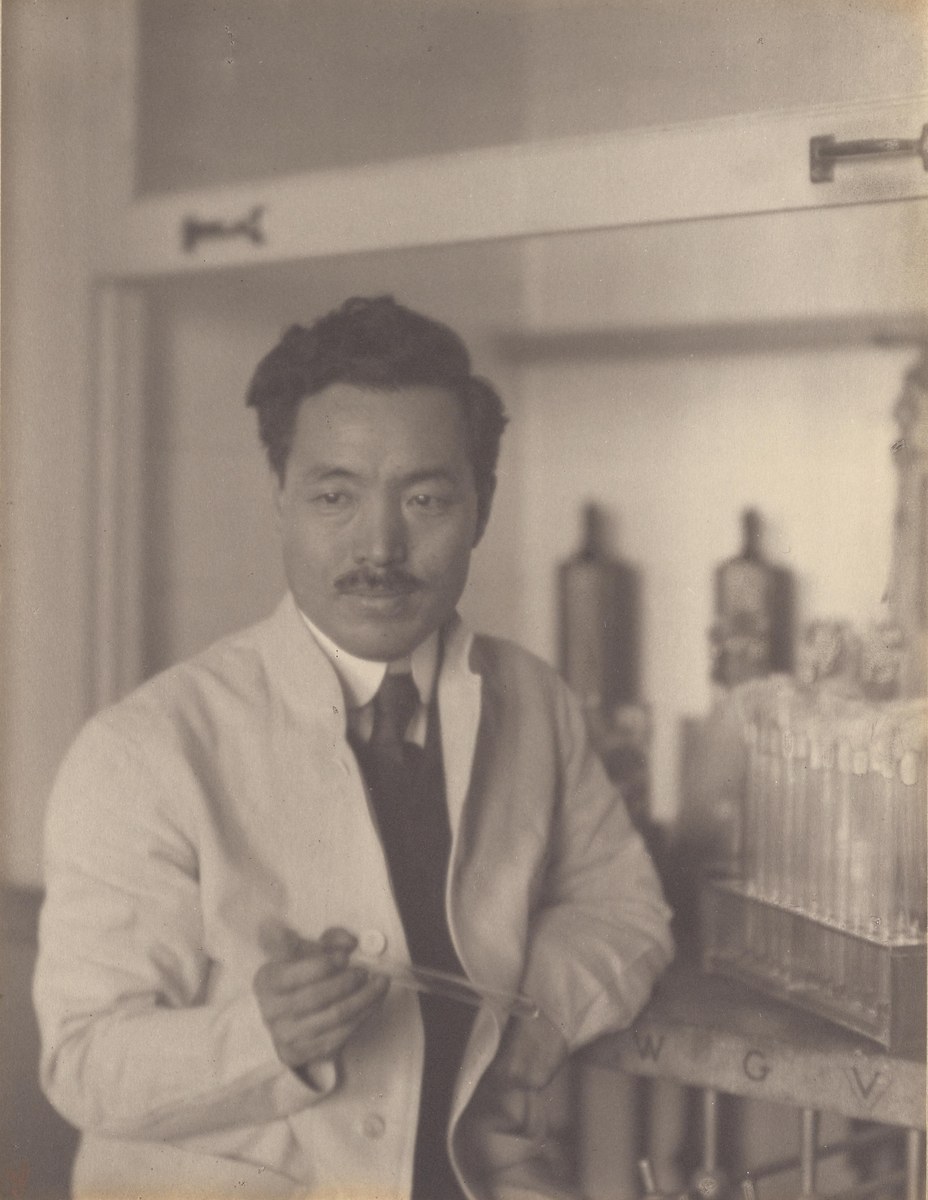

Doris Ulmann, Hideyo Noguchi, 1919, Doris Ulmann Photograph Collection, University of Oregon Libraries, Special Collections and University Archives. · Photographic portrait of Hideyo Noguchi in a laboratory with culture tubes, by Doris Ulmann (1882-1934), dated 1919 and inscribed by Noguchi, in the Doris Ulmann Photograph Collection, University of Oregon Libraries, Special Collections and University Archives. The Libraries' item record states photographer, date 1919, rights 'No Copyright - United States' and Public Domain Mark 1.0; the photographer died in 1934, so US copyright (life plus 70 years) has expired and the work is not a candidate for URAA restoration. The 6840 x 9320 pixel scan shows the whole mount, inscription and colour target; it was cropped to the photographic print only and downscaled to 928 x 1200, never upscaled. · Public domain (photographer died 1934; University of Oregon rights statement and Public Domain Mark 1.0)
과학자 · 20세기
노구치 히데요
1876–1928
주요 업적 분야
아직 성격 매칭에 포함되지 않았습니다 — 기록된 근거가 성격 모델 전체를 다루기에는 충분하지 않습니다. 이 페이지의 다른 모든 내용은 자유롭게 확인하실 수 있습니다.
핵심 특성
주요 업적
록펠러 의학연구소에서 1913년 전신마비 환자의 뇌에서 매독 스피로헤타를 검출했고, 한 학술 전기는 이를 그의 왕성했던 매독 연구기의 유일하게 지속된 성과로 평가한다.
바르토넬라 바실리포르미스를 분리하고 동물실험으로 오로야열과 베루가 페루아나가 하나의 질병의 두 양상임을 보였다.
1918년부터 렙토스피라 이크테로이데스를 황열의 원인으로 보고했고 이를 이용한 백신이 만들어졌으나, 1927년까지 원인이 바이러스로 밝혀지며 그 주장은 부정되었다. 그는 1928년 아크라에서 황열로 사망했다.
삶의 장면들
1927~28년 아크라에서 탐험대의 아드리안 스토크스가 사망한 뒤 황열 바이러스 연구에 매달렸으며, 역사가들은 그의 실험실이 어수선했고 표지 작업과 선별이 부주의했다고 기술한다.
이는 비판적 역사가들이 기술하듯 실험실 관리가 느슨했던 연구자의 모습과 부합한다. 디테일 지향
1918년 에콰도르 환자에게서 스피로헤타를 보고했고 충분한 대조 없이 기니피그 감염을 만들어 냈으며, 록펠러 연구소는 그 균으로 만든 백신을 1926년까지 배포했다.
이는 빠르고 자신 있게 실험했으나 대조군이 주장의 강도를 뒷받침하지 못한 연구자의 면모와 부합한다. 분석적 엄밀성
전환점
1900년 12월 빌린 뱃삯으로 필라델피아의 사이먼 플렉스너 연구실에 도착했고, 1904년 플렉스너가 이끄는 록펠러 연구소에 합류해 평생 그곳에서 연구했다.
이는 거의 지원 없이 해외로 옮겨 경력을 건 연구자의 모습과 부합한다. 위험 감수
비슷한 인물
전체적인 프로필이 이 사람과 닮은 사람들이에요.


무스타파 케말 아타튀르크

베니토 후아레스

아웅산 수치

안나 파블로바

프리드리히 대왕
출처
- Hideyo Noguchi (Q356114) -- verified live via Wikidata (2026-10-30): English label 'Hideyo Noguchi', description 'Japanese bacteriologist (1876-1928)', Korean label '노구치 히데요', born 1876-11-09 (Wikidata value), died 1928-05-21, citizenship Japan, P18 image 'Noguchi Hideyo.jpg'. Orientation only; not used as support for any row.
- National Diet Library (Japan), 'Portraits of Modern Japanese Historical Figures: Noguchi Hideyo' (entry text, read in Japanese) and the site's usage notice. CANONICAL SIGNIFICANCE SOURCE: it describes him as a bacteriologist who went to the United States in 1900, in 1911 achieved a pure culture of the syphilis spirochete at the Rockefeller Institute for Medical Research, received the Imperial Academy prize in 1915 and Academy membership in 1923, and travelled to Central and South America and Africa to find the yellow fever pathogen, dying of the infection in Ghana in 1928. Brief institutional reference text written by library staff; it does not mention the later discrediting of his yellow fever work.
- 'Hideyo Noguchi' (Dictionary of Scientific Biography entry, Gale, reproduced on Encyclopedia.com), read in full: training and the passage to Philadelphia under Simon Flexner, the Rockefeller Institute career, the 1913 detection of the syphilis spirochete in the brains of paretics called the sole enduring accomplishment of the period, Oroya fever and verruga peruana shown to be one disease caused by Bartonella bacilliformis, the Leptospira icteroides yellow fever claim and its 1927 discrediting, the work at Accra and his death. Scholarly reference biography by a named historian of science that is openly critical of his technique and conclusions and of how his patrons minimised his faults; its speculation about his state of mind and the manner of his death is not used.
- Siang Yong Tan and Jill Furubayashi, 'Hideyo Noguchi (1876-1928): Distinguished bacteriologist' (Singapore Medical Journal 55(10), 2014, pp. 550-551), read in full: the Penn and Rockefeller career, the 1909 snake venom monograph, the complement-fixation and luetin tests, the 1913 isolation of the syphilis spirochete from the brains of paresis and tabes patients, Rocky Mountain spotted fever antiserum, Oroya fever and verruga peruana, and a 'dark side' section on the incorrect aetiologies, the Ecuador yellow fever claim with inadequate controls, criticism of his methods and record keeping, non-reproducible syphilis culture claims and criticism of luetin tests on children. Short modern medical-history profile by a physician and a student, citing Plesset and Kita; the sentences about his own health and mental state are explicitly speculative and are not used.
- J. Gordon Frierson, 'The Yellow Fever Vaccine: A History' (Yale Journal of Biology and Medicine, 2010), read for the Noguchi sections: his 1918 Ecuador work, the naming of Leptospira icteroides, the vaccine and antiserum made at the Rockefeller Institute and the 7,964 vaccinations he reported, the criticism of the sloppy trial statistics, the 1926 Theiler and Sellards result that his organism was serologically identical to the Weil's disease leptospire, the discontinued distribution, and his 1927-28 work in West Africa. Independent vaccine-history review by a physician-historian, critical of Noguchi's practice in Accra.
- S. S. Kantha, 'Hideyo Noguchi's research on yellow fever (1918-1928) in the pre-electron microscopic era' (Kitasato Archives of Experimental Medicine 62(1), 1989, pp. 1-9): only the PubMed abstract was readable. It describes the yellow fever investigations as one of the low points of his career, says his Leptospira icteroides claim was discredited in 1927, and says the paper assesses the causes of his erroneous interpretation. Used for that framing only.
- Joseph Luna, 'Hideyo Noguchi's Bust Is Back in Welch Hall' (Rockefeller University, Natural Selections), read in full: his arrival at Flexner's Philadelphia laboratory in 1900, the self-taught preparation for the Japanese medical exam, the syphilis spirochete culture work with filtered rabbit preparations, twenty-five Nobel nominations, the Ecuador yellow fever claim and its doubt when the African cases showed no leptospira, and his death in Accra in 1928. Admiring institutional feature from his own institution that nevertheless recommends the Kita biography for an honest account of his faults.
- University of Oregon Libraries, Special Collections, Doris Ulmann Photograph Collection: 'Hideyo Noguchi [001a] (recto)', photographer Doris Ulmann (1882-1934), 1919, rights statement 'No Copyright - United States' and Public Domain Mark 1.0, checked for the portrait only.