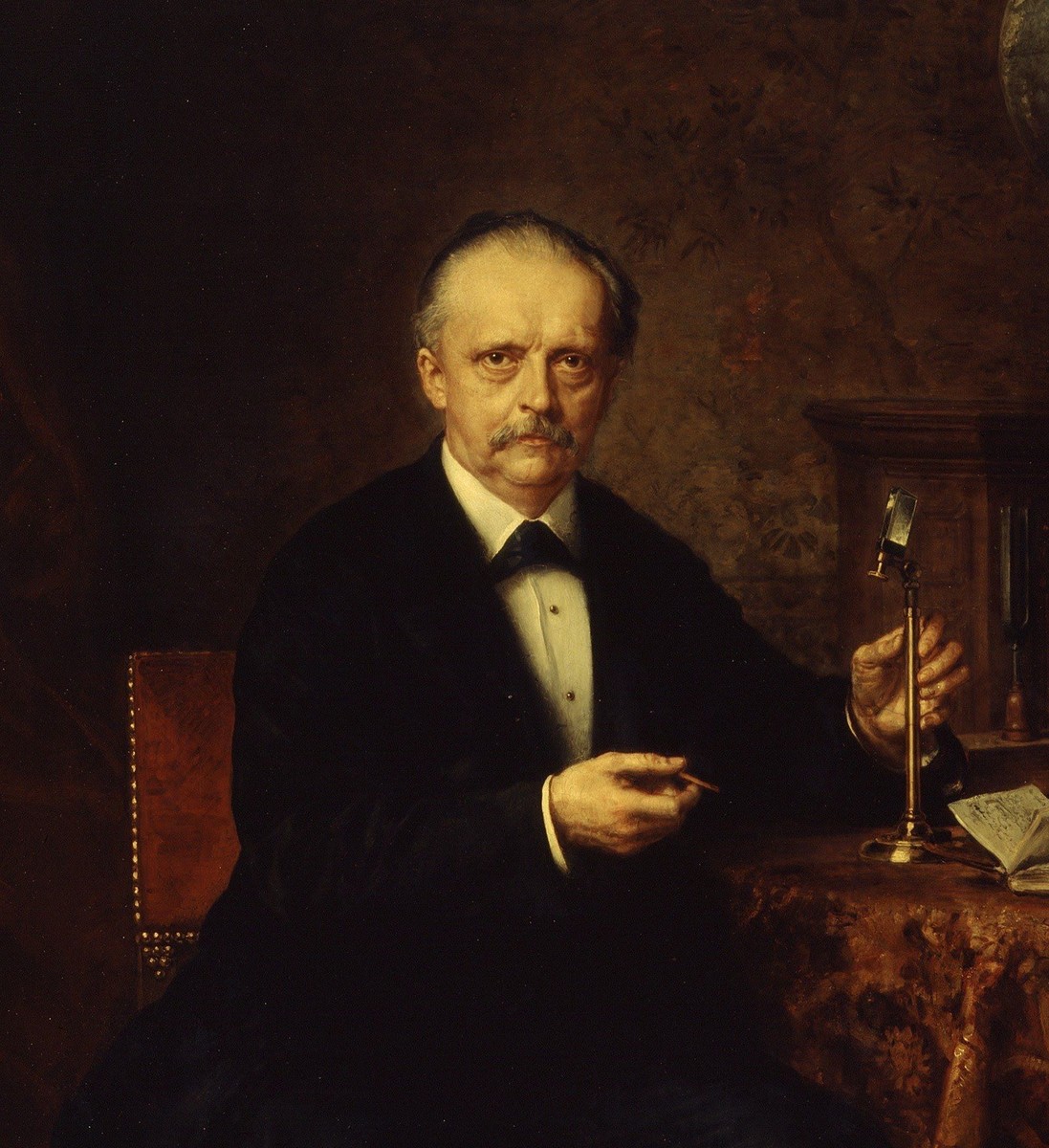
Ludwig Knaus, 'Der Physiker Hermann von Helmholtz', 1881, Alte Nationalgalerie, Staatliche Museen zu Berlin (A I 314); photograph credit Staatliche Museen zu Berlin / Andres Kilger, Public Domain Mark 1.0; the file is cropped and downscaled from the Google Art Project reproduction · Staatliche Museen zu Berlin, Alte Nationalgalerie, inventory A I 314 (ObjID obj:958941; https://id.smb.museum/object/958941): Ludwig Knaus (1829-1910), 'Der Physiker Hermann von Helmholtz', 1881, oil on panel, 120 x 85 cm, acquired 1881 by purchase after a commission for the National Gallery's portrait collection; the museum's photograph credit reads 'Staatliche Museen zu Berlin, Alte Nationalgalerie / Andres Kilger' with the Public Domain Mark 1.0. The file used is the Google Art Project reproduction on Wikimedia Commons ('Ludwig Knaus - Der Physiker Hermann von Helmholtz (1881).jpg', 2311 x 3303 pixels), cropped to the upper body (1600 x 1750 pixels at original scale) and then downscaled once to 1097 x 1200; never upscaled. Rights: the painter died in 1910, the painting is a commissioned portrait of the living sitter, and the museum's own record states the Public Domain Mark; no conflicting copyright notice was found on its page. It shows him seated in evening dress with an optical instrument in his hand (the museum says he is explaining the ophthalmoscope) and optical and acoustic apparatus on the table beside him. · Public Domain Mark 1.0 (Staatliche Museen zu Berlin; painter Ludwig Knaus died 1910)
물리학자 · 19세기
헤르만 폰 헬름홀츠
1821–1894
주요 업적 분야
아직 성격 매칭에 포함되지 않았습니다 — 기록된 근거가 성격 모델 전체를 다루기에는 충분하지 않습니다. 이 페이지의 다른 모든 내용은 자유롭게 확인하실 수 있습니다.
핵심 특성
주요 업적
1847년 7월, 아직 프로이센 군의관이던 헬름홀츠는 베를린 물리학회에서 논문 「힘의 보존에 대하여」를 발표해 에너지 보존의 수학적 원리를 제시했다. 포겐도르프는 실험적 성격이 부족하다며 자신이 편집하는 『물리학 및 화학 연보』에 이 논문을 싣기를 거절했고, 논문은 별도의 소책자로 나왔다. 헬름홀츠는 훗날 로베르트 마이어가 그 원리를 먼저 밝혔다고 인정했다.
1850~51년 헬름홀츠는 의사들이 살아 있는 망막을 볼 수 있게 한 검안경을 만들었고, 이어 세 권짜리 『생리광학 편람』(1856~67)과 『음감각론』(1862~63)으로 시각과 청각 생리학의 실험적 토대를 놓았다. 이 저작에는 지각에서의 무의식적 추론 이론, 음높이 지각 이론, 모음 음색 설명이 들어 있으며, 한 사회과학 백과사전은 후대의 관점에서 그의 가장 중요한 공헌이 감각 생리학과 심리학에 있다고 평한다.
생리학과 나란히 헬름홀츠는 물리학에서도 큰 업적을 남겼다. 1858년의 소용돌이 운동 유체역학 논문, 1871년 베를린 대학 물리학 교수가 된 뒤 서로 경쟁하는 전기역학 이론들을 비판적으로 검토한 연구(『과학 인명 사전』은 이 연구가 맥스웰의 장 이론을 유럽 대륙의 물리학자들에게 처음 알렸고 제자 하인리히 헤르츠에게 영감을 주었다고 말한다), 그리고 화학 반응에서 자유 에너지와 속박 에너지를 구분한 1882년의 논문이 그것이다. 1880년대 후반에는 새로 설립된 물리기술제국연구소의 소장이 되었다.
삶의 장면들
1850년 말 헬름홀츠는 동물의 눈이 반사된 빛으로 빛난다는 브뤼케의 발견을 강의하려고 준비하다가 반사된 광선이 어떤 상을 맺는지를 물었고, 안경 렌즈와 현미경용 커버글라스로 기구를 만들어 이를 확인하려 했다. 이 기구는 쓰기가 몹시 어려웠고, 그는 훗날 반드시 성공하리라는 확신이 없었다면 끈기 있게 계속하지 못했을 것이라고 말했다. 약 여드레 뒤 그는 살아 있는 사람의 망막을 보았다. 1850년 12월 17일 그는 아버지에게 이 착상이 너무나 뻔해서 자신과 다른 사람들이 그렇게 늦게야 알아본 것이 거의 우스꽝스러울 지경이라고 편지에 썼다.
새 기구를 끝내 작동시킨 끈기와 일치하지만, 이 기록은 주로 헬름홀츠 자신의 말이며 전기 작가는 이 발명이 그가 말한 것만큼 단순하지는 않았다고 지적한다. 끈기
1852년 헬름홀츠는 색 실험을 바탕으로 보색에 관한 뉴턴의 설명을 부정했고, 토머스 영의 3색 수용기설을 되살렸다가 곧바로 반박했다. 그라스만은 앞의 결론을 즉시 공격했고, 1855년 헬름홀츠는 실험상의 오류를 인정하며 뉴턴 이론이 요구하는 보색이 나오는 새 실험을 발표했다. 1858년에는 자신이 이전에 제기한 반론을 받아들이도록 고친 영의 이론을 가장 앞장서서 옹호하는 사람이 되어 있었다.
자신이 발표한 결론을 스스로 바로잡은 연구자의 모습과 일치하지만, 이 기록은 하나의 사전 항목에 의존하며 후대의 한 서평자는 다른 일류 과학자들의 의견이 그의 생각을 좀처럼 바꾸지 못했다고 말한다. 입장 수정 성향
전환점
1866년 무렵 헬름홀츠는 감각 생리학에 관한 대작들을 마치고 생리학을 떠나 물리학으로 옮길 생각을 하고 있었다. 1868년에는 생리학이 한 사람이 다 아우르기에는 너무 커졌고, 독일 물리학은 잘 훈련된 젊은 인력이 부족하다고 썼다. 1870년 베를린 대학의 물리학 교수 자리가 비자 그는 새 물리학 연구소 건립을 약속받은 뒤 1871년 초에 이를 수락했고, 베를린에서는 전기역학과 열화학, 이후에는 최소 작용의 원리로 관심을 돌렸다.
한 사람이 다루기에 옛 분야는 너무 커졌고 새 분야는 인력이 부족하다고 판단해 분야를 옮긴 연구자의 모습과 일치하지만, 그 이유는 주로 그 자신의 1868년 진술을 통해서만 알려져 있다. 분야 횡단성
비슷한 인물
전체적인 프로필이 이 사람과 닮은 사람들이에요.
출처
- Hermann von Helmholtz (Q60024) -- verified live via the Wikidata API (2026-10-16): English label 'Hermann von Helmholtz', description 'German physicist and physiologist (1821-1894)', Korean label present, instance of human, born 31 August 1821 (Potsdam), died 8 September 1894, citizenship Kingdom of Prussia, German Empire and Germany. Orientation only; not used as support for any row.
- 'Helmholtz, Hermann von', Complete Dictionary of Scientific Biography (as reproduced on Encyclopedia.com; the page shows no author credit; its topic line reads 'energetics, physiological acoustics, physiological optics, epistemology, hydrodynamics, electrodynamics') -- CANONICAL SIGNIFICANCE SOURCE: a scholarly biographical entry that treats the 1847 memoir 'Über die Erhaltung der Kraft' as setting out the mathematical principles of the conservation of energy, his invention of the ophthalmoscope in 1851, the three-volume Handbuch der physiologischen Optik, Die Lehre von den Tonempfindungen, the 1858 hydrodynamics of vortex motion, his critical assessment of competing electrodynamic theories (which first brought Maxwell's field theory to Continental physicists and inspired his pupil Heinrich Hertz), the 1882 free-energy memoir, his unsuccessful late attempt to ground all physics on the principle of least action, and his career from Potsdam army surgeon through Königsberg, Bonn and Heidelberg to the Berlin physics chair (1871) and the presidency of the Physikalisch-Technische Reichsanstalt. Independent scholarly biography; its passages on his family, wives, health and the political significance of his call to Berlin were not used. Read the biographical, energetics and physiological-optics sections in full and the remaining sections in summary paragraphs and by keyword.
- 'Helmholtz, Hermann von', International Encyclopedia of the Social Sciences (as reproduced on Encyclopedia.com; no author shown on the page; it cites Koenigsberger and Boring) -- a second, independent entry written from the standpoint of psychology and the social sciences: posterity sees his most significant contributions in sensory physiology and psychology, where he laid foundations for the experimental study of hearing and vision; his measurement of the speed of the nerve impulse (about 27 metres per second in a frog, 50-60 in humans) against the physiologists Müller's and von Humboldt's initial disbelief; the ophthalmoscope and ophthalmometer, accommodation, colour mixture, the doctrine of unconscious inference, summation tones, vowel theory and the Tonempfindungen; his empirical epistemology and challenge to Kant on space; and over 200 papers and books. Scholarly summary, admiring in tone; its passages on his family, his father's philosophy, his 1893 journey and his death were not used. Read in full.
- Walther Gerlach, 'Helmholtz, Hermann von', Neue Deutsche Biographie 8 (1969), p. 499 ff. (online at Deutsche Biographie; in German) -- a physicist's scholarly entry: his work on nerve conduction and the 'Helmholtz pendulum', the energy-conservation lecture and pamphlet of 1847 (with the note that Robert Mayer had stated the principle earlier, that most physicists and physiologists were reserved or hostile 'to Helmholtz's surprise' and that Poggendorff refused it for the Annalen), the optical work from the ophthalmoscope of 1850-51 to the Handbuch, the eight-year work behind the Tonempfindungen, vortex theorems, electrodynamics and the principle of least action, the remark that his life's work cannot be divided into periods and that he was 'always what the problem demanded', that he had little success with his lectures ('we felt that he was at least as bored as we were', in Max Planck's words) and that he held to a mechanical and continuum picture that the discoveries following his death contradicted. Independent scholarly biography; its closing remarks on school reform and popularisation were not needed. Read the whole biographical text.
- Leo Koenigsberger, 'Hermann von Helmholtz', translated by Frances A. Welby with a preface by Lord Kelvin (Oxford: Clarendon Press, 1906; abridged English translation of the three-volume German life of 1902-03; Internet Archive copy from the University of California Libraries) -- the contemporary life-and-letters biography by a mathematician who knew him, quoting his letters to his father and to Du Bois-Reymond and his own recollections: the 1847 memoir and the reservations of Magnus and Poggendorff, who advised an independent publication; the Robert Mayer priority question and his repeated crediting of Mayer; the discovery of the ophthalmoscope in December 1850 (his letter of 17 December 1850 and his 1891 account of making it from spectacle lenses and cover-glasses and persevering for about eight days); Kelvin's preface calling him a master and leader in mathematics, biology and physics. Admiring and described by the modern biographer David Cahan as hagiographical; used for documented episodes and quotations, with Helmholtz's own words as self evidence only. The full OCR text was downloaded; read the preface and the passages on 1847, the priority question and the ophthalmoscope, and searched the rest by keyword.
- Richard Joyner (emeritus professor of chemistry, Nottingham Trent University), review of David Cahan's 'Helmholtz: A Life in Science' (University of Chicago Press, 2018), Times Higher Education, 25 October 2018 -- an independent, partly critical review: Helmholtz's contributions 'rarely equalled' in breadth and depth; the ophthalmoscope, energy conservation, colour vision, music physiology and the Handbuch; his rise through competing state appointments; his being a workaholic who networked well with other leading scientists whose opinions 'rarely altered his own', his involvement in priority disputes 'to an extent that is now unusual', his laboratory as a magnet for young scientists, and Planck's remark that his lectures were never properly prepared; and Joyner's complaint that the biography says too little about his scientific thinking. Counter-voice on conduct and teaching; its remarks on his health, on his Anglophilia and Francophobia and on antisemitism in Berlin were not used (health, private life and politics). Read in full.
- Staatliche Museen zu Berlin, Sammlungen online, record 'Der Physiker Hermann von Helmholtz' (Alte Nationalgalerie, inventory A I 314, ObjID obj:958941; Ludwig Knaus (1829-1910); 1881; oil on panel, 120 x 85 cm; acquired 1881 by purchase after a commission for the portrait collection; photograph credit 'Staatliche Museen zu Berlin, Alte Nationalgalerie / Andres Kilger' with the Public Domain Mark 1.0) -- checked for the portrait's rights and identification; the museum's catalogue text says Knaus painted Helmholtz and Mommsen in 1881 on an order for the National Gallery, showing Helmholtz lecturing and explaining the ophthalmoscope with optical and acoustic instruments on the table. No conflicting notice was found. Not used for any scoring.
- Wikimedia Commons file page 'Ludwig Knaus - Der Physiker Hermann von Helmholtz (1881).jpg' -- checked through the Commons API for the file used: the Google Art Project reproduction of the Alte Nationalgalerie painting (accession A I 314), 2311 x 3303 pixels, signed 'L. Knaus. 1881', tagged PD-Art and public domain on the basis of the painter's death in 1910; the page links the SMB record above. Not used for any scoring.