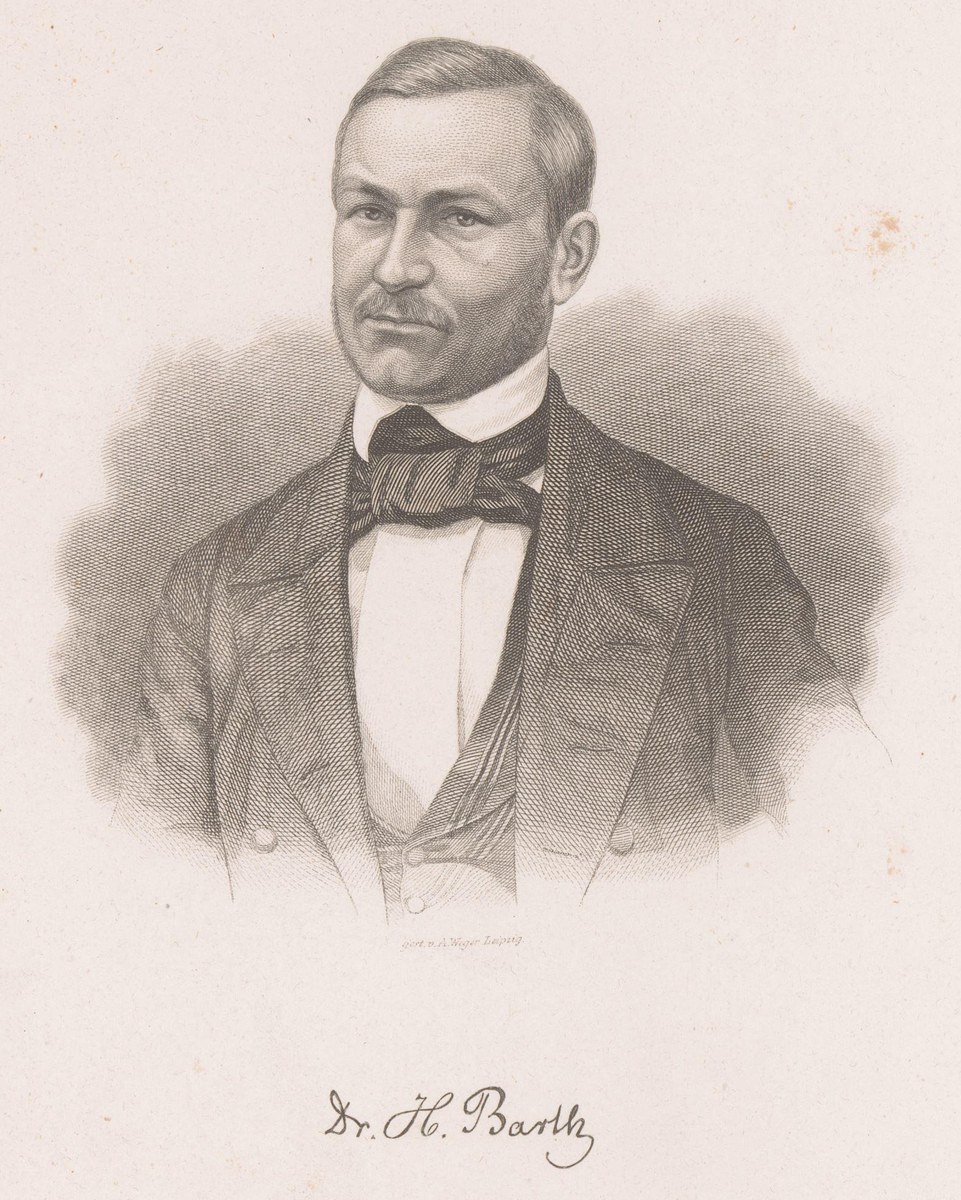

August Weger (printmaker), Portrait of Heinrich Barth, engraving, 1850-1892, Rijksmuseum, Amsterdam (RP-P-1915-724), public domain · Engraved portrait print 'Portret van Heinrich Barth' by the printmaker August Weger, Leipzig, published by Baumgaertner's Buchhandlung, Leipzig, dated by the museum only as between 1850 and 1892; Rijksmuseum, Amsterdam, object RP-P-1915-724, released as Public Domain Mark and CC0. The museum scan was 2984 x 3794 pixels; this project cropped it to the engraved portrait with its facsimile signature and reduced it to 961 x 1200 pixels, never enlarging it · Public Domain (Rijksmuseum Public Domain Mark; printmaker died 1892)
탐험가 · 19세기
하인리히 바르트
1821–1865
주요 업적 분야
아직 성격 매칭에 포함되지 않았습니다 — 기록된 근거가 성격 모델 전체를 다루기에는 충분하지 않습니다. 이 페이지의 다른 모든 내용은 자유롭게 확인하실 수 있습니다.
핵심 특성
주요 업적
1850~55년 영국 후원 탐사대의 일원으로 트리폴리에서 사하라를 건너 차드호, 베누에강, 팀북투까지 나아갔고, 동료 두 명이 숨진 뒤에도 홀로 탐사를 이어가 5권짜리 『북·중앙아프리카 여행과 발견』으로 기록했다.
1853~54년 팀북투와 그 주변에서 약 여섯 달을 머물며 알바카이 족장의 보호 아래 수단 지역 연대기를 접했고, 아프리카에도 고유한 역사가 있다는 견해를 굳혔다.
아프리카 역사와 언어 연구의 개척자로서 중앙아프리카 언어 어휘집을 모았고, 1863년부터 베를린 대학 지리학 교수로 재직하며 카를 리터 재단을 설립했다.
삶의 장면들
1852년 9월 아돌프 오버베크가 숨지고 홀로 남은 뒤에도 바르트는 서쪽 팀북투로 가기로 결심해, 유럽인이 지나지 않은 지역을 거쳐 1853년 9월 7일 도착했다.
동료를 잃고도 학문적 목표를 지켜 나간 사람과 일치하는 모습이다. 끈기
지도 제작자 아우구스트 페터만은 바르트가 약 5분마다 시계와 나침반을 읽고 하루 중 시간대별 낙타의 걸음 속도를 재어 노정 거리를 정했다고 전했다.
공동 작업자의 증언이고 훔볼트는 위치 측정을 문제 삼았지만, 꼼꼼한 기록 습관과 일치하는 모습이다. 디테일 지향
전환점
1851년 3월 리처드슨, 1852년 9월 오버베크가 잇따라 숨지면서 바르트가 탐사를 이끌다 결국 홀로 남아, 세 사람의 임무가 6년에 걸친 단독 답사로 바뀌었다.
탐사의 학문적 목표를 혼자서도 이끌어 간 사람과 일치하는 모습이다. 자율성 욕구
비슷한 인물
전체적인 프로필이 이 사람과 닮은 사람들이에요.
출처
- Heinrich Barth (Q60141), verified live via the Wikidata API (2026-11-02): label 'Heinrich Barth', description 'German explorer (1821-1865)', born 1821-02-16, died 1865-11-25, citizenship Germany (and a second state), Korean label present. Orientation only; not used as support for any row.
- Encyclopaedia Britannica, 'Heinrich Barth' (print view, revised 2026), read in full: German geographer and one of the great explorers of Africa; classical education at Berlin; fluent in French, Spanish, Italian, English and Arabic; 1845-47 Mediterranean coast travels published 1849; 1850 departure from Tripoli with Richardson and Overweg on a British-sponsored expedition; assumed command when Richardson died; explored south and southeast of Lake Chad and mapped the upper Benue; went to Timbuktu after Overweg died in 1852 and stayed six months; about 10,000 miles travelled, routes laid down by dead reckoning, the first account of the middle Niger; his large Reisen und Entdeckungen volumes (1857-58) with anthropological, historical and linguistic information; professor of geography at Berlin 1863. CANONICAL SIGNIFICANCE SOURCE. Concise reference biography; no behavioural detail beyond the route.
- Julius Loewenberg, 'Barth, Heinrich', Allgemeine Deutsche Biographie vol. 2 (1875), pp. 96-99, read in full on German Wikisource (proofread twice against the source): a near-contemporary German national biography giving his education (philology under Boeckh, geography under Ritter), the 1845-48 Mediterranean journey, the 1849-55 expedition by date and route (Air, Kano, the Benue, Lake Chad, Baghirmi, Timbuktu 5-7 September 1853, a seven-month stay, being reported dead, meeting Eduard Vogel in December 1854), the cost of about 10,000 thalers, Petermann's praise of his route surveys (reading watch and compass about every five minutes and measuring camel pace), Humboldt's 1852 complaint that he could not fix positions astronomically, the professorship in Berlin in 1863 and the Carl Ritter foundation he founded, the unfinished Central African vocabularies (1862-63), and his death in 1865. In German; a 19th-century national biography, patriotic in tone, and Petermann (who drew his maps) is an admiring collaborator.
- Heinrich Barth Institute (University of Cologne), 'Information boards Timbuktu' project page, read in full: states that he spent about six months in and around Timbuktu, received protection from Sheikh al-Baqqai who gave him access to manuscripts including chronicles of Sudanic history, that his 1849-1855 expedition covered almost 20,000 km, that he drew on comparative linguistics, Arabic manuscripts, oral tradition and rock art to study African history, and that the institute regards him as a pioneer of African history and of the scientific study of African languages. An institute named for him, so admiring; used for significance and the kinds of evidence he collected, not for personality.
- Kirkus Reviews, review of Steve Kemper, 'A Labyrinth of Kingdoms' (June 2012), read in full: an independent trade review of the first English-language biography; describes him as taking careful notes on the peoples he met, mixing with local people and questioning them constantly, bribing suspicious chiefs, being held captive for months, being stranded in Timbuktu, and as arrogant and introspective; says his 1857 account was criticised for its tolerant portrayal of Arabs. Brief; the reviewer's character remarks are his own.
- Gerhard Mueller-Kosack, review of Steve Kemper, 'A Labyrinth of Kingdoms' (Mega-Chad book reviews, 2012), read in full: a specialist review of the Kemper biography; says Barth was a meticulously organised explorer-scientist who guarded his independence by going off on scientific excursions early in the expedition, that Richardson worried about his impatience in travelling ahead, that he was 'thorny' but loyal and made friendships (al-Bakkay), that he took things personally and later fell out with British and German officials and academics, that he used his linguistic skills and educated allies for safety, fired his gun into the air at night to signal he could protect himself, and aimed to describe almost every inch of the landscapes, languages and histories he met; also says Kemper reports a lack of compassion over his companions' deaths and a tediously detailed style. A scholarly critical-and-sympathetic secondary reading; the review itself notes the book's main text is unreferenced.
- Christian Science Monitor, 'Heinrich Barth: the greatest explorer you've never heard of' (13 July 2012), read in full: an interview with biographer Steve Kemper; says Barth was prickly and easily offended, was held in effective house arrest in Timbuktu for seven months but made outings despite threats, wrote about 3,500 pages, recorded market conditions, prices and who held power, found the Benue, reported Timbuktu's manuscripts and scholars, and was neglected because he was German working for Britain, his book was dense, and his findings about Islam and African societies conflicted with European colonial interests. An author interview promoting his own book, so admiring and not independently assessed.