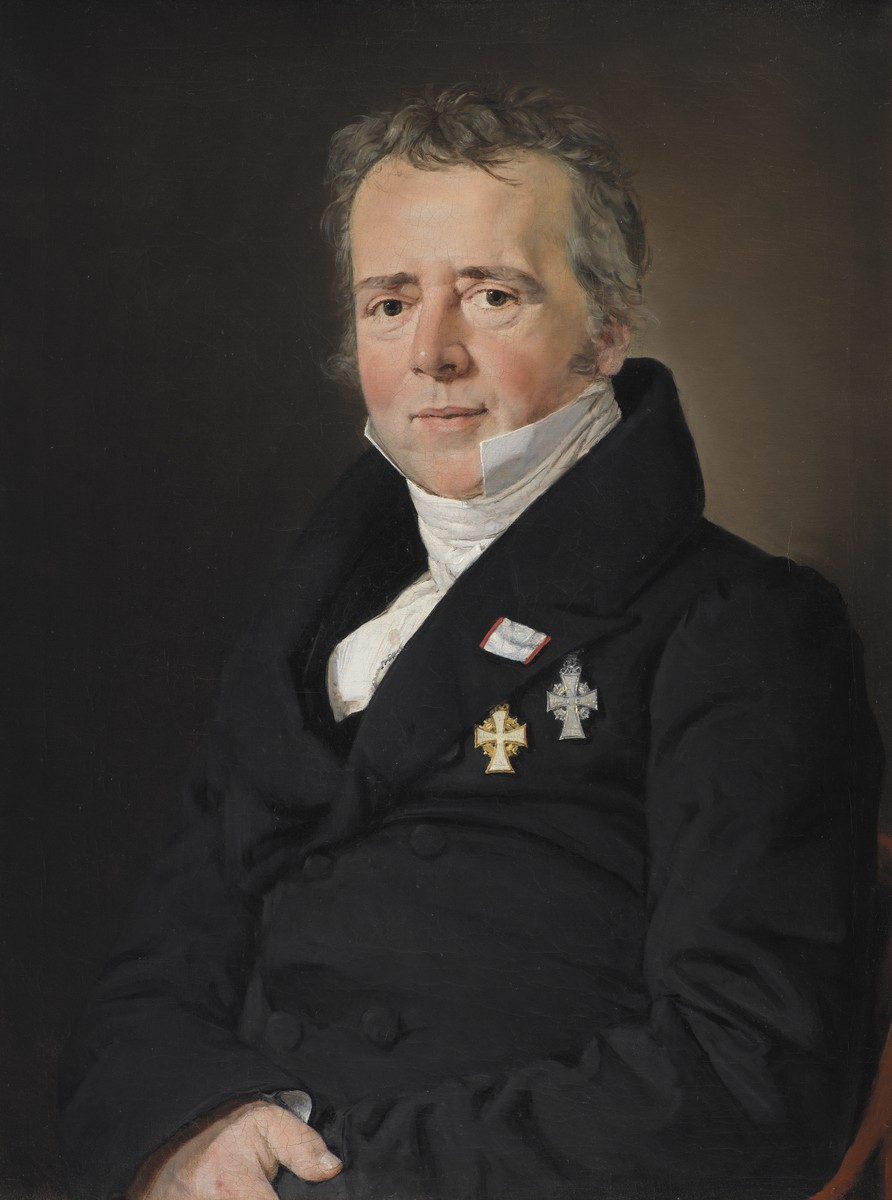
C. A. Jensen, Portrait of the Scientist Hans Christian Ørsted, 1832-1833, oil on canvas, Statens Museum for Kunst (KMS8176), public domain; downscaled from the SMK Open image · Statens Museum for Kunst (SMK, National Gallery of Denmark), SMK Open record KMS8176 -- Christian Albrecht Jensen (1792-1870), 'Portrait of the Scientist Hans Christian Ørsted' (also catalogued as 'Portrait of the Physicist Hans Christian Ørsted'), 1832-1833, oil on canvas, 678 x 510 mm, painted during the sitter's lifetime and exhibited at Charlottenborg in 1833; the museum's open API record states that the work is in the public domain and carries the Public Domain Mark 1.0; native image 5214 x 7015 pixels (16.2 MB JPEG), downscaled once to 892 x 1200 (never upscaled, no cropping). · Public domain (SMK Open: Public Domain Mark 1.0; painter C. A. Jensen died 1870)
물리학자 · 19세기
한스 크리스티안 외르스테드
1777–1851
주요 업적 분야
아직 성격 매칭에 포함되지 않았습니다 — 기록된 근거가 성격 모델 전체를 다루기에는 충분하지 않습니다. 이 페이지의 다른 모든 내용은 자유롭게 확인하실 수 있습니다.
핵심 특성
주요 업적
1820년 강의 중의 시연에서 처음 희미한 현상을 관찰한 외르스테드는 그해 7월 훨씬 강한 전지로 실험을 되풀이해, 도선에 흐르는 전류가 가까이 둔 나침반 바늘을 움직인다는 것을 보였고 그 결과를 1820년 7월 21일자 4쪽짜리 라틴어 소책자로 발표했다. 몇 달 안에 파리의 아라고, 앙페르, 비오와 사바르가 이를 재현하고 확장했으며, 이후 패러데이와 맥스웰의 연구도 이 발견이 밝힌 전기와 자기의 연결 위에서 이루어졌다.
그는 덴마크의 과학 교육을 세우는 데에도 기여했다. 1824년 자연과학보급협회를 세워 세상을 떠날 때까지 이끌었고, 1829년에는 오늘날 덴마크 공과대학교(DTU)가 된 폴리테크닉 학교의 설립에 참여해 1851년까지 초대 원장을 맡았다.
화학에서는 1820년 후추에서 알칼로이드인 피페린을 얻었고 1825년에는 금속 알루미늄을 만들었다. 또한 1817년부터 1845년까지 액체와 기체의 압축을 측정했는데, 용기 안팎의 압력이 같아지도록 설계를 고친 압축계(피에조미터)를 사용했으며, 물질의 상태가 바뀌기 전까지는 압축이 가해진 힘에 비례한다고 결론지었다.
삶의 장면들
강의 중 바늘이 희미하게 움직인 뒤 외르스테드는 약 석 달 동안 이 현상을 다시 실험하지 않았다. 3인칭으로 쓴 그의 글은 그 이유로 효과가 미약하고 혼란스러웠던 점과, 친구 리터를 비롯한 앞선 철학자들의 오류에 대한 기억을 들 수 있다고 적는다. 1820년 7월 그는 훨씬 큰 전지로 실험을 재개해 여섯 명의 관찰자를 증인으로 세우고, 도선의 거리와 방향이 바늘의 편향에 미치는 영향을 길게 측정한 뒤에야 결과를 발표했다.
미약한 결과를 발표하기 전에 신중하게 검증하는 태도와 일치한다. 분석적 엄밀성
1823년 영국에서 돌아오는 길에, 장인과 노동자에게 자연과학을 가르치는 기관들을 둘러본 외르스테드는 장인, 농민, 산업 종사자와 경영자에게 자연과학 지식을 퍼뜨릴 덴마크의 협회를 세우겠다는 계획을 세웠다. 그는 1824년 자연과학보급협회를 세웠고, 덴마크 인명사전에 따르면 죽을 때까지 이 협회를 이끌며 많은 시간을 쏟았다. 미국물리학회는 그가 과학을 대중이 접할 수 있게 하는 일을 매우 중요하게 여겼다고 덧붙인다.
연구실 밖의 사람들에게 과학을 전하려는 동기와 일치한다. 영향 창출 동기
전환점
1802~1804년 파리 유학 중 독일 자연철학자들을 열렬히 따르던 외르스테드는 친구 요한 리터를 나폴레옹이 내건 갈바니 전기 분야의 발견상 후보로 밀었지만, 그 발견은 끝내 입증되지 못했다. 그는 프랑스 학술지에서 혹독한 비판을 받았고, 코펜하겐에 돌아왔을 때는 판단보다 열정이 앞서는 사람이라는 평판이 따라다녔다. 덴마크 인명사전에 따르면 그는 리터의 결과 상당수가 상상의 산물임을 깨달았고, 그 뒤로는 적어도 어느 정도의 증거가 생길 때까지 자신의 철학적 생각을 억제했다.
공개적인 실패 뒤에 증거의 기준을 높이는 태도와 일치한다. 입장 수정 성향
비슷한 인물
전체적인 프로필이 이 사람과 닮은 사람들이에요.


에이다 러브레이스

루트비히 비트겐슈타인

이븐 할둔

벤저민 프랭클린

레이첼 카슨
출처
- Hans Christian Ørsted (Q44412) -- verified live via the Wikidata API (2026-10-15): English label 'Hans Christian Ørsted', description 'Danish physicist and chemist (1777-1851)', Korean label present, instance of human, born 14 August 1777 in Rudkøbing, died 9 March 1851 in Copenhagen, citizenship Kingdom of Denmark, occupations including physicist, chemist, inventor, university teacher, engineer and pharmacist; a name search also returns unrelated entities (a descendant, a prize, an institute, a statue, articles) but only this one is the physicist. Orientation only; not used as support for any row.
- Alan Chodos (former editor of APS News), 'July 1820: Oersted & Electromagnetism', APS News (American Physical Society, 'This Month in Physics History'), 1 July 2008 -- CANONICAL SIGNIFICANCE SOURCE: the Society's account that by the end of the 18th century electrical and magnetic phenomena were believed to be distinct forces, that Ørsted's July 1820 pamphlet showed they were closely related, that he turned on a current during a lecture demonstration and saw a compass needle deflect (dated 21 April 1820 in the article) but that 'accounts differ on whether the demonstration was designed to look for a connection between electricity and magnetism, or was intended to demonstrate something else entirely', that he tried various wires, reversed the current, varied the orientation and interposed wood or glass, that the publication 'caused an immediate sensation' and led to Ampère's mathematical law, Faraday's induction and Maxwell's equations, and his other work (private lectures after returning to Copenhagen, the Society for Dissemination of Natural Science, the Polytechnic in 1829, aluminium in 1825). Professional-society retrospective, admiring but careful about the accident story. Read in full.
- 'Hans Christian Ørsted', Encyclopaedia Britannica (online biography) -- short overview: Danish physicist and chemist who discovered that an electric current in a wire can deflect a magnetized compass needle, professor at Copenhagen from 1806, an evening lecture in April 1820, the discovery of piperine in 1820 and preparation of metallic aluminium in 1825, the 1824 society for spreading scientific knowledge among the public, and the adoption in the early 1930s of the name 'oersted' for the CGS unit of magnetic field strength; quick facts list the 1820 Copley Medal. Encyclopaedia entry, neutral. Read in full (three paragraphs of article text and the quick facts).
- Ole Norling-Christensen, 'H.C. Ørsted', Dansk Biografisk Leksikon (3rd edition, 1979-84, online on Lex; entry last changed 2012; in Danish) -- the Danish national biography's scholarly entry: his schooling and prize essays (aesthetics 1796, medicine 1797), pharmacy examination (1797) and Kantian doctorate (1799), the 1801-04 study journey and the Paris failure over Ritter and Winterl, the 1812 chemical system and its suggestion that electricity might be converted into magnetism, the 1820 experiment as described in his own 1828 autobiography and 1830 encyclopaedia article, the compressibility work and his piezometers, the Society for the Dissemination of Natural Science (planned 1823, founded 1824), the Polytechnic (opened 1829, first director), his work for the Academy of Sciences (secretary from 1815), his advice to students such as L. A. Colding, his more than 2,000 Danish scientific word coinages, and his late philosophical works. A scholarly national-biography entry, admiring, drawing partly on his own writings; the family, religious-controversy and iconography sections were not used. Read in full.
- Karen Jelved and Andrew D. Jackson (editors and translators of Ørsted's Selected Scientific Works, Princeton 1998), 'H. C. Ørsted and the Discovery of Electromagnetism', Niels Bohr Institute teaching text, Copenhagen, 2019 (25 pages) -- a scholarly outreach essay: Ørsted's own third-person account of the lecture experiment and of the three-month pause, his Kantian background and 1803 statement of a unifying programme, the prize essays, the Ritter and Winterl episode in Paris, the acoustic-figure and compressibility experiments (1805-1845), the July 1820 series with six named observers, the reception (Davy's Copley Medal proposal, Arago's 11 September 1820 demonstration, Ampère's and Biot and Savart's work), Ampère's letter explaining why the Parisians had not looked, the priority and plagiarism claims and Ørsted's 1821 and 1830 replies, his remarks about Ampère, and his turn after about 1825 to education and public service. Scholarly essay by his modern editors, admiring but analytical. Read in full.
- Giuseppe Giuliani (formerly University of Pavia), 'Electromagnetic induction: physics, historical breakthroughs, epistemological issues and textbooks', arXiv:2102.11036, 17 February 2021, the section on Ørsted's discovery -- a physicist-historian's account of the accident legend: Gilbert's 1820 remark in the Annalen der Physik that the effect 'happened by chance', Ørsted's own 1821 account of a prepared test of a long-held belief whose first result was 'indisputable' but 'confusing', Hansteen's 1857 letter and the doubts of Stauffer and Kipnis about it, and his conclusion that the discovery was by no means accidental although the path to it was 'long, uncertain and rhapsodic'; also Ørsted's description of his July 1820 experiments. Scholarly preprint, independent of Danish sources. Read the sections on Ørsted (the rest of the 55-page paper, on induction, was not read).
- Henry Bence Jones, The Life and Letters of Faraday, vol. 2 (London, 1870), pp. 389-391, Internet Archive scan -- the letter of Christopher Hansteen (Norwegian astronomer and Ørsted's acquaintance) to Faraday dated 30 December 1857, which calls Ørsted 'a man of genius' but 'a very unhappy experimenter' who needed an assistant or an auditor to arrange experiments and tells the story that, after a lecture, Ørsted tried the wire parallel to the needle, saw the needle swing and 'tumbled over it by accident'. A contemporary's recollection written 37 years after the event (scholars note that Hansteen was not in Copenhagen then); read only the letter and its context.
- William B. Ashworth Jr., 'Hans Christian Oersted', Scientist of the Day, Linda Hall Library of Science, Engineering and Technology, 22 April 2024 -- a historian's short feature: that 'according to tradition' Ørsted made a 'famous accidental discovery' on 21 April 1820 while demonstrating for students, that he announced it on 21 July 1820 in a four-page Latin pamphlet, that it introduced electromagnetism into physics, that the original compass is said to be preserved in Copenhagen, that he was part of the Danish Golden Age and a friend of Hans Christian Andersen, and that hundreds of thousands were said to have joined his funeral procession. Library history feature, popular in tone and repeating the accident tradition (recorded as a conflicting account). Read in full.
- Niels Bohr Institute, University of Copenhagen, 'Electromagnetism - The unique discovery' (Great Danish researchers: HC Ørsted), 28 May 2010 -- the Institute's popular account: that Ørsted was sure there was a connection between electric and magnetic forces and, before a lecture, decided to try to demonstrate it with a test set-up, that the needle moved when it was parallel to the wire, that he repeated the experiment many ways before reporting it, the Paris reception (Coulomb's view, the 11 September 1820 demonstration, Ampère's rush to experiment), and Faraday's induction of 1831. Institutional popular text, national-pride tone, presents the experiment as planned. Read in full.
- Technical University of Denmark (DTU), 'DTU's historie' (in Danish) -- the university's account that the Polytechnic was founded on 5 November 1829 by H.C. Ørsted, the man who discovered electromagnetism, on the model of the École Polytechnique in France, with an early emphasis on basic science over practical teaching so that it first trained mainly technical teachers. Institutional history, proud in tone; used for the founding date and model only. Read in full.
- DTU Physics, 'History' (department page) -- the department's statement that the university was founded in 1829 with Hans Christian Oersted as its first Director, that physics was taught until 1876 by professors holding joint posts with the University of Copenhagen, the first being Oersted, who had published in 1820 his paper on the relation between electricity and magnetism, and that a collection of Oersted's electrification machines is still held. Institutional history, brief. Read in full.
- Anja Skaar Jacobsen (historian of science), 'A romantic scientist' (review of Dan Charly Christensen, Hans Christian Ørsted: Reading Nature's Mind, Oxford University Press, 2013), Physics World, 28 November 2013 -- review of the first complete biography: that Ørsted expected a connection between electricity and magnetism 'unlike his French colleagues' and had looked for one for years, as part of a programme seeking connections among electricity, magnetism, chemical affinity, heat and light; a polymath in science, philosophy, art and poetry; Davy's description of him as 'a man of simple manners, of no pretensions ... but ingenious, and a little of a German metaphysician'; the reviewer's disagreement with the author over calling him romantic. Historian's review of a scholarly biography, admiring; the passages on his love life, family losses and brother's career were not used. Read in full.
- Norsk Teknisk Museum (Norwegian Museum of Science and Technology), object record 'Batteri' with biographical note on H. C. Ørsted, on DigitaltMuseum -- the museum's note (in Norwegian, based on the Danish Technical Museum's text) that Ørsted took the pharmacy examination in 1797, was professor in Copenhagen 1806-29, co-founder and first director of the Polytechnic 1829-51, 'discovered' the magnetic effect of electricity during a lecture in 1820, was 'a very versatile physicist' who built a piezometer, produced aluminium, confirmed Boyle's and Mariotte's results on the compressibility of gases, founded the Society for the Dissemination of Natural Science in 1824 and coined Danish words such as ilt, brint, vægtfylde and varmefylde. Museum catalogue note, brief. Read in full.
- Statens Museum for Kunst (SMK, National Gallery of Denmark), SMK Open record KMS8176, 'Portrait of the Scientist Hans Christian Ørsted' (also titled 'Portrait of the Physicist Hans Christian Ørsted'), by C. A. (Christian Albrecht) Jensen, 1832-1833, oil on canvas, 678 x 510 mm -- checked for the portrait's rights: the museum's open API record (api.smk.dk, read as the SMK Open web page itself is a JavaScript app) marks the work as public domain and gives the rights statement 'https://creativecommons.org/publicdomain/mark/1.0/' (Public Domain Mark 1.0), creator dates 1792-1870, native image 5214 x 7015 pixels, acquired by the museum on 13 October 2000, catalogued in Sigurd Schultz, C.A. Jensen (1932), vol. 2, no. 249; the Wikimedia Commons copies of the same image add the provenance (the landowner P. B. Scavenius, Gjorslev; an estate auction in 1925; sold at auction in 2000) and an exhibition at Charlottenborg, Copenhagen, in 1833. Not used for any scoring.