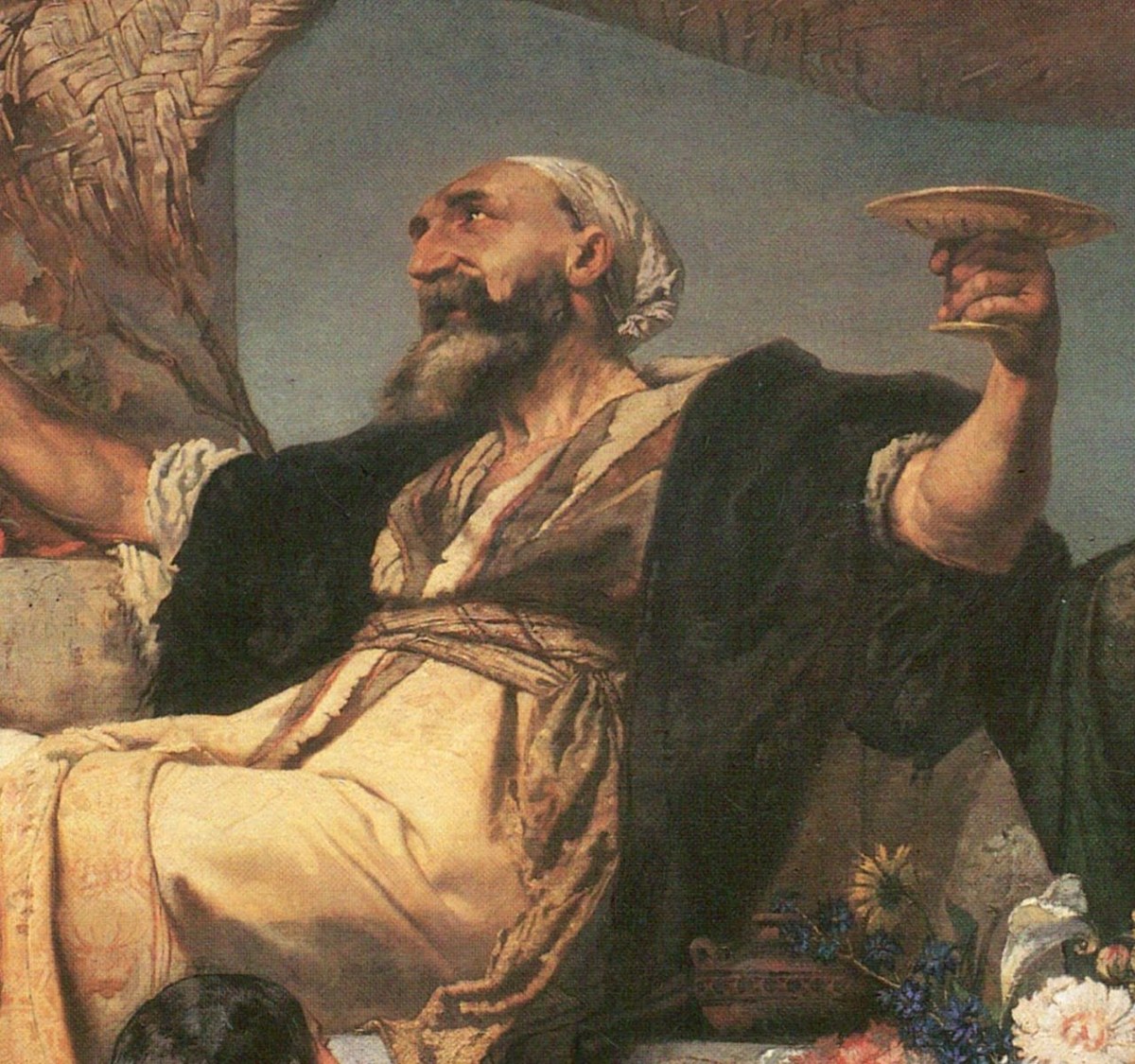

Anselm Feuerbach, Hafis vor der Schenke, 1852, Kunsthalle Mannheim, public domain, via Wikimedia Commons · Detail of 'Hafis vor der Schenke' (Hafez in front of the tavern), oil on canvas, Anselm Feuerbach, 1852, Kunsthalle Mannheim (acquired 1913). An imagined nineteenth-century painting made about 460 years after the poet's death, so it is a later depiction and not a likeness. The painter died in 1880, so the work is in the public domain by age worldwide, and a faithful photograph of a flat painting adds no new copyright. The file is a plain crop of the figure from the full 3000 x 2428 pixel image on Wikimedia Commons (originally from Zeno.org), downscaled to 1200 x 1125 with no upscaling. · Public domain (artist died 1880)
시인 · 중세
하피즈
1325–1390
주요 업적 분야
아직 성격 매칭에 포함되지 않았습니다 — 기록된 근거가 성격 모델 전체를 다루기에는 충분하지 않습니다. 이 페이지의 다른 모든 내용은 자유롭게 확인하실 수 있습니다.
주요 업적
그는 《디반》에 실린 가젤들을 썼는데, 브리태니커는 이를 페르시아 서정시의 최고 작품 가운데 하나로 꼽으며, 학자들은 이 시집이 그의 사후 다른 사람들이 엮었을 수 있다고 본다.
시라즈 여러 통치자 밑에서 궁정 시인으로 활동하며 전통적인 송시 대신 가젤을 찬가에 썼고, 칭송은 한두 행으로 줄였다.
소박하고 흔히 구어에 가까운 그의 시구는 널리 사랑받아 많은 구절이 속담과 격언으로 쓰이며.
삶의 장면들
브리태니커에 따르면 그는 궁정 시인으로 활동하면서 쿠란과 신학 주제를 강의하고 종교 고전에 대한 주석서를 썼다.
이는 궁정에서의 활동뿐 아니라 학자로서의 훈련에도 바탕을 둔 시인의 모습과 일치한다. 숙련 지향
전환점
1368년 또는 1369년경 그는 시라즈 궁정의 총애를 잃었고 약 20년 뒤 세상을 떠나기 직전에야 지위를 되찾았다. 다른 사전은 총애를 잃은 시기를 1366~1376년으로 본다.
이는 궁정 사정의 변화로 경력이 중단되었지만 작품 활동은 이어졌던 경로와 일치한다. 숙련 지향
비슷한 인물
전체적인 프로필이 이 사람과 닮은 사람들이에요.
출처
- Hafez (Q6240), verified live via the Wikidata API (2026-10-31): label 'Hafez', description 'Persian poet and mystic (1325-1389)', born 1326 and 1325 (year precision), died 1389, Korean label present, images 'Anselm Feuerbach Hafis vor der Schenke (cropped).jpg' and a statue photograph. Orientation only; not used as support for any row.
- The Editors, 'Hafez', Encyclopaedia Britannica, read in full. CANONICAL SIGNIFICANCE SOURCE: one of the finest lyric poets of Persia, born 1325/26 and died 1389/90 in Shiraz; classical religious education, lectures on the Quran and commentaries on religious classics; court poet under several rulers of Shiraz who fell out of favour about 1368-69 and regained his place only about twenty years later; his principal form the ghazal, used instead of the qasida in panegyrics with the panegyric element cut to a line or two; colloquial and musical language; the Divan and its partial English translations. Reference entry; the praise is retrospective.
- Baha'-al-Din Khorramshahi, 'Hafez ii. Hafez's Life and Times', Encyclopaedia Iranica (2002), read in full. Scholarly entry: details of the life are 'extremely sketchy' and the tazkira sketches often unreliable or fictitious; the earliest surviving document is a preface to the Divan by a contemporary who may have been Muhammad Golandam, with scholars disagreeing on his identity and the text's accuracy; dates of birth (715/1315 or 717/1317) and death (792/1390, with 791/1389 in some sources) disputed; schooling in the Quranic sciences and Arabic; poems on patrons from the Inju and Muzaffarid courts; a warning against reading biography out of the poems. Primary scholarly source for this profile and the main limit on what can be scored.
- 'Hafiz', World Eras (Gale), via Encyclopedia.com, read in full: the Quran-memorizer nickname, said to have worked as a baker's apprentice and manuscript copyist, broad education in Arabic and Persian literature, lectures on Quranic interpretation at a college, royal disfavour dated 1366-1376 with some time away from Shiraz in Isfahan and Yazd, his refusal of distant rulers' invitations, a Divan said to have been finalised in 1368 but perhaps arranged by a follower after his death, about five hundred authentic poems amid many false attributions, and the use of ghazal conventions for other purposes; cites Wickens in the Encyclopedia of Islam and Hillmann. Reference article; some details are hedged with 'said to'.
- Poetry Foundation, 'Hafez', read in full (one paragraph): very little is known of his life, he left school to work at a bakery and as a copyist after his father's death, became a court poet under Abu Ishak, taught at a religious college and wrote ghazals of love, spirituality and protest whose lines became proverbs. Short institutional biography; its details overlap with the Gale entry and the 'bakery' account is of the traditional kind.
- Joshua J. Mark, 'Hafez Shiraz', World History Encyclopedia, read in the life and court-poet sections: the Quran-memorizer name, memorisation of earlier Persian poets as influences, no definitive collection of his works and a divan compiled by others whom scholars cannot identify or date, and the traditional anecdotes of the baker's delivery boy and Shakh-e Nabat, which it reports with 'is said to'. Popular reference article; its legendary episodes are NOT used and serve as the example of what is excluded.