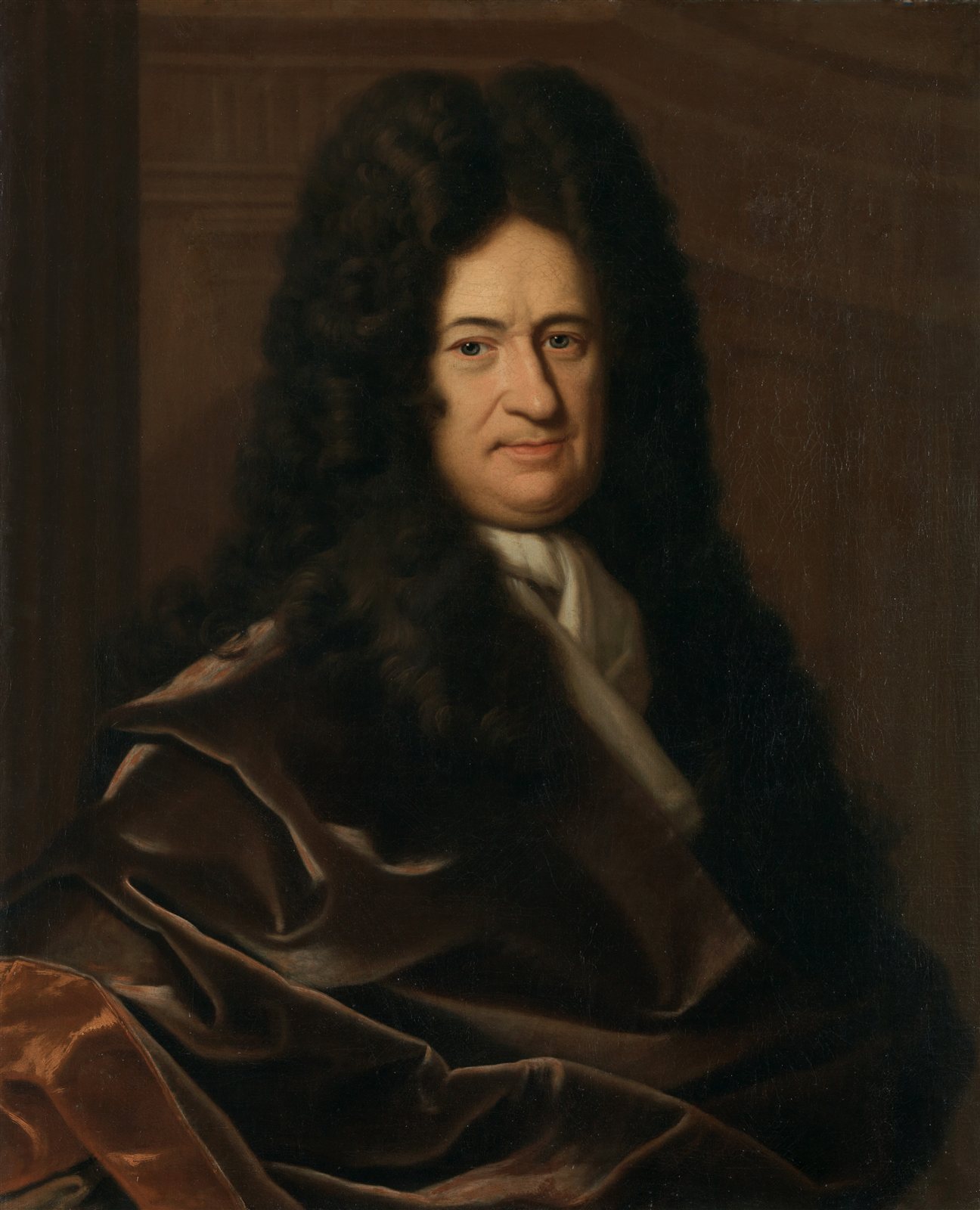
Christoph Bernhard Francke, 'Bildnis des Philosophen Gottfried Wilhelm Freiherr von Leibniz', oil on canvas, c. 1695; Herzog Anton Ulrich-Museum, Braunschweig. Public domain (PD-Art, PD-old-100-1923: the painter died in 1729). Commons records no restrictions. · Herzog Anton Ulrich-Museum, Braunschweig (inventory GG 558 per Wikidata Q29171873), via Wikimedia Commons file 'Christoph Bernhard Francke - Bildnis des Philosophen Leibniz (ca. 1695).jpg' (original 4486x5538, downsized to 1600px long edge at JPEG quality 85) · Public domain
핵심 특성
주요 업적
라이프니츠는 1672~76년 파리에서 미분과 적분의 계산법을 만들어 냈다. 그는 1675년 11월 21일 처음으로 적분 기호를 썼고, 1676년 가을에는 d(x^n) = n x^(n-1) dx 규칙을 얻었으며, 1684년 《악타 에루디토룸》에 이 방법을, 1686년에 적분법을 발표했다. 그가 만든 d와 적분 기호 표기는 지금도 쓰인다. 아이작 뉴턴은 이보다 앞서 자신의 방법을 만들었으나 발표하지 않았고, 스탠퍼드 철학 백과사전은 대부분의 역사가가 두 사람이 서로 독립적으로 작업했다고 본다고 전한다.
라이프니츠는 몇 가지 원리를 중심으로 철학 체계를 세웠다. 어떤 것도 충분한 이유 없이는 존재하지 않는다는 원리와, 세계가 그가 단자(모나드)라 부른 단순한 실체로 이루어져 있다는 생각이다. 그는 1710년 《변신론》에서 이 세계가 가능한 모든 세계 가운데 최선이라고 논증했고, 1714년 《단자론》에서 체계를 요약했다. 볼테르의 《캉디드》는 이 '최선의 세계' 논증을 훗날 풍자했고, 비판적 독자였던 버트런드 러셀은 《단자론》을 일관되기는 하나 자의적인 동화라고 평했다.
라이프니츠는 덧셈, 뺄셈, 곱셈, 나눗셈을 하도록 계산기를 설계했고, 1673년 런던 왕립학회에 미완성 모형을 선보였다. 그는 1679년까지 이진법 산술 체계를 다듬었으며, 1701년 파리 과학아카데미 회원으로 선출된 것을 기념해 보낸 논문 〈새로운 수의 과학에 관한 시론〉으로 이를 발표했다.
라이프니츠는 1695년 시작한 운동 끝에 브란덴부르크 선제후를 설득하여 1700년 7월 11일 브란덴부르크 과학협회를 세우게 했고, 종신 초대 회장으로 임명되었다. 맥튜터(MacTutor)에 따르면 이 협회는 처음에는 별로 성공하지 못했으나 몇 년 뒤 베를린 아카데미 설립으로 이어졌다. 드레스덴, 빈, 상트페테르부르크에 아카데미를 세우려던 그의 비슷한 계획은 생전에 실현되지 못했다.
삶의 장면들
1673년 1월 런던에서 라이프니츠는 수학자 존 펠에게 급수에 관한 자신의 결과를 설명했는데, 펠은 그것이 무통(Mouton)의 책에 이미 있다고 말했다. 라이프니츠는 다음 날 무통의 책을 찾아보고 펠의 말이 옳음을 확인했다. 맥튜터는 그가 자신의 수학 지식이 바라던 것보다 부족함을 깨닫고 노력을 배가했다고 덧붙이며, 머츠(Merz)는 이 만남을 계기로 그가 펠이 일러 준 책들을 구해 파리에서 크리스티안 하위헌스에게 수학을 더 체계적으로 배우기 시작했다고 서술한다.
곧바로 책을 확인하고 지적을 받아들여 공부 방식을 바꾼 일은 증거에 따라 생각을 고치는 태도와 부합한다. 다만 나중의 우선권 논쟁과 하르츠 광산 사업 실패를 남의 탓으로 돌린 일을 보면 이런 태도가 일관되지는 않았다. 입장 수정 성향
라이프니츠는 1715년 11월부터 1716년 11월 사망할 때까지 뉴턴을 옹호하는 새뮤얼 클라크와 공간, 시간, 자유의지, 빈 공간을 가로지르는 인력에 관해 논문 다섯 편을 주고받았다. 그는 충분이유율에 호소하여 절대 공간과 진공을 부정했고, 클라크의 답변에 하나하나 응수했으며, 클라크가 이성에 귀 기울일 생각이 있는지 의문을 제기했다. 클라크는 라이프니츠가 증명 없이 자신의 원리를 주장했고 논점을 회피했다고 반박했으며, 이 논쟁은 라이프니츠의 죽음으로 중단되었다.
뉴턴 학파의 대표적 입장에 정면으로 맞서 반론마다 응수한 일은 독립적 사고와 부합한다. 다만 어조가 한쪽으로 기운 대목도 있고, 상대편은 그의 핵심 전제가 증명되지 않았다고 판단했다. 독립적 사고
전환점
1672년 마인츠 선제후는 라이프니츠를 외교 임무로 파리에 보냈고, 그는 그곳에서 4년을 머물렀다. 그는 하위헌스, 아르노, 말브랑슈를 만났고, 하위헌스에게 수학과 물리학을 배웠으며, 데카르트와 파스칼의 미발표 원고를 읽었다. 스탠퍼드 철학 백과사전은 이를 그의 생애에서 가장 중요한 기회라고 부르며, 미적분 표기와 계산기 설계도 이 시기의 것이다. 그는 1676년 하노버의 도서관장 자리를 맡아 떠났고, 남은 생을 그곳에서 보냈다.
외교 임무로 얻은 체류를 당대 최고 수학자들과 원고를 찾아가는 기회로 활용한 일은 기회 포착과 부합한다. 다만 그 파견 자체는 스스로 찾은 것이 아니라 후원자를 통해 주어졌다. 기회 감지
비슷한 인물
전체적인 프로필이 이 사람과 닮은 사람들이에요.
출처
- Gottfried Wilhelm Leibniz (Q9047) -- verified live via Special:EntityData (2026-10-05): en label 'Gottfried Wilhelm Leibniz', description 'German mathematician and philosopher (1646-1716)'; P18 is the Francke portrait file. Orientation only; not used as support for any row.
- Gottfried Wilhelm Leibniz -- Wikipedia article (raw wikitext opened), orientation only; not used as support for any scored row.
- Stanford Encyclopedia of Philosophy, 'Gottfried Wilhelm Leibniz' (Brandon C. Look, peer-reviewed scholarly reference entry) -- read locally in full for the Life section, the overview, the fundamental principles (best, contradiction, sufficient reason, continuity), the monad sections, the Theodicy/optimism section and the chronology of writings. Scholarly and sympathetic but notes the Russell and Voltaire criticisms of the Monadology and optimism and says most historians now hold that Newton and Leibniz developed the calculus independently.
- MacTutor History of Mathematics (University of St Andrews), 'Gottfried Wilhelm von Leibniz' biography (J. J. O'Connor and E. F. Robertson; quotes G. MacDonald Ross and the Encyclopaedia Britannica) -- read locally in full for the Paris years and calculus notation (1672-76), the Hanover period (Harz mining project, binary arithmetic, determinants, Guelf history), academy campaigns, the Newton priority dispute and the 1715-16 Clarke correspondence. Mathematics-historians' account that is critical of the Royal Society committee of 1712-13 but also records Leibniz's failures.
- John Theodore Merz, Leibniz (Edinburgh and London: William Blackwood and Sons, Philosophical Classics for English Readers, 1884), Internet Archive scan (leibniz00merz_0) -- Victorian secondary biography and philosophical introduction by a historian of science, drawing on Guhrauer and Gerhardt; read locally: the chapters on the calculus and the controversy with Newton (including the Oldenburg correspondence of 1676-77), the Hanover years (Harz mines, Protogaea, church reunion), and the academy projects in Berlin, Dresden, Vienna and St Petersburg. Evaluative language is admiring in places; only the dated facts and the weighing of the priority evidence are used.
- Bertrand Russell, A Critical Exposition of the Philosophy of Leibniz (Cambridge University Press, 1900), Internet Archive scan (cu31924052172271) -- CRITICAL philosophical study by a later logician who argues Leibniz's private papers are more rigorous than his published works; read locally: the preface and Chapter I on Leibniz's character, circumstances and method of presentation, the discussion of why he never wrote a single systematic work, and the passages from the letters to Arnauld on arguments he chose not to publish.
- G. W. Leibniz and Samuel Clarke, Exchange of papers, November 1715 - October 1716 (first published by Clarke in 1717), in Jonathan Bennett's modernized edition at earlymoderntexts.com -- PRIMARY documents: Leibniz's five papers (to Princess Caroline's circle) and the Newtonian Clarke's five replies, read locally in full. Clarke is an ADVERSARIAL contemporary perspective who accuses Leibniz of begging the question on sufficient reason; Bennett's editorial summaries are used only as finding aids.