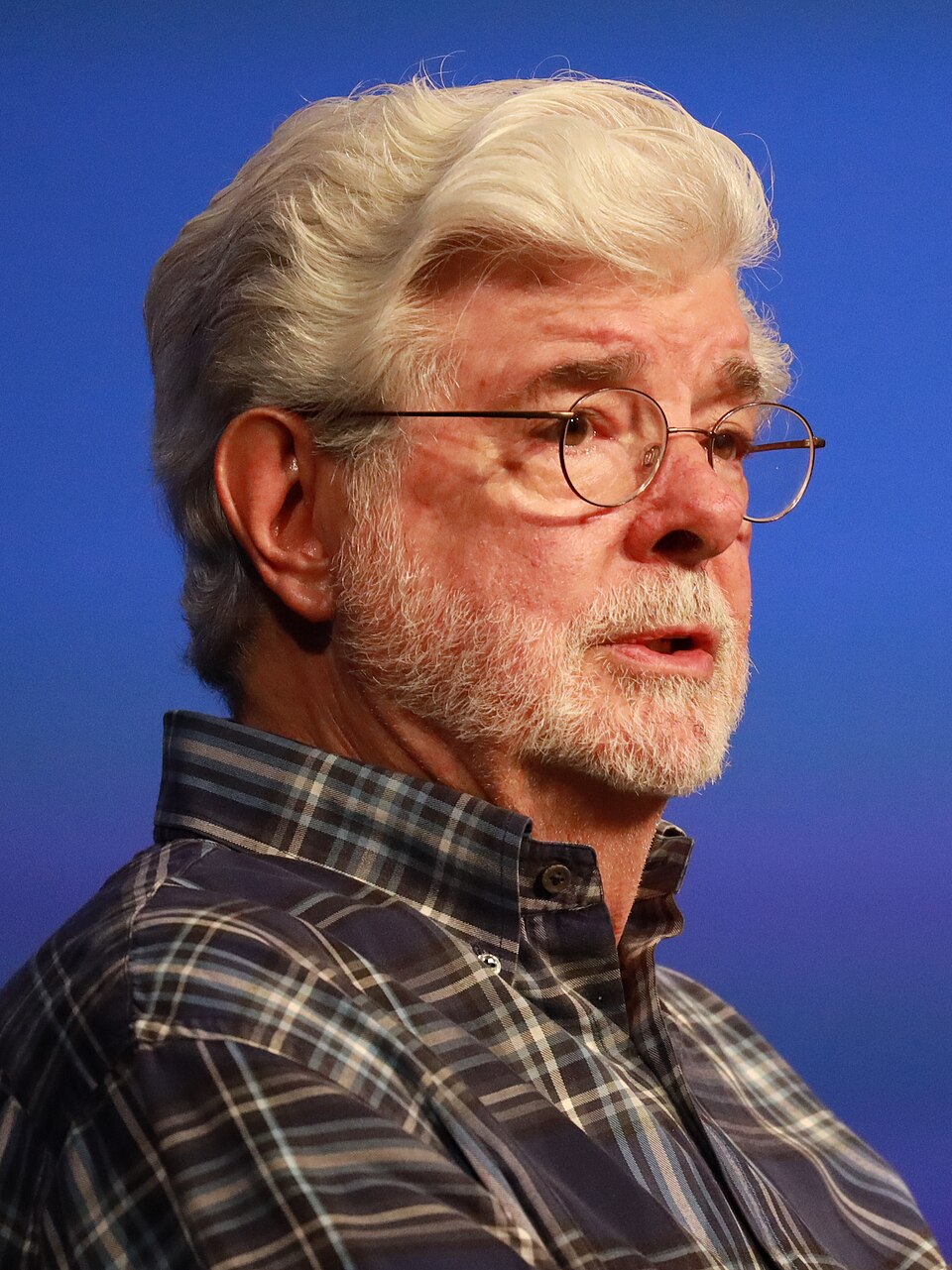

Photo: Kevin Payravi / WikiPortraits, 2024, CC BY-SA 4.0 · Wikimedia Commons 'George Lucas 2024.jpg': photograph by Kevin Payravi (WikiPortraits) of George Lucas at the 'An encounter with George Lucas' session, 2024 Cannes Film Festival, 24 May 2024, uploaded as own work under CC BY-SA 4.0 (attribution 'Kevin Payravi / WikiPortraits'). Original 2385 x 3182; saved from the Commons 900-pixel-wide thumbnail at 960 x 1281 (downscaled only, no upscaling; 960 px is the stored thumbnail width actually served). · CC BY-SA 4.0
영화감독 · 현대
조지 루카스
b. 1944
주요 업적 분야
아직 성격 매칭에 포함되지 않았습니다 — 기록된 근거가 성격 모델 전체를 다루기에는 충분하지 않습니다. 이 페이지의 다른 모든 내용은 자유롭게 확인하실 수 있습니다.
핵심 특성
주요 업적
빈티지 모험극과 서부극, 조지프 캠벨의 신화 이론을 엮은 스페이스 오페라 '스타워즈'(1977)를 쓰고 연출했다. 브리태니커는 이 영화가 당시 역대 최고 흥행작이 되었고 특수효과 중심 SF의 물결을 낳았다고 설명한다.
루카스필름(1971)과 '스타워즈'를 위해 만든 특수효과 공방 인더스트리얼 라이트 앤 매직(1975)을 세웠다. 컴퓨터 제어 카메라 시스템과 이후의 디지털 작업은 현대 영화 특수효과의 토대가 되었고, 루카스필름 그룹은 사운드와 THX 부문으로도 확장되었다.
인디아나 존스를 창조하고 '레이더스'와 스타워즈 속편의 총괄 제작을 맡았다. 스타워즈의 속편·상품화 권리를 협상했으며, 업적아카데미는 이것이 영화 캐릭터 완구 연계 모델의 출발이 되었다고 평가한다.
삶의 장면들
1976년 런던 촬영을 마치고 돌아온 루카스는 ILM의 새 밴나이스 창고에서 완성된 특수효과 컷이 세 개 정도뿐이고 팀이 컷 제작보다 장비 제작에 몰두하고 있다는 점에 불만을 가졌다.
이는 장비보다 완성된 컷을 중시하는 까다로운 태도와 부합하지만, 출처는 당시 보도를 요약한 카탈로그 기록이다. 디테일 지향
폭스와 스타워즈 계약을 하면서 루카스는 속편·상품화 권리를 요구했고, 수익은 급여가 아니라 완구에서 나올 것이라고 말했다.
이는 스튜디오들이 가격에 반영하지 않던 상업적 기회를 알아보는 안목과 부합하지만, 일부는 본인의 발언에 근거한다. 기회 감지
전환점
코폴라의 아메리칸 조에트로프에서 만든 'THX 1138'(1971) 이후 루카스는 자신의 회사 루카스필름을 세웠고, '청춘 낙서'(1973)의 성공으로 스타워즈를 추진할 수 있었다.
이는 스튜디오 안에서 일하기보다 자신의 회사를 세우려는 성향과 부합한다. 자율성 욕구
비슷한 인물
전체적인 프로필이 이 사람과 닮은 사람들이에요.
출처
- George Lucas (Q38222) -- verified live via the Wikidata API (2026-10-23): English label 'George Lucas', description 'American filmmaker and philanthropist (born 1944)', born 14 May 1944, no date of death, P18 images 'George Lucas cropped 2009.jpg', 'George Lucas 2024.jpg', 'George Lucas by Gage Skidmore.jpg'. Orientation only; not used as support for any row.
- Encyclopaedia Britannica, 'George Lucas' by Michael Barson (britannica.com), read in full through an Internet Archive copy (the live site blocks automated access): USC film degree 1966; 1967 Warner Bros. internship assisting Coppola; THX 1138 (1971) made through Coppola's American Zoetrope, respectful reviews but a debt to Orwell and a deliberate pace; formed Lucasfilm Ltd. in 1971, later containing Industrial Light & Magic (1975), regarded as the most prestigious special-effects workshop in American film; American Graffiti (1973) shot in under a month for well under a million dollars; Star Wars (1977) chose space opera over then-current dystopian science fiction, borrowed heavily from Joseph Campbell and Kurosawa's The Hidden Fortress, became the top-grossing film in history and its special-effects technologies spawned a host of imitators; after it Lucas announced he would retire from directing and make Lucasfilm an incubator for films directed by others; executive producer of Empire, Jedi and Raiders; mixed 1980s results (Willow minor success, Howard the Duck a spectacular failure); Young Indiana Jones Chronicles was a ratings failure but let ILM experiment with effects; 1997 he added new computerized effects to the Star Wars films and 'critics were less enthusiastic'; returned to direct the prequels 1999-2005; sold Lucasfilm to Disney for $4 billion in 2012; Kennedy Center honoree 2015. CANONICAL SIGNIFICANCE SOURCE. Childhood and a car crash passage in the article were not used.
- American Academy of Achievement, 'George Lucas' biographical profile with excerpts from a 1999 Academy interview (achievement.org), read in full: USC student short, 1967 Warner Bros. scholarship and work as Coppola's assistant, co-founding American Zoetrope (1969) and forming Lucasfilm (1971); American Graffiti and Star Wars credits; several studios turned Star Wars down because science fiction was seen as a poor box-office genre; Lucas negotiated sequel and merchandising rights, which the page credits with starting the modern film toy tie-in model; Lucasfilm divisions (ILM, Skywalker Sound, THX, LucasArts, licensing) and the 2012 sale to Disney; 1992 Thalberg Award. Lucas's work-method statements (perseverance, independence, ignoring critics, crediting helping peers) are his own words and are treated as SELF-ACCOUNT only, never as sole support for a row.
- American Cinematographer (1971), 'THX 1138' production article republished by the American Society of Cinematographers (theasc.com), read in full: Warner Bros. financed and released the film but American Zoetrope produced it; Lucas, then 25, directed, co-wrote with Walter Murch and edited it, with Coppola as executive producer; about 22 Bay Area locations and only one built interior set; Lucas wanted a documentary 'cinema verite' look with no makeup and almost entirely available light, pushed film and Techniscope for faster lenses; cinematographer Albert Kihn says Lucas, with strong visual instincts, controlled the style. Contemporary trade-press account by crew members; the article does not cover Warner's reaction to the finished film.
- American Film Institute Catalog, 'Star Wars (1977)' production notes (catalog.afi.com), read in full: Lucas developed the project with Gary Kurtz from 1971; Universal ended its contract when he asked for more money; Alan Ladd Jr. optioned the script for about $10,000 despite doubts from other Fox executives; Fox would not pay more than $7 million, objected to killing off Obi-Wan and declined to fund cantina reshoots (Ladd approved $20,000 for second-unit work); budget cut from $16 million to about $8-9.5 million; filming from March 1976 in Tunisia and London; at ILM's new Van Nuys warehouse only about three shots were finished when Lucas returned, and he was frustrated that staff were focused on tools rather than shots; he worked on four script drafts at once, kept Anthony Daniels' voice for C-3PO, targeted '14- and 15-year-olds' and said 'If I make money, it will be from the toys'; 43 theaters on 25 May 1977. Archive catalogue compiled from named press reports of the time; some of its figures conflict between its own sources.
- Library of Congress National Film Registry essay 'Star Wars' by Matt Zoller Seitz (reprinted from 'The A List: The National Society of Film Critics' 100 Essential Films', 2002), read in full through an Internet Archive copy of the loc.gov PDF: calls Lucas an intense, detail-oriented film-school graduate who wanted to make Star Wars for years while the major studios kept turning him away; nearly every composition storyboarded in advance; new visual-effects and sound technology that changed how films were produced; the film's success pushed studios toward blockbuster economics and spawned a merchandising industry; detractors and historians blamed Lucas and Spielberg for ending the adventurous Hollywood of the late 1960s (a Time Out quote and David Thomson's 1997 Esquire piece 'Who Killed the Movies?'); Lucas built Marin County-based Lucasfilm as a privately owned studio, retired from direction for two decades while producing, and, the essay says, seemed torn about his responsibility, with PR documents offered during the Phantom Menace tour arguing more independent films were made after Star Wars. COUNTER-VOICE source. The essay carries a disclaimer that its views are the author's, not the Library's.
- J. W. Rinzler (author of 'The Sounds of Star Wars', 2010), 'The Sounds of Star Wars' interview feature, The World / PRX (Here and Now), 15 August 2013 (theworld.org), read in full: Lucas wanted organic, original sounds rather than a silver-suit science-fiction sound, gave sound designer Ben Burtt latitude while working closely with him, and treated sound as a major creative element; Burtt built the lightsaber hum, Chewbacca's voice and Vader's breathing from everyday sources on a very small budget. Author-interview radio feature; not independent of Rinzler's book, which was not opened.
- Joe Fordham, 'John Dykstra, ASC: Finding Joy in the Process', American Cinematographer / theasc.com, 14 July 2023, read in full: Douglas Trumbull referred Dykstra to Lucas and Gary Kurtz, who were looking for a way to film space battles at the fledgling Industrial Light & Magic; the computer-controlled Dykstraflex (seven-axis dolly and head with a VistaVision camera, repeatable moves allowing composites) earned Dykstra a shared Academy Scientific and Engineering Award; Dykstra credits the original crew's collaboration; he founded Apogee in 1978. Independent craft-press profile of Lucas's effects collaborator; says nothing about Lucas's own working style or about ILM's later move.
- Wikimedia Commons file page 'George Lucas 2024.jpg' (wikitext and API record), checked for the portrait's licence: photograph by Kevin Payravi (WikiPortraits), taken at the 2024 Cannes Film Festival session 'An encounter with George Lucas' on 24 May 2024, uploaded as own work under CC BY-SA 4.0 (attribution 'Kevin Payravi / WikiPortraits'), original 2385 x 3182. The earlier lead 'George Lucas cropped 2009.jpg' was not used. Not used for any scoring.