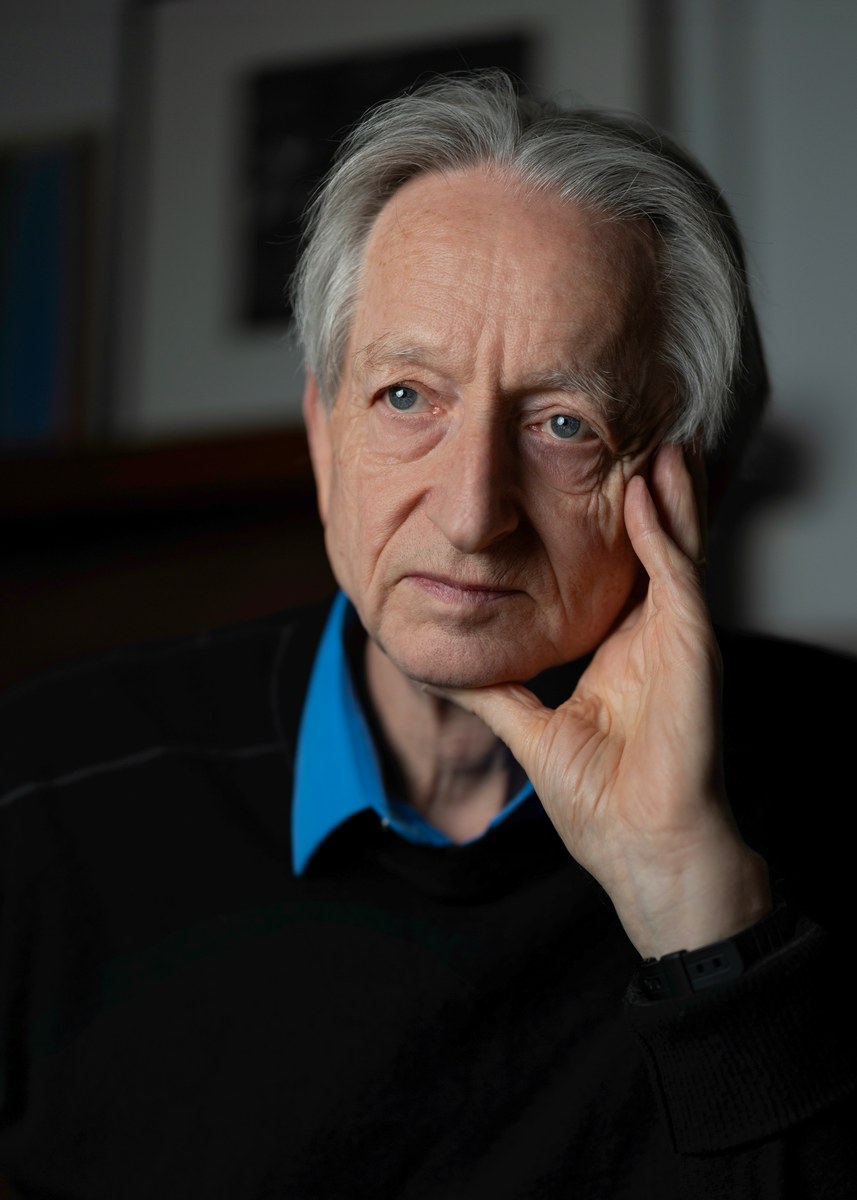

Photo: Christopher Michel, 2026, CC BY-SA 4.0 · Wikimedia Commons, 'Geoffrey Hinton in 2026.jpg' -- portrait photograph by Christopher Michel, dated 13 May 2026 and uploaded to Commons by the photographer himself (account Cmichel67, 'Own work') under CC BY-SA 4.0. Original 4131 x 5784 pixels (SHA-1 4f67d2b0, matches the Commons record); saved downscaled only (never upscaled) to 857 x 1200. · CC BY-SA 4.0
컴퓨터 과학자 · 현대
제프리 힌턴
b. 1947
주요 업적 분야
아직 성격 매칭에 포함되지 않았습니다 — 기록된 근거가 성격 모델 전체를 다루기에는 충분하지 않습니다. 이 페이지의 다른 모든 내용은 자유롭게 확인하실 수 있습니다.
핵심 특성
주요 업적
존 홉필드와 함께 인공신경망 기반 머신러닝을 가능하게 한 기초적 발견으로 2024년 노벨 물리학상을 공동 수상했으며, 홉필드 네트워크를 토대로 볼츠만 머신을 만들었다.
러멜하트, 윌리엄스와 함께 1986년 역전파 논문을 공저해 이 방법을 널리 알렸고, 르쿤·벤지오와 함께 2019년 튜링상을 공동 수상했다.
신경망에 대한 관심이 시들던 1990년대에도 연구를 이어갔고, 2012년 그의 토론토 연구실에서 제자 수츠케버와 크리제프스키가 만든 알렉스넷이 신경망의 폭넓은 채택을 이끌었다.
삶의 장면들
2017년 그는 수십 년에 걸쳐 구상해 온 것으로 소개된, 더 적은 데이터로 사물을 인식하도록 설계된 캡슐 네트워크를 다룬 논문 두 편을 발표했다.
기존 구조를 다듬는 데 그치지 않고 새로운 신경망 구조를 제안해 온 성향과 일치한다. 창의적 독창성
제자들은 힌턴이 면담에서 자신의 최신 아이디어와 결과를 공유해 영감을 주고, 학생들의 걸림돌을 없애 주려 애썼다고 회상한다.
제자들의 설명처럼 진도 점검보다 공동 작업을 중심에 둔 지도 방식과 일치한다. 협업 성향
전환점
2012년 힌턴과 제자 수츠케버, 크리제프스키는 GPU로 학습한 합성곱 신경망으로 이미지넷 대회에 참가했다. 이 논문은 역대 가장 많이 인용된 논문 중 하나가 되었고, 그 전에는 신경망을 쓰는 연구자가 드물었으나 이후에는 거의 모두가 썼다.
오래 지속한 신경망 연구가 성공을 가능케 한 데이터와 하드웨어를 만난 것과 일치한다. 끈기
비슷한 인물
전체적인 프로필이 이 사람과 닮은 사람들이에요.


엘리자베스 케이디 스탠턴

프리다 칼로

파블로 피카소

마야 안젤루

듀크 엘링턴
출처
- Geoffrey Hinton (Q92894) -- verified live via the Wikidata API (2026-10-23): English label 'Geoffrey Hinton', description 'British-Canadian computer scientist and psychologist', born 1947-12-06, no date of death, citizenship United Kingdom and Canada, Korean label present, English and Korean Wikipedia sitelinks present, P18 'Geoffrey Hinton in 2026.jpg'. Orientation only; not used as support for any row.
- R. Kalvapalle, 'Geoffrey Hinton wins Nobel Prize in Physics', U of T News, University of Toronto, 8 October 2024, read in full: shared the 2024 Nobel Prize in Physics with John Hopfield for foundational discoveries enabling machine learning with artificial neural networks; Hinton built on Hopfield's network to create the Boltzmann machine, which can learn to recognise elements within data and generate new examples, and he and his graduate students later built on it; the Royal Swedish Academy of Sciences noted that he kept researching in the 1990s when interest in neural networks waned and that his work 'helped start the new explosion of exciting results' in the 2000s; at Toronto since 1987, University Professor 2006, co-founder and chief scientific adviser of the Vector Institute, an early CIFAR-supported researcher, 2019 Turing Award with LeCun and Bengio; Hinton says his work drew on statistical physics although he is not a physicist. CANONICAL SIGNIFICANCE SOURCE (it relays the Nobel committee's rationale because nobelprize.org returned HTTP 403 to the fetch tool). Employer-university news release, admiring; its paragraphs on his 2023 departure from Google and his AI-safety advocacy were not used.
- University of Toronto News, 'Neural net behind Geoffrey Hinton's Nobel Prize to be preserved by Computer History Museum' (21 March 2025), read in full: graduate students in Hinton's lab began using GPUs for neural networks in the early 2000s; Ilya Sutskever believed performance would scale with data and, after ImageNet appeared in 2009, persuaded Alex Krizhevsky in 2011 to train a convolutional network on it, with Hinton as principal investigator; Krizhevsky spent about a year adjusting and retraining it on two NVIDIA cards until it beat competitors; the 2012 paper by the three is among the most cited ever and before AlexNet few machine-learning researchers used neural networks, afterwards almost all did; Hinton's summary: 'Ilya thought we should do it, Alex made it work and I got the Nobel Prize'; Jeff Dean of Google says the code underlies the landmark paper. CANONICAL SIGNIFICANCE SOURCE (with the Nobel news release). Institutional, admiring; it credits students' work and shows Hinton's role as supervisor, not the author of the training work.
- University of Toronto News, 'Congratulations pour in for Geoffrey Hinton after Nobel win' (8 October 2024), read in full: remarks from colleagues and current and former students -- Yoshua Bengio, Raquel Urtasun, Eyal de Lara, Leah Cowen, Chris Maddison ('a fantastic adviser' who 'worked really, really hard to remove the barriers for his students'), Nick Frosst (learned most of what he knows about doing science from Hinton, especially his 'curiosity and playfulness'), Kevin Swersky (meetings were not typical check-ins; Hinton shared his own latest ideas and results to inspire students), Ujan Sen (Hinton 'didn't really care too much about pedigree', 'almost childlike playfulness'), Tina Behrouzi ('always goes with what he believes, not what the flow is'). Admiring, celebratory, all from his own institution and former students; used only for behavioural descriptions of research and mentoring, with confidence capped. Maddison's remark about his own health challenges and Hinton's response, and all praise of general stature, were not used.
- University of Toronto News, 'Six degrees of separation: how U of T's Geoffrey Hinton is connected to top AI researchers around the world' (28 March 2017), read in full: says he supervised more than 30 doctoral students and many postdocs, master's students and undergraduates, and names former students and postdocs (Brendan Frey, Yann LeCun as a postdoc, Ruslan Salakhutdinov, Richard Zemel, Ilya Sutskever, Alex Krizhevsky) with their later careers, and the 2012 image-recognition entry and the DNNresearch company acquired by Google. Institutional listing; no quotation from Hinton; supports only the extent of his supervision.
- Synced Review, 'Who invented backpropagation? Hinton says he didn't, but his work made it popular' (23 April 2020), read in full: Juergen Schmidhuber's April 2020 critique of the Honda Prize press release ('six false and/or misleading attributions of credit to Dr. Hinton'), Hinton's Reddit reply ('I have never claimed that I invented backpropagation'; David Rumelhart invented it independently; his group did not know the history when they first published and failed to cite earlier inventors; his real claim is that he was the person to clearly demonstrate that backpropagation could learn interesting internal representations; a rare case of an academic receiving too much credit), the 2015 Nature review background, and a Google DeepMind researcher's remark that science should credit ideas rather than people; notes the 1986 Nature paper with Rumelhart and Williams that popularised it. Independent trade press; CRITICAL COUNTER-VOICE on credit attribution; Hinton's reply is his own statement (self) reported alongside the opposing claim.
- Gary Marcus, 'Two Nobel Prizes for AI, and Two Paths Forward' (Substack, October 2024), read in full for its research-related content: argues the prize citation credits Hinton with inventing backpropagation although Paul Werbos developed its modern form in a 1974 thesis and David Parker rediscovered it in 1982 (citing Stephen Grossberg: 'good marketing does not imply priority'), quotes a Hinton defender that the committee 'didn't know the neural network history very well', and says Hinton has long championed backpropagation and neural networks while dismissing neurosymbolic AI, contrasting him with Demis Hassabis. Critical outside commentator who is himself a long-time opponent of pure deep-learning approaches; used only as the counter-voice on credit and on research style. Its other passages (policy, AI-safety debate, any remarks on Hinton's later statements) were not used.
- Jamie Condliffe, 'Google Researchers Have a New Alternative to Traditional Neural Networks', MIT Technology Review, 1 November 2017, read in full: Hinton's two papers (arXiv and OpenReview) introducing capsule networks, groups of neurons organised in layers where agreeing capsules activate one at a higher level; approach said to have been 'in the making for decades' and expected to recognise objects in new situations with less data; results matched regular networks on handwritten characters and made fewer errors on toys seen from new angles; caveats that capsule networks were still slower and results limited to a few tasks; no outside expert quoted. Short trade-press report; its remarks on his worries about AI's future were not used.
- Wikimedia Commons file page 'Geoffrey Hinton in 2026.jpg' (with the Commons API record and wikitext) -- checked for the portrait: author and uploader Cmichel67 (Christopher Michel), photograph dated 2026-05-13, licence CC BY-SA 4.0 ('own work'), original 4131 x 5784 pixels. Rights record only; no trait row rests on it.