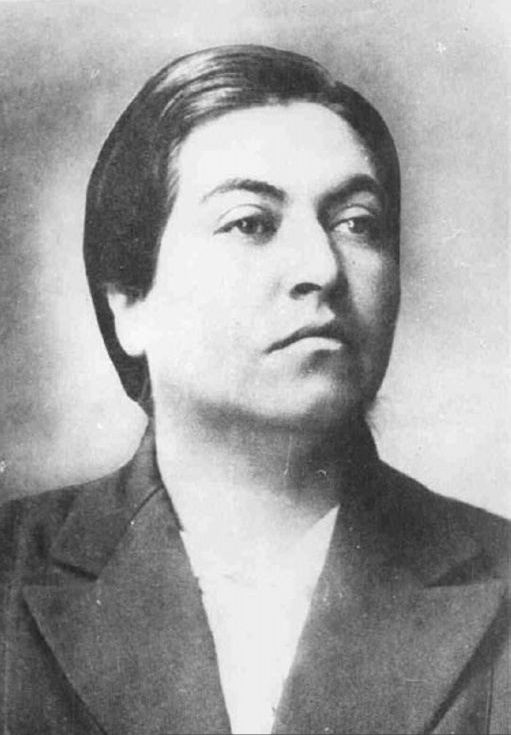

Photograph, 1922, photographer unidentified; Biblioteca Nacional de Chile, Memoria Chilena, Archivo del Escritor · Memoria Chilena (Biblioteca Nacional de Chile), photograph record MC0010812 'Gabriela Mistral', Archivo del Escritor, dated 1922 (Punta Arenas; production not identified), reproduced as Wikimedia Commons 'Gabriela Mistral, 1922.jpg' (511 x 735, uploaded under CC0 from the library record). The library's own page states 'Patrimonio cultural comun' and that the document may be used and reproduced freely; the photographer is not identified. File used unchanged, no resampling. The Wikidata image 'Gabriela Mistral 1945.jpg' (Anna Riwkin-Brick, 280 x 396, creator died 1970) was rejected as not public domain by age. A caveat: the creator is unknown, so the rights basis is the institution's stated terms plus the photograph's age. · Public domain (library statement: patrimonio cultural comun)
시인 · 20세기
가브리엘라 미스트랄
1889–1957
주요 업적 분야
아직 성격 매칭에 포함되지 않았습니다 — 기록된 근거가 성격 모델 전체를 다루기에는 충분하지 않습니다. 이 페이지의 다른 모든 내용은 자유롭게 확인하실 수 있습니다.
핵심 특성
주요 업적
『황폐(Desolacion)』(1922), 『애정(Ternura)』(1924), 『벌목(Tala)』(1938), 『포도압착기(Lagar)』(1954) 등의 시집을 펴냈으며, 비탄과 사랑, 어린 시절과 자연을 노래한 서정시로 라틴아메리카를 대표하는 시인이 되었다.
1945년 노벨 문학상을 받았다. 그의 서정시는 라틴아메리카 세계의 이상적 열망의 상징이 되었다는 평가를 받았으며, 라틴아메리카 작가로는 처음 수상했다.
독학으로 교사가 되어 푼타아레나스와 테무코의 여학교 교장을 지냈고, 1922년 멕시코의 초청을 받아 농촌 교육 개혁과 대중 도서관 계획을 도왔다.
삶의 장면들
신문 기고 때문에 라세레나 사범학교 입학을 거부당한 뒤, 혼자 준비해 1910년 교사 자격을 얻었다.
이는 제도적 거부 이후에도 스스로의 방법으로 목표를 향해 나아가는 태도와 맞는다. 끈기
시인재단의 전기에 따르면 그는 푼타아레나스 교장 시절 달리 배울 길이 없던 노동자들을 위한 야간 수업을 열었다.
이는 교육에서 소외된 사람들에게 교육을 넓히려는 동기와 맞는다. 영향 창출 동기
전환점
1922년 미국의 스페인어 교사들의 요청으로 『황폐』가 뉴욕에서 출간되어, 멕시코에서 일하던 그에게 국제적 명성을 안겨 주었다.
이는 칠레를 넘어 독자를 얻은 독창적인 시 세계와 맞는다. 창의적 독창성
비슷한 인물
전체적인 프로필이 이 사람과 닮은 사람들이에요.
출처
- Gabriela Mistral (Q80871) -- verified live via the Wikidata API (2026-10-26): English label 'Gabriela Mistral', description 'Chilean poet, diplomat and educator (1889-1957)', born 1889-04-07, died 1957-01-10, citizenship Chile, Korean label '가브리엘라 미스트랄', P18 image 'Gabriela Mistral 1945.jpg'. Orientation only; not used as support for any row.
- Memoria Chilena (Biblioteca Nacional de Chile), minisite 'Gabriela Mistral (1889-1957)', Presentacion text updated July 2023, read in full: considered one of the main references of Chilean and Spanish-American literature, Nobel Prize 1945 as the Swedish Academy's first recognition of Latin American letters; her start as a school aide around 1905, the failed entry to the Normal School in La Serena (a chaplain found her poems 'somewhat socialist and a bit pagan', per Gonzalez Vera), her regularising of her teaching through special exams in 1910, posts at Traiguen, Punta Arenas, Antofagasta and Temuco; the 1914 Juegos Florales prize for the 'Sonetos de la muerte'; the 1922 invitation to Mexico to help with educational reform and popular libraries; Desolacion (New York, 1922), Lecturas para mujeres (1924), Tala (1938), Lagar (1954); the 1951 national prize. Personal-life passages (bereavements, relationships) deliberately not used. CANONICAL SIGNIFICANCE SOURCE. National-library institutional biography, citing scholarly sources; admiring.
- Nobel Foundation, 'Gabriela Mistral' Facts and Biographical pages (nobelprize.org), read in full: prize motivation 'for her lyric poetry which, inspired by powerful emotions, has made her name a symbol of the idealistic aspirations of the entire Latin American world'; biography written at the time of the award listing Sonetos de la muerte (1914), Desolacion (1922), Ternura (1924), Tala (1938), her teaching of elementary and secondary school, her role in the education systems of Mexico and Chile and her university teaching in the United States and Puerto Rico (consular and League of Nations posts are not scored). Award-body record, contemporary but promotional.
- Hjalmar Gullberg, Swedish Academy, 'Award Ceremony Speech' for the 1945 Nobel Prize in Literature (nobelprize.org; from Nobel Lectures, Elsevier 1969), read in full: places her as a Latin American poet from a village teacher; describes Desolacion (1922, New York), the children's songs of Ternura (1924) and Tala (1938, published in Buenos Aires for the benefit of children victims of the Spanish Civil War) and calls her the great singer of sorrow and motherhood and the 'queen' of Latin American poetry. Contemporary ceremonial praise with legend-like biography; the passage on her private tragedy is not used.
- Gabriela Mistral, 'Banquet speech' (Nobel Prize in Literature 1945, nobelprize.org), read: her own words calling herself, by 'an undeserved stroke of fortune', the direct voice of the poets of her race and indirect voice of the Spanish and Portuguese tongues, and praising Sweden's schools, teachers and workers. Self material; used only as context for her self-description and never as support for a score.
- Poetry Foundation, 'Gabriela Mistral' biography (poetryfoundation.org), read in large part (about the first two-thirds of the long scholarly biography): her style marked by disdain for modernist ornament and deliberate breaks of prosodic rules that make some verses harsh to recite; her 1904-06 newspaper writing including a 1906 article urging women's education; refusal of admission to the La Serena Normal School and her self-preparation and 1910 teaching certificate; teaching and administrative posts, evening classes for workers in Punta Arenas, advice to the young Neruda in Temuco; the 1922 Mexican invitation and rural-education work, Lecturas para mujeres, and Desolacion published in New York on the insistence of American Spanish teachers; her letter on writing a new school poetry; prolific prose for newspapers. The final third (later travels, consular work, last years) was not read in detail. Scholarly biography; admiring, with some critical notes on style and the unedited state of her complete works.
- Academy of American Poets, 'Gabriela Mistral' biography (poets.org), read in full: teacher and administrator in Mexico and Chile; first Latin American writer to receive the Nobel Prize in Literature (1945) and Chile's national prize (1951); selected books Desolacion, Ternura, Tala, Lagar; university posts in the United States; quotes Ursula K. Le Guin, her translator, that Mistral 'worked constantly, tirelessly, all her life, at her craft' as a self-taught, almost wholly self-made poet. Institutional bio with a translator's retrospective tribute; admiring.
- Carola Sepulveda, 'Gabriela Mistral y el Chile reciente (a 75 anos del Premio Nobel)' (El Desconcierto, Santiago, 10 December 2020), read in full: Chilean academic's opinion column arguing that official memory presented Mistral as a docile 'teacher-mother' and neglected her prose on social and cultural issues, her work as teacher and intellectual concerned with women, children, peasants and workers, and that recent readings find a more complex figure; notes her exclusion from the Normal School after regional newspaper writing and that the Chilean national literature prize came six years after the Nobel. Contemporary revisionist critique of her reception rather than of her work; the column's references to dictatorship-era politics are not used.
- Memoria Chilena (Biblioteca Nacional de Chile), photograph record 'Gabriela Mistral' (code MC0010812, Archivo del Escritor, Coleccion Gabriela Mistral; publication data 'Punta Arenas, Chile: produccion no identificada, 1922'), checked for the portrait: intellectual-property field 'Patrimonio cultural comun' with the statement that the document belongs to the common cultural heritage and may be used and reproduced freely. Not used for any scoring.