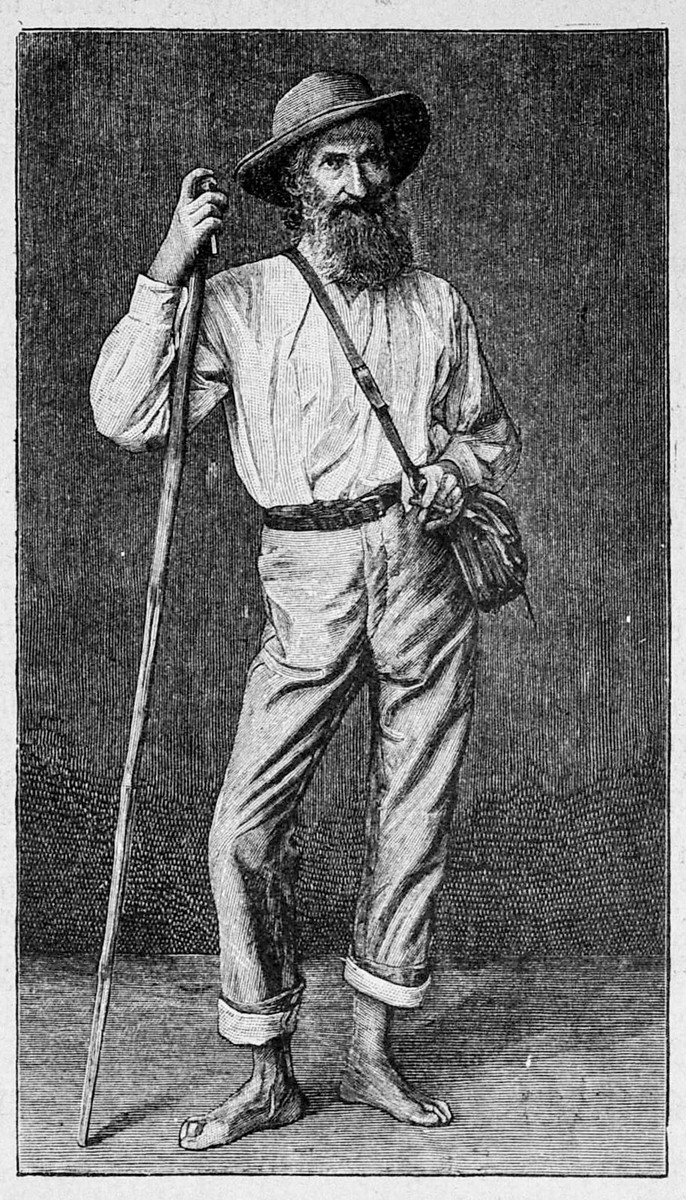
Unsigned wood engraving, after an unnamed photograph, in Die Gartenlaube (Leipzig: Ernst Keil's Nachfolger), 1892, p. 288; scan via Wikimedia Commons (public domain). Cropped and downscaled. · Wood-engraved portrait captioned 'Der Naturforscher Dr. Fritz Müller in Blumenau', published with Peter Vogel's article about him in the Leipzig family magazine Die Gartenlaube, 1892, p. 288 (the article text, p. 291, says it carries his portrait on p. 288). Engraver and the underlying photograph are not named. The file is the illustration cropped from a Wikimedia Commons scan of the 1892 volume (916 x 1602 pixels) and downscaled to 686 x 1200 with no upscaling. · Public domain by age: an unsigned illustration first published in Leipzig in 1892 (before 1931 in the United States and well over 70 years from publication for an anonymous work elsewhere). No museum or library holds an item record for this scan: it is a volunteer's scan of his own bound volume uploaded to Wikimedia Commons, so the basis is age, not an institutional statement.
핵심 특성
주요 업적
브라질 해안의 갑각류 발생을 연구해 다윈의 이론을 검증한 『다윈을 위하여』(1864)를 썼고, 다윈은 1869년 영어판 출간 비용을 댔다.
서로 관련 없는 맛없는 나비들이 닮아 가는 이유를, 포식자가 경고 무늬를 학습하므로 닮은 종들이 희생을 나눠 진다는 논리로 설명했다. 이 개념은 그의 이름을 따 뮐러 의태라 불린다.
블루메나우에서 덩굴식물, 난초, 흰개미, 벌에 관한 현장 관찰을 다윈에게 보냈고, 1876년부터 리우데자네이루 국립박물관의 순회 박물학자로 일했다.
삶의 장면들
야생에서 잡은 수컷 나비의 날개를 펴다가 날개의 털뭉치에서 강한 냄새가 나는 것을 알아채고, 이를 암수 사이의 화학 신호와 연결지었다.
현장 표본의 사소한 세부에 밀착해 주의를 기울이는 태도와 부합한다. 디테일 지향
1865~1882년 다윈에게 약 106통의 편지를 썼고, 다윈은 그의 관찰 여러 건을 『네이처』의 짧은 논문 여섯 편을 포함해 학술지에 보냈다.
멀리 있는 협력자와 발견을 꾸준히 공유하는 습관과 부합한다. 협업 성향
전환점
1861년 다윈의 『종의 기원』 독일어 번역본을 받은 뒤 갑각류 연구를 다윈 이론의 검증으로 재편했고, 이는 『다윈을 위하여』와 다윈과의 서신 교환으로 이어졌다.
검증할 가치가 있다고 본 새 이론을 중심으로 연구를 재편하는 태도와 부합한다. 분석적 엄밀성
비슷한 인물
전체적인 프로필이 이 사람과 닮은 사람들이에요.


소르 후아나 이네스 데 라 크루스

레오나르도 다빈치

벤저민 프랭클린

에이브러햄 링컨

찰스 다윈
출처
- Fritz Müller (Q62086), verified live via the Wikidata API (2026-11-06): English label 'Fritz Müller', description 'German-Brazilian biologist (1822-1897)', born 31 March 1822, died 21 May 1897, citizenship Germany and Brazil, no Korean label. Orientation only; not used as support for any row.
- English Wikipedia, 'Fritz Müller' (read for orientation and to find the scholarly references; not used as support for any row).
- Dictionary of Scientific Biography entry 'Müller, Fritz (Johann Friedrich Theodor)' (Gale text on Encyclopedia.com, read in full). CANONICAL SIGNIFICANCE SOURCE: calls Für Darwin (1864) a fundamental contribution to evolutionary biology and his name immortalised in 'Müllerian mimicry'; he applied Darwin's ideas to the Crustacea as a specific test case; he explained why unrelated unpalatable species resemble each other (predators must learn, so look-alikes share the losses); his work ranged from Coelenterata, Annelida and Crustacea to entomology and plant fertilisation; almost 250 articles; Darwin paid for the 1869 English translation and quoted him extensively; the entry describes 'extraordinary powers of observation', modesty and indifference to fame; he lost the museum post in 1891 when he refused to move to Rio. The entry also covers political, religious and private-life material that is not used here. Standard scholarly reference work, admiring in tone.
- Neue Deutsche Biographie vol. 18 (1997), article 'Müller, Fritz (Müller-Desterro)' by Karl Mägdefrau, with the older Allgemeine Deutsche Biographie entry (Heß, 1906) on the same Deutsche Biographie page (both read; the ADB text was read in part). German national biographical reference: he left school teaching because of an irresistible wish to study animals and plants abroad; naturalist for the National Museum in Rio from 1876; visiting botanists (Schimper, Schenck, Möller) lodged with him for long research stays; he dealt with Crustacea, leeches, termites, stingless bees, mimicry and later flower ecology and lianas; about 250 papers; wide correspondence with Darwin, Haeckel, Weismann and his brother Hermann; honorary membership of the Entomological Society of London and the Leopoldina (1884); Darwin's phrase 'the prince of the observers'; the 1892 relocation order and his dismissal without compensation. Independent of the English-language sources. Includes political and religious background that is unscored context.
- Peter Vogel, 'Ein deutscher Pionier der Wissenschaft in Brasilien', Die Gartenlaube (Leipzig) 1892, pp. 288 and 291, with a portrait of the sitter on p. 288 (Wikisource transcription of both pages read in full). Eyewitness report of a 1887 visit to Blumenau: describes him barefoot with a bamboo staff, taking in his own post, calling himself the 'hand-labourer of the master' (Darwin), a naturalist who observes living animals, never shot an animal to kill it and walks unarmed; praises his observing genius and quotes Darwin's 'prince of observers'; reports the press news that his museum post had been terminated because he would not move to Rio. Contemporary popular magazine, admiring, one visitor's account.
- Klaus Hartfelder, review of David A. West, 'Darwin's Man in Brazil: The Evolving Science of Fritz Müller' (2016), Genetics and Molecular Biology 41(3), 2018, pp. 722-724 (PMC, open access, read in full). Modern scholarly overview: Müller reorganised his crustacean studies as a test of Darwin's theory after receiving the Origin in 1861, nearly 30 papers on marine invertebrates 1858-1865; Für Darwin; Darwin sponsored the 1869 translation; 106 letters to Darwin; observations on climbing plants, orchids, termites and bees that Darwin forwarded to journals; the 1879 mimicry paper with its mathematical argument; his male-scent observations on butterflies; his critical distance from Haeckel's recapitulation idea; a later Gould reading of his work; his name the most cited reference in the Origin from the fourth edition onward; his move to travelling naturalist in 1876. A review of one biography, admiring and relying on West and Möller.
- Darwin Correspondence Project letter 4885A (Müller to Darwin, Desterro, 31 August 1865) with the Darwin Online record of Darwin's letters to Müller (Möller ed., 1921, vol. 2) containing the Darwin: A Companion entry (van Helvert and van Wyhe, 2021) on Müller (both pages read). Records letters from 1865 to 1881, six short papers by Müller in Nature with introductory notes by Darwin, Darwin's regard for him as one of the most able naturalists living, the 1880 flood in which he was nearly drowned and Darwin's offer of 100 pounds for lost books (not needed), the dismissal for refusing to live in Rio, and the editors' remark that Haeckel took the recapitulation theory from Für Darwin without acknowledgement. Scholarly editorial apparatus of the Darwin archives; sympathetic to Darwin's circle.
- Thomas N. Sherratt, 'The evolution of Müllerian mimicry', Naturwissenschaften 95, 2008 (PMC, open access; abstract, introduction and framing read; the body was skimmed). COUNTER-VOICE: 130 years after Müller, reports that his specific model of learning with a fixed number n of attacks per season has not been supported and that several experiments suggest two distinct unpalatable prey types may be as easy to learn as one, while his general insight that rare unpalatable forms suffer higher mortality than common ones is well supported; notes a long-running debate about co-mimics of unequal defence.
- James Mallet, 'Mimicry: an interface between psychology and evolution', Proceedings of the National Academy of Sciences 98, 2001 (PMC, open access commentary, read in full). Says Müller in 1879 used a mathematical argument, perhaps the first in evolutionary ecology (Malthus excepted), to show that pairs of unpalatable species gain mutualistic benefits from resemblance; his relative-benefit formula was soon shown to be an approximation and his fixed-n assumption is doubted by Speed and others, though the benefit to both species remains positive. Independent, partly critical modern scientific commentary.