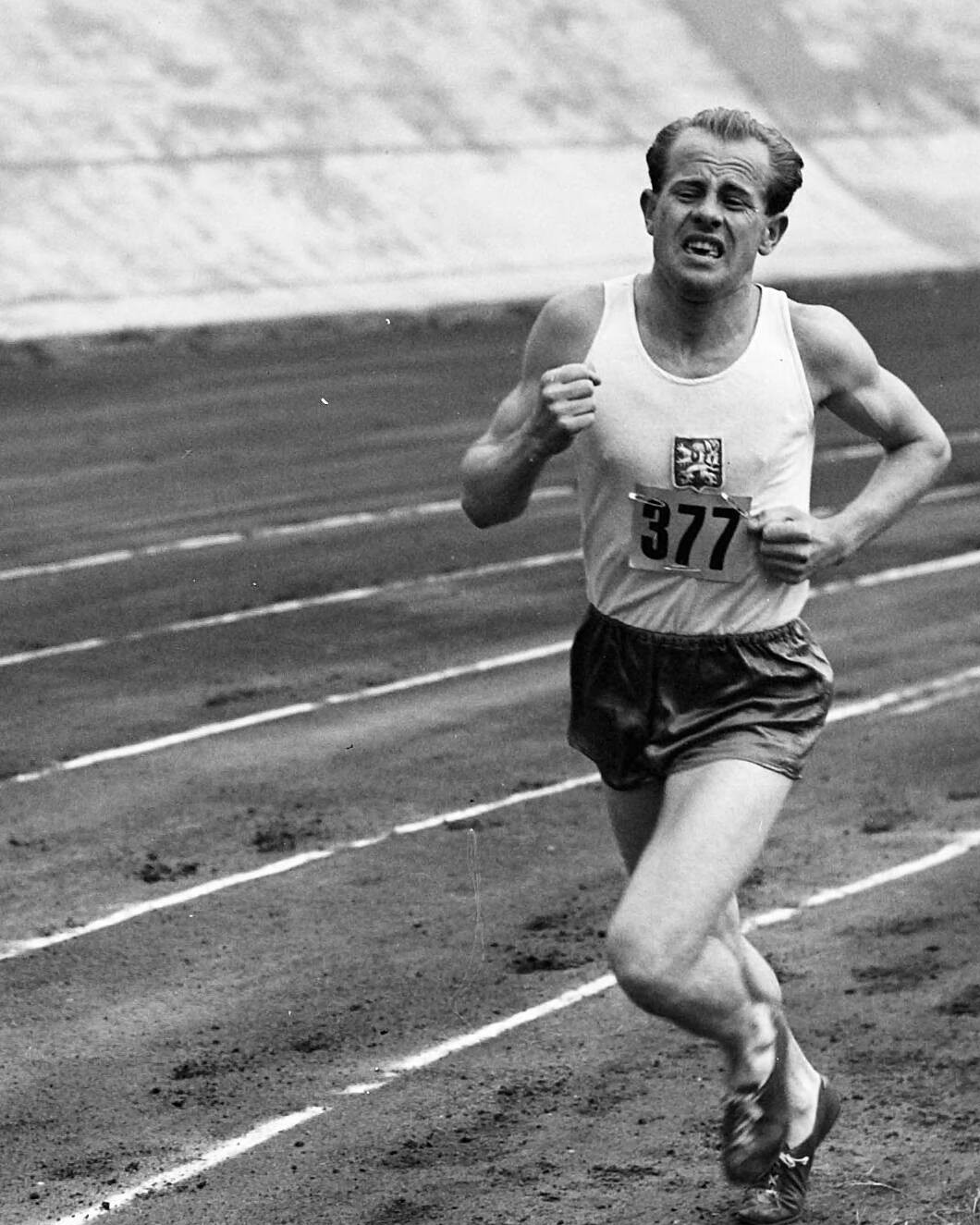

J.D. (Daan) Noske / Anefo, 'Internationale atletiekwedstrijd in het Olympisch Stadion. Emil Zatopek', August 1948; Nationaal Archief, Fotocollectie Anefo, bestanddeelnummer 902-9145, CC0 · Nationaal Archief (Dutch National Archives), Fotocollectie Anefo, item 902-9145, via Wikimedia Commons (cropped) · CC0 1.0
핵심 특성
주요 업적
에밀 자토페크는 1948년 런던 올림픽에서 10,000m 금메달과 5,000m 은메달을 땄다. 1952년 헬싱키 올림픽에서는 5,000m에서 우승하고 10,000m 2연패를 이룬 데 이어 생애 첫 마라톤에서도 우승했으며, 8일 사이에 세 종목 모두 올림픽 신기록(14분 06초 6, 29분 17초 0, 2시간 23분 03초 2)을 세웠다. 한 대회에서 이 세 종목을 모두 우승한 선수는 아직 없다.
자토페크는 400m를 빠르게 달리고 짧게 조깅하며 쉬는 반복 훈련, 흔히 수십 회에 이르는 인터벌 훈련을 중심으로 훈련을 짰다. 전문가들은 처음에는 이 방식을 비웃었지만, 올림피디아는 그가 장거리 선수들 사이에 인터벌 훈련을 널리 퍼뜨린 선수라고 평가한다(인터벌 훈련 자체는 한 코치가 처음 소개했다). 그는 1949년부터 1950년대 중반까지 5,000m에서 30,000m 사이 거리에서 세계 신기록을 18번 세웠고, 여기에는 최초의 29분 이내 10,000m와 1951년 최초의 1시간 이내 20,000m(59분 51초 8)가 포함된다.
삶의 장면들
타임스 부고는 자토페크가 경기용 신발이 가볍게 느껴지도록 무거운 군화를 신고 훈련했고, 호흡에 도움이 되는지 보려고 방독면을 써 보았으며(도움이 되지 않았다), 통행금지로 실내에 머물러야 할 때는 빈방에서 제자리 달리기를 했다고 기록한다. 월드 애슬레틱스는 군 훈련병 시절 그가 군화와 여러 겹의 옷을 입고 깊은 눈 속에서 10~12km를 달렸으며, 헬싱키 한 해 전인 1951년에는 지구력을 시험하려고 2주 사이에 20,000m 경기를 두 번 뛰었다고 덧붙인다.
이렇게 장비와 환경을 직접 시험해 보는 모습은 그의 프로필에 매겨진 실험 정신과 일치한다. 방독면이 도움이 되지 않았다는 타임스의 언급은 모든 시도가 성과로 이어진 것은 아니었음을 보여 준다. 실험 성향
올림픽 금메달은 없지만 세계 기록을 여러 개 가진 호주의 론 클라크가 1966년 프라하를 찾았을 때, 오래전에 은퇴한 자토페크는 그를 공항까지 태워다 주며 작은 꾸러미를 건넸다. 클라크가 비행기 안에서 열어 보니 클라크의 이름과 그날의 날짜가 새겨진 자토페크의 1952년 올림픽 10,000m 금메달이 들어 있었다. 월드 애슬레틱스가 전하는 클라크의 회상에 따르면 자토페크는 이것이 '우정 때문이 아니라 받을 자격이 있기 때문'이라고 말했고, 클라크는 눈물을 흘렸다.
전환점
1968년 자토페크는 몇 주 전 개혁파의 '2,000어 선언'에 서명했는데, 바르샤바 조약군이 체코슬로바키아를 침공하자 바츨라프 광장으로 나가 그곳의 소련군 병사들과 논쟁을 벌였다. 개혁 운동이 진압된 뒤 그는 군과 공산당에서 제명되었고 그의 이름은 교과서에서 지워졌다. 이후 수년간 시골에서 물과 광물을 탐사하는 팀에서 육체노동을 했고(세부 내용은 기록마다 다르다), 나중에는 체육부에서 외국 스포츠 간행물을 읽는 일을 맡았으며, 1989년 이후 공식 복권되었다.
비슷한 인물
전체적인 프로필이 이 사람과 닮은 사람들이에요.
출처
- Emil Zátopek, English Wikipedia article (read via the MediaWiki extracts API, 2026-10-04) -- orientation only; not used as support for any scored row. Read for cross-checking: it records the 1966 Ron Clarke medal gift and notes there is no evidence for the uranium-mine rumour (the camps had closed).
- Emil Zátopek (Q52589) -- verified live via wbgetentities (2026-10-04): en label 'Emil Zátopek', description 'Czech long-distance runner (1922-2000)', instance of human, born 19 Sep 1922, died 21/22 Nov 2000, citizenship Czechoslovakia and Czech Republic, ko label '에밀 자토페크' with a kowiki sitelink. Orientation only; not used as support for any row.
- Olympedia (Olympic historians' reference database) athlete biography of Emil Zátopek, with career results, personal bests, Olympic-record table and list memberships -- non-self reference biography, read in full. Used for Olympic results and records, the 18 world records of 1949-1954, the description of him as the first great distance runner to popularize interval training, and for his running the 1956 marathon only weeks after hernia surgery.
- Simon Turnbull, 'Marking the centenary of the birth of Zatopek', World Athletics Heritage feature, 19 September 2022 -- institutional/journalistic feature (non-self) quoting Zátopek's own recollection of the marathon suggestion, Jim Peters's 1950s autobiography on the Helsinki marathon exchange, Zátopek's 1967 BBC interview on his training load, and Ron Clarke's recollection of the medal gift. Read in full. Its dating of the Clarke visit after the 1968 Games and its 'uranium mine' labour claim are contradicted by other sources read and are not used.
- Richard Askwith (author of the biography Today We Die a Little!, 2016), 'Emil Zátopek: The greatest Olympian vanished from public life after he defied Russian tanks in 1968', The Independent, 24 March 2016, adapted from the book -- BIOGRAPHER's account (non-self; admiring in tone but it also records his heavy drinking in exile and 'public capitulations to the regime for which the dissident movement never forgave him'). Read in full: Bata factory years, training methods, 1948 and 1952 Games, acts of generosity, the Jungwirth stand, 1966 medal gift to Ron Clarke, August 1968 and the exile.
- Richard Askwith, book extract on the July 1952 standoff over teammate Stanislav Jungwirth's travel papers, The42.ie, December 2016 (from Today We Die a Little!) -- BIOGRAPHER's text (same perspective as the Independent piece, not an independent second account). Read in full.
- 'Great moments - Zatopek's zenith', Athletics Weekly, diamond-anniversary series, with comments from biographer Richard Askwith on the Jungwirth standoff, the 'tonsillitis' cover story and the pressure before Helsinki 1952 -- journalistic retelling resting on Askwith (not independent of him). Read in full.
- 'Emil Zatopek, 1922-2000: one of the track greats, dies at 78', The Times (London), 22 November 2000, unsigned obituary (text as mirrored on a German running-history site; Times Newspapers copyright) -- obituary by a major newspaper (non-self). Read in full: early life at Bata, training experiments, 1948-1956 career, the 1968 manifesto and Wenceslas Square, dismissal, later manual work and sports-ministry job.
- Encyclopaedia Britannica, 'Emil Zátopek' (editors' biography) -- reference overview (non-self). Read in full; used for Olympic medals, the 18 world records, the first sub-29-minute 10,000 m, the sub-one-hour 20,000 m of 1951, the 1946 Prague-to-Berlin bicycle trip, and the origin and spread of his interval training.
- EBSCO Research Starters, 'Emil Zátopek' -- secondary reference biography (non-self; draws on Bob Phillips's 2004 biography and Askwith). Read in full: factory race he tried to avoid, officer-school training by flashlight, interval training, the 1952 marathon, the post-1954 decline and heavier training, post-1968 work and 1989 rehabilitation.
- Milt Marmor (Associated Press), 'Unbelievable Zatopek Exhausts Rivals and Writers' Adjectives', Evening Star (Washington, D.C.), 3 August 1952, image 54, via Library of Congress Chronicling America -- CONTEMPORARY wire report (non-self). Read in full: his conduct in the 5,000 m heat, his talking during the marathon, languages spoken, pulse and heart measurements.
- Associated Press, 'Track Program Ends As Zatopek Provides Unequaled Climax', Evening Star (Washington, D.C.), 28 July 1952, image 15, via Library of Congress Chronicling America -- CONTEMPORARY wire report of the Helsinki marathon (non-self). Read in full for his question to Jim Peters about the pace and his move to the lead at 20 km.
- Wire report on the Helsinki track programme, Atlanta Daily World, 25 July 1952, image 7, via Library of Congress Chronicling America -- CONTEMPORARY press (non-self). Read for the statement that he had promised his countrymen he would win the 5,000 m, the 10,000 m and the marathon.
- Will Grimsley (Associated Press), 'Sports Roundup', The Key West Citizen, 9 December 1952, image 5, via Library of Congress Chronicling America -- CRITICAL contemporary US sports column (non-self, Cold War viewpoint) arguing that Zátopek fell short of an American ideal of 'sportsman' after the Helsinki Games because he allowed his fame to be used for Communist propaganda. Read in full; recorded as the adversarial perspective and NOT used to score any trait.
- Associated Press, 'Zatopek Back in Action, Wins at 10,000 Meters', Evening Star (Washington, D.C.), 8 October 1956, image 44, via Library of Congress Chronicling America -- CONTEMPORARY wire item (non-self) reporting his first 10,000 m race since his recent operation (Radio Prague), won in 29:33.4. Read in full.
- Olympic Museum (IOC) collection record for Alain Mimoun's London 1948 diploma, including the museum's note on Mimoun's career and his account of meeting Zátopek at the finish of the 1956 Melbourne marathon -- institutional record (non-self; the account is Mimoun's recollection). Read in full.