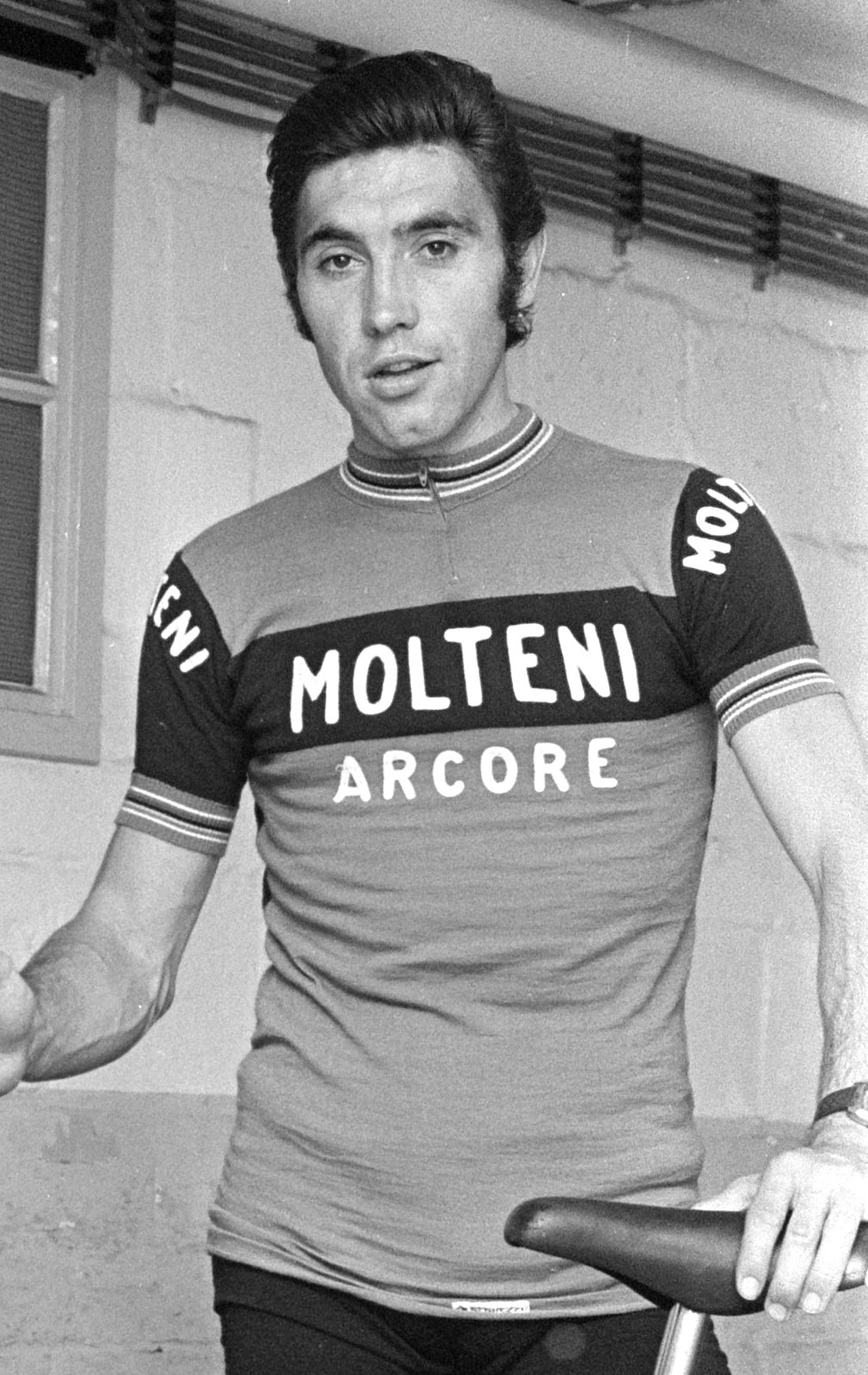

Anefo / Nationaal Archief, 2 August 1973 (Olympisch Stadion, Amsterdam), CC0 1.0 (Merckx cut from 'Joop Zoetemelk en Eddy Merckx schudden elkaar de hand'; resized) · Nationaal Archief (Fotocollectie Anefo, bestanddeelnummer 926-5866), via Wikimedia Commons (extracted crop published on Commons from the archive's Flickr Commons upload) · CC0 1.0
운동선수 · 20세기
에디 메르크스
b. 1945
주요 업적 분야
아직 성격 매칭에 포함되지 않았습니다 — 기록된 근거가 성격 모델 전체를 다루기에는 충분하지 않습니다. 이 페이지의 다른 모든 내용은 자유롭게 확인하실 수 있습니다.
핵심 특성
주요 업적
메르크스는 1964년 세계 아마추어 도로 선수권에서 우승했고 1965년 프로로 전향했다. 1969년에는 1939년 이후 벨기에 선수로는 처음으로 투르 드 프랑스에서 우승했으며, 스포츠 일러스트레이티드의 1972년 기사는 그가 1970년과 1971년에도 다시 우승했다고 기록한다.
1972년 10월 25일 멕시코시티의 야외 올림픽 벨로드롬에서 메르크스는 한 시간 동안 49.431km를 달려 올레 리테르의 기록을 788m 늘렸다. 사이클리스트 매거진은 이 기록이 28년 동안 유지되었다고 전한다.
메르크스는 1978년 봄에 선수 생활을 마쳤고, 1980년 이탈리아의 프레임 제작자 우고 데로사의 도움을 받아 자전거 회사 에디 메르크스 사이클스를 세웠다. 사이클링 위클리에 따르면 이 회사의 자전거는 이후 세븐일레븐, 모토로라, 퀵스텝 등 프로 팀에 공급되었다.
삶의 장면들
1971년 7월 8일 오르시에르메를레트에서 메르크스는 약 100km 동안 아무도 선두 교대를 해 주지 않는 추격 그룹을 끌고 달린 끝에 루이스 오카냐에게 8분 41초를 잃었다. 벨기에 RTBF와 라 데아슈(La DH)의 회고 기사에 따르면, 이틀 뒤 그는 몰테니 팀 동료 세 명과 함께 251km 마르세유 구간의 출발 직후부터 공격해 약 2분을 되찾았다.
그때까지 투르에서 겪은 가장 큰 손실 뒤에도 공격을 이어 간 이 모습은 이 프로필의 끈기 점수와 부합한다. 다만 이 구간에서 되찾은 시간은 뒤진 차이의 일부에 그쳤다. 끈기
1972년 메르크스의 집을 찾은 스포츠 일러스트레이티드 기자는 지하 작업실에서 최대 3년까지 숙성시키는 바퀴 약 100개를 보았고, 그가 오르막, 평지, 거친 노면에 따라 안장 위치를 바꿔 가며 실험한다는 이야기를 들었다. 프레임 제작자 에르네스토 콜나고는 훗날 메르크스가 한 해에 20대가 넘는 자전거를 가져갔고 자전거가 제대로 맞을 때까지 공장을 떠나지 않았다고 회고했다.
이런 작업 습관은 이 프로필의 디테일 지향 점수와 나란히 놓인다. 메르크스 본인은 뒷날의 일부 조정을 1969년 트랙 사고 이후의 편안함 문제와 연결했으며, 이 프로필은 그 부상에서 어떤 결론도 끌어내지 않는다. 디테일 지향
전환점
메르크스는 1972년 아워 레코드 도전 장소로, 후원사 몰테니가 밀라노를 원했음에도 멕시코시티 벨로드롬을 택했다. 그의 마사지사 기욤 미힐스와 2015년 레메스클라(Remezcla) 기사는 밀라노와 리에주 대학의 검사, 그리고 고지대를 흉내 내기 위해 차고에서 산소통의 공기를 마시며 롤러를 탄 6주간의 준비 과정을 전한다. 메르크스도 2004년 사이클 스포트 인터뷰에서 같은 고지대 훈련을 설명한다.
단 한 시간을 위해 몇 주 동안 정해진 준비를 이어 간 과정은 이 프로필의 자기 규율 점수를 보여 주는 한 사례이며, 후원사의 뜻과 다른 장소 선택은 자율성 욕구 항목과도 관련된다. 자기 규율
비슷한 인물
전체적인 프로필이 이 사람과 닮은 사람들이에요.


엘리자베스 1세

마틴 루터 킹 주니어

투생 루베르튀르

존 D. 록펠러

아웅산 수치
출처
- Eddy Merckx (Q103756) -- identity verified live via the wbgetentities API (2026-09-26): label 'Eddy Merckx', description 'Belgian cyclist (born 1945)', P569 17 Jun 1945, no P570, citizenship Belgium (Q31), instance of human, occupation sport cyclist (Q2309784), nl alias 'Edouard Louis Joseph "Eddy" Merckx', fr aliases 'Le Cannibale', 'L'Ogre de Tervuren', ko label '에디 메르크스' (ko aliases '에디 먹스'), kowiki sitelink '에디 메르크스', P18 'Eddy Merckx Molteni 1973.jpg'. Orientation only; not used as support for any row.
- Richard Abraham, 'Eddy Merckx: the man behind the legend', Cycling Weekly (2016 feature from an interview at the Eddy Merckx Cycles factory, Brussels) -- journalist's feature (non-self framing) with Merckx's own quotations (self). Non-self content used: the 1969 Tour of Flanders episode (manager Guillaume Driessens drove alongside in the team car shouting at him to stop his attack with about 45 miles to go; contemporaneous Cycling report quoted), the 1969 Mourenx stage account, the sidebar on his bike tinkering and the 1980 founding of the bicycle company with Ugo De Rosa's help, and current company boss Rob Beset's remark. Fetched with curl and read in full; health passages (2014 heart operation, 1969 Blois injuries as cause) are NOT used as evidence.
- James Spender, 'From the archive: In conversation with Eddy Merckx: "Psychology is important in racing. He never beat me."', Cyclist magazine (interview c.2019, republished online) -- mainly SELF (Merckx's own recollections of the 1972 Giro against Fuente, the 1969 Mourenx attack, Savona 1969, giving criterium money to team-mates, 1975) plus two non-self secondary retellings: Graeme Fife's 'Inside the Peloton' account of Guerrino Tosello's on-bike microphone question to Merckx on stage 6 of the 1972 Giro, and Richard Moore's (Bicycling) account that after the 1975 Puy de Dome stage Merckx went back down with a gendarme to identify the spectator who punched him and pressed charges. Fetched with curl and read in full; the Blois crash and 1975 injury passages are not used.
- 'Eddy Merckx interview', Cycle Sport special issue 2004 (republished by Cycling Weekly 2010; interviewer unnamed on the page) -- long SELF interview (the 1966 move from Solo-Superia to Peugeot after Van Looy's treatment, lessons from Tom Simpson, 1972 Hour Record preparation with sports doctors and a home trainer with an oxygen mask, his view that a racer races to win, reconciliation with Freddy Maertens) containing one NON-SELF firsthand item: team-mate Patrick Sercu told the magazine that Merckx took on all the negotiations to set up his final team so that his team-mates would be paid for another year, and the interviewer notes he employed former team-mates at his bike factory. Fetched with curl and read in full; the Blois back-injury, pain and illness passages are NOT used.
- John Underwood, 'The Majesty of Monsieur Merckx', Sports Illustrated, 24 Jul 1972 (SI Vault; read via the Wayback Machine copy because the live Vault URL returned 404) -- CONTEMPORANEOUS journalist's feature (non-self) reporting from the spring-1972 Tour of Flanders weekend and a visit to Merckx's home. Carries FIRSTHAND statements of his manager Jean Van Buggenhout (subject-affiliated: before a race he goes to his mechanics again and again to check; trains 250-300 days a year; practised two weeks for a televised charity basketball match), of Les Sports editor Theo Van Griethuysen (self-declared 'Merckxist', partisan: 'he is the boss... not Molteni, not the coach'; can be very hard with team-mates 'for the discipline of the team'; did not protest after Eric De Vlaeminck grabbed his jersey in Liege-Bastogne-Liege 1970), quotations from rivals Louison Bobet ('almost too professional... interested only in cycling, and in winning') and Jacques Anquetil ('must win all the time... by five or six minutes'; 'enjoys a fight'), an observer's account of his impassive reply after losing minutes at Orcieres-Merlette in the 1971 Tour and his attack the next day, the Col de Mente crash (he looked to see if Ocana was all right, then rode on), and the writer's own observation of his home workshop (100 wheels curing, drilling holes, experimenting with saddle positions by terrain) with Merckx's own words on seat angle (self). Also states that after the 1969 Giro case he demanded a urine test after each day of that year's Tour. Fetched with curl and read in full; the back-injury, Blois and private-life passages are not used.
- The Inner Ring (blog), 'Book review: Merckx, Half Man Half Bike', 21 Mar 2012 -- secondary REVIEW (non-self) summarising William Fotheringham's 2012 biography: that Merckx attacked to enlarge an already large lead in case of a later puncture or crash, and that he was constantly tinkering with his bike, adjusting saddle height mid-race or demanding a frame be flown to Switzerland to race on the next day. Counted only as a weak retelling of Fotheringham (the book itself is a restricted lending copy on the Internet Archive and was NOT read). Fetched with curl and read in full.
- 'Marseille fut le theatre de l'attaque la plus folle du Tour lancee par Eddy Merckx', La DH / Les Sports+ (Belgian daily), 22 Jul 2017 (French, unsigned; translated by the researcher) -- journalist's retrospective (non-self, secondary, drawing on L'Equipe and period quotations) of stage 12 of the 1971 Tour (10 Jul 1971): two days after losing 8:42 at Orcieres-Merlette, Merckx and Molteni team-mates Wagtmans, Huysmans and Stevens attacked from the start with 251 km to go; he was furious with Stevens, who had slacked on the rest day, urged on his team-mates and berated the breakaway companions; Tour director Jacques Goddet's L'Equipe comment and Ocana's remark are quoted; the Col de Mente attacks and crash are summarised. Fetched with curl and read in full.
- 'Tour de France 1971 : Orcieres-Merlette, le plus grand revers d'Eddy Merckx et le point de depart de sa revolte', RTBF Actus (Belgian public broadcaster), July 2026 (French, unsigned; translated by the researcher) -- broadcaster's retrospective (non-self, secondary) of the 1971 Tour: at Orcieres-Merlette (8 Jul) he pulled a group of about ten riders for some 100 km without anyone taking a turn and on French TV at the finish acknowledged Ocana's superiority (his own words, self); the 10 Jul Marseille attack from the start; after Ocana's crash on the Col de Mente he refused to put on the yellow jersey and told RTBF journalist Theo Mathy that evening he did not know whether he would continue and would rather have finished second than win that way (archive quotation, self), before a French directeur sportif talked him round (Mathy's account). Fetched with curl and read in full.
- 'Joseph Bruyere, le fidele lieutenant d'Eddy Merckx, revient sur ses 3 victoires sur le Nieuwsblad', RTBF Actus (interview with Bruyere at home, c.2023-25; French, translated by the researcher) -- FIRSTHAND recollections (non-self, insider) of Molteni team-mate Joseph Bruyere: the 1974 Het Volk plan that the whole Molteni team rode for Eddy, and that prize money (e.g. his 17,000 Belgian francs) was shared equally among all team-mates, 'the same when Eddy won'. Fetched with curl and read in full; his health remarks are not used.
- 'Bruyere, le lieutenant devenu heros', L'Avenir (Belgian daily), 25 Apr 2014 (French, unsigned; translated by the researcher) -- journalist's retrospective with Joseph Bruyere's FIRSTHAND recollections (non-self, insider) of Liege-Bastogne-Liege 1976: Merckx asked his team-mates to harden the race, Bruyere went clear with Van Springel, and Merckx, his leader, disrupted the chase behind until Bruyere won solo. Fetched with curl and read in full.
- 'Ernesto Colnago: The Big Interview', Cycling Weekly (c.2012; interview with the 80-year-old frame-builder at his factory) -- FIRSTHAND recollection (non-self; Colnago was Merckx's frame supplier at Molteni, so commercially affiliated): Merckx took more than 20 bikes a year, would come in the morning and not leave until he had the perfect bike, and on the Tuesday before a Liege-Bastogne-Liege asked for more saddle setback, taken from 16 to 19 and finally 21 cm. Fetched with curl and read in full; only the Merckx passage is used.
- James Startt, 'The day Bernard Thevenet dropped Eddy Merckx', VeloNews / Velo (outsideonline.com), 1 Oct 2019 -- Q&A interview giving rival Bernard Thevenet's FIRSTHAND recollections (non-self, rival) of the 1975 Tour: at the rest-day press conference Merckx publicly named Thevenet his biggest rival; on the Col d'Allos Merckx sensed he was not at 100 percent and attacked, and gapped him on descents; 'Eddy would exploit the slightest error'; on the final day on the Champs-Elysees 'Eddy attacked from the gun'. Fetched with curl and read in full.
- Giles Belbin, 'How Bernard Thevenet dethroned Eddy Merckx at the 1975 Tour', Cyclist magazine (online feature, undated c.2018-20) -- cycling historian's account (non-self, secondary) of the 1975 Tour: that inside the final kilometre on the Puy de Dome Merckx was slapped by one spectator and punched in the kidneys by another, that he accompanied police back down the road to find the assailant, that charges were filed and the man was ordered to pay one franc in symbolic damages, and that he attacked on the Allos two days later. Fetched with curl and read in full; the injury (fractured jaw) and 'feeling the effects' passages are not used.
- Samindra Kunti, 'Eddy Merckx on the Legendary Cycling Record He Broke in Mexico City: "It Was Pain, Pain, and Pain"', Remezcla, 11 Nov 2015 -- journalist's feature from a joint interview in Brussels with Merckx (self) and his 1970s masseur Guillaume Michiels (FIRSTHAND insider, non-self): that Merckx chose the Mexico City velodrome although sponsor Molteni wanted Milan; that the universities of Milan and Liege tested him and for six weeks he rode static rollers in his garage breathing from some 30 oxygen bottles with doctors checking him; Michiels on his nervousness during the postponement and on Giorgio Albani signalling 'easy, easy' during a deliberately fast start (Merckx: 'a deliberate way to be ahead of the projected time table'). Fetched with curl and read in full; the exhaustion-at-finish passage is not used.