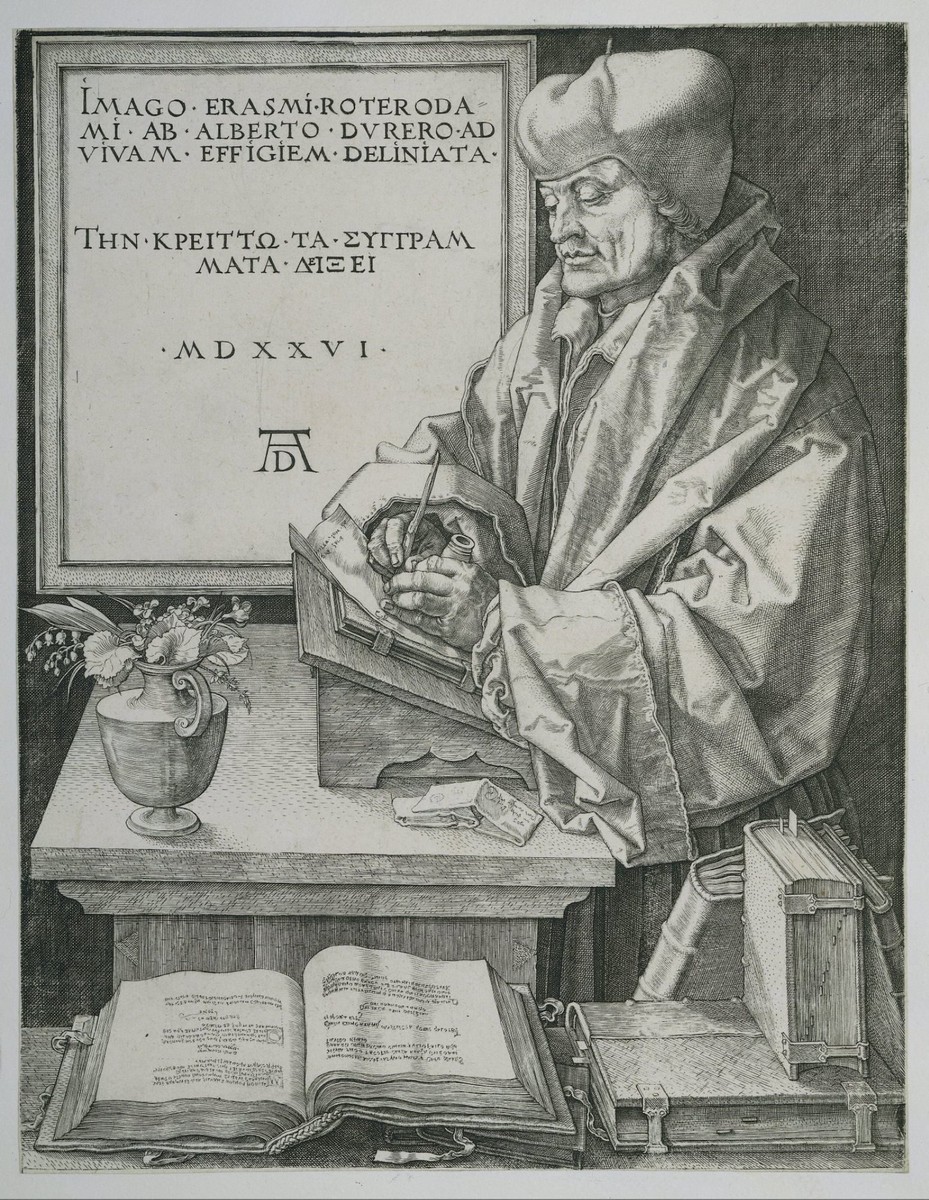

Albrecht Dürer, Portrait of Erasmus of Rotterdam, engraving, 1526. Rijksmuseum, Amsterdam, RP-P-OB-1281 (Public Domain). Downscaled. · Engraving 'Imago Erasmi Roterodami ab Alberto Durero ad vivam effigiem deliniata' by Albrecht Dürer, dated MDXXVI (1526) and monogrammed AD, in the Rijksmuseum, Amsterdam (object number RP-P-OB-1281). The plate's own lettering names the sitter and says the image was drawn from life; the file is the museum's full-image scan (original 2894 x 3736 pixels) downscaled to 929 x 1200 with no upscaling. · Public Domain Mark 1.0 on the museum's image and a CC0 right on the museum's record, as read live; the work is a 1526 engraving by an artist who died in 1528.
학자 · 근세
에라스뮈스
1466–1536
주요 업적 분야
아직 성격 매칭에 포함되지 않았습니다 — 기록된 근거가 성격 모델 전체를 다루기에는 충분하지 않습니다. 이 페이지의 다른 모든 내용은 자유롭게 확인하실 수 있습니다.
핵심 특성
주요 업적
북유럽 르네상스를 대표하는 인문학자로, 1516년 자신의 라틴어 번역과 주석을 곁들인 그리스어 신약성서를 출간했다. 이는 시장에 처음 나온 판이었고, 그는 이후 네 차례 개정했다.
알두스 출판사를 위해 3,000개가 넘는 항목으로 늘린 『격언집』과 풍자서 『우신예찬』(1511)을 비롯한 베스트셀러를 썼으며, 『우신예찬』은 지금까지 계속 출간되고 있다.
히에로니무스, 아우구스티누스, 크리소스토무스, 오리게네스의 저작을 편집했고, 학식 있는 경건과 원어 원전으로의 회귀를 널리 알렸다.
삶의 장면들
1516년 신약성서는 출판업자 프로벤의 재촉으로 약 열 달 만에 만들어졌고, 초판에는 수백 개의 조판 오류가 있었다.
출판업자의 압박 속에 매우 빠르게 작업하며 완성도를 일부 희생한 모습과 부합한다. 실행 속도
그는 몇 년 동안 어느 종교 진영도 공개 지지하기를 거부했고, 1524년에는 마지못해 루터를 겨냥한 정중한 자유의지 논고를 펴냈다.
양쪽에서 의심을 받으면서도 독립적인 지적 입장을 지킨 태도와 부합한다. 독립적 사고
전환점
첫 영국 체류 중 모어와 콜레트를 만난 뒤 그리스어 학습에 나섰고, 이는 그를 성서 학문으로, 이어 그리스어 신약성서 편찬으로 이끌었다.
학문적 목표를 위해 새 언어를 깊이 익히기로 한 결심과 부합한다. 숙련 지향
비슷한 인물
전체적인 프로필이 이 사람과 닮은 사람들이에요.


마이모니데스

앨런 튜링

소르 후아나 이네스 데 라 크루스

볼프강 아마데우스 모차르트

공자
출처
- Desiderius Erasmus (Q43499), verified live via the Wikidata API (2026-11-06): English label 'Erasmus', description 'Dutch Renaissance humanist, Catholic priest, and theologian (1466-1536)', Korean label 데시데리위스 에라스뮈스, born 28 October 1466 (other values 6 November 1466 and 1469 also listed), died 12 July 1536, country of citizenship the Seventeen Provinces. Orientation only; not used as support for any row.
- Stanford Encyclopedia of Philosophy, 'Desiderius Erasmus' (first published 2017, substantive revision 2025; introduction, the life and works section and the methodology section read). CANONICAL SIGNIFICANCE SOURCE: Christian humanism and learned piety; the call 'ad fontes'; a pioneering Greek New Testament that shows text-critical principles; success in literature, education, religion and theology; bestsellers Praise of Folly, Adages, Handbook of the Christian Soldier; the 1516 edition was hastily assembled on his publisher Froben's urging from the manuscripts he could consult, praised by humanists and attacked by theologians; four revised editions (1519, 1522, 1527, 1531) with expanded notes; editions of Jerome, Augustine, Chrysostom and Origen, in many cases the first reliable critical text; for some years he refused to endorse any religious party and published the free-will Diatribe against Luther reluctantly in 1524; moved to Leuven then Basel, and in 1529 to Freiburg; works placed on the Index. Modern scholarly overview, balanced, with the critics' side stated.
- Encyclopaedia Britannica, 'Erasmus' (the freely visible first half read: life up to his Basel work on the 1516 New Testament and the revision that followed; the rest is behind a subscription wall and was not read). Calls him the greatest scholar of the northern Renaissance and the first editor of the New Testament; his independent stance made him a target of suspicion for partisans on both sides; he expanded the Adages into a work of over 3,000 entries for Aldus's press that first made him famous; Praise of Folly written in More's house; the conviction that 'ancient theology' required mastery of Greek; his own mistakes as a textual critic alongside a 'towering' place in the history of scholarship; conservative theologians at Leuven resisted. Reference article, admiring but notes his errors.
- Encyclopaedia Britannica, eleventh edition (1911), 'Erasmus, Desiderius' by Mark Pattison and Percy Stafford Allen (Wikisource transcription, read in part: the Italy and Venice period, the Basel years, the polemics and the assessment). An older, critical historiography: he did the work of two men at Venice writing and correcting proof together; by pensions and gifts he could refuse offers that would have compromised his independence; his sarcasm and quarrels (including with Budé) drew exasperation, a contemporary calling him extremely thin-skinned; argues that his neutrality came from the reasonableness of his nature rather than timidity, while noting that opponents called him a trimmer; judges the Greek Testament to have no critical value as an edition yet profound influence because it was first and exposed Vulgate errors. Contradicts the modern view on the text's scholarly value.
- Museum of the Bible collection record 'Novum Instrumentum Omne, Erasmus's New Testament' (Basel: Froben, 1516; page read in full). Says he was the first to prepare a complete Greek New Testament for publication, presenting his own Latin translation and critical notes; the hurried work was done in just ten months and resulted in hundreds of typesetting errors; from the second edition onward it was titled Novum Testamentum. Museum catalogue entry, with a provenance history of the museum's copy.
- William Andrews Clark Memorial Library (UCLA), Tudor collection title-list entry 'Novum Instrumentum omne' (page read in full). In England he took Lord Mountjoy as pupil, met More and Colet, set about learning Greek and began a new Greek-to-Latin translation of the Gospels and Epistles; Colet lent manuscripts from St Paul's; he used four partial Greek manuscripts in Cambridge and five in Basel; the Complutensian Greek text was printed first (1514) but delayed until 1522 by papal privilege; his Greek text is clearly inferior to the Alcala text, but his reputation, priority in the market and low cost led to wide distribution and long-lasting influence on biblical scholarship. Library description, balanced on quality.
- Rijksmuseum, Amsterdam, linked-art record for object RP-P-OB-1281, 'Portret van Erasmus' (Imago Erasmi Roterodami ab Alberto Durero ad vivam effigiem deliniata), engraving by Albrecht Dürer dated MDXXVI with monogram AD, 249 x 193 mm (record opened live; the museum states the date, title and monogram are engraved on the object and carries a Public Domain Mark and a CC0 right). Used for the portrait only, not as support for any row.