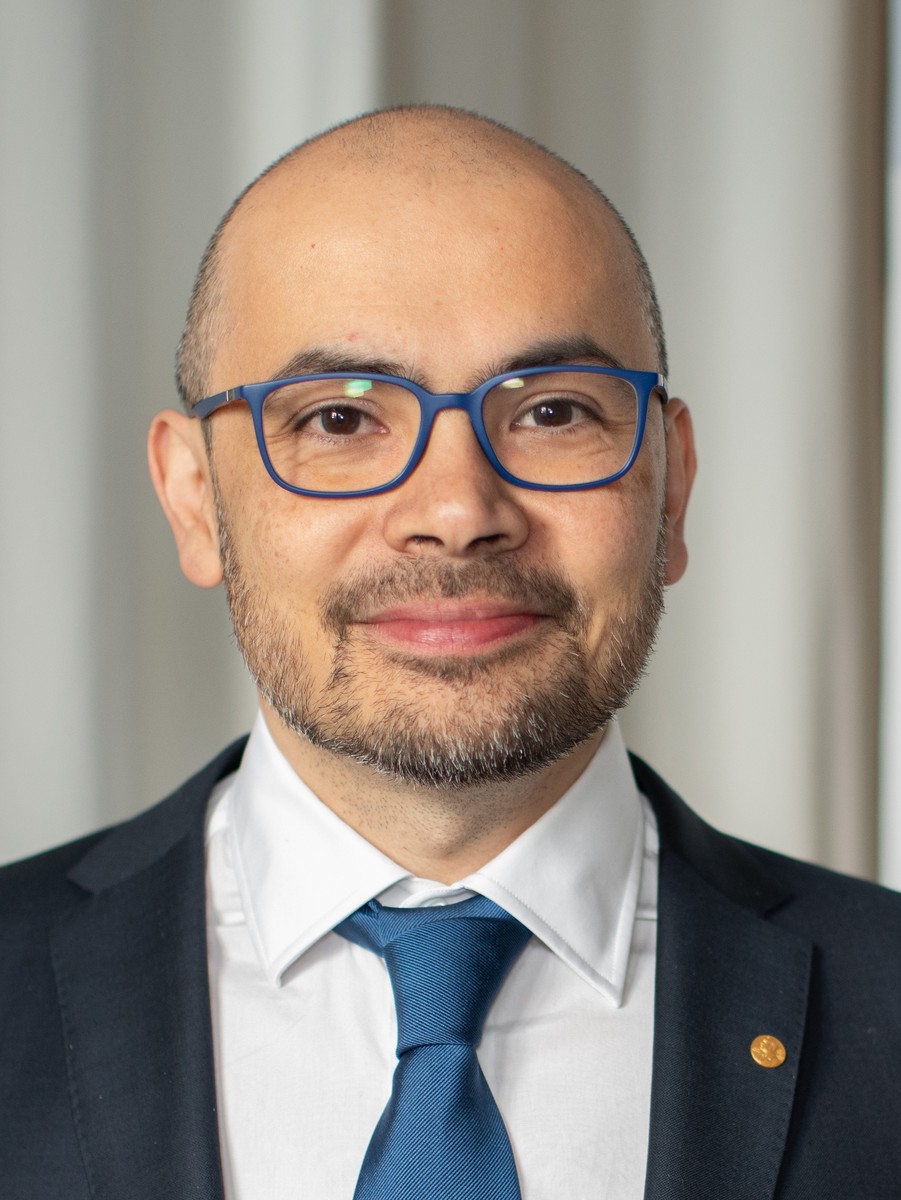
Photo: John Sears (WikiPortraits), 7 December 2024, CC BY-SA 4.0, cropped and downscaled from the original · Wikimedia Commons, 'Demis Hassabis, 2024 Nobel Prize Laureate in Chemistry 7 (cropped).jpg' -- a Commons crop (made 9 August 2025 by another editor) of 'Demis Hassabis, 2024 Nobel Prize Laureate in Chemistry 7.jpg', a photograph by John Sears (uploaded by him as own work on 11 December 2024) taken on 7 December 2024 at the Nobel Prize week in Stockholm as part of the WikiPortraits initiative; the page states that the copyright holder publishes it under CC BY-SA 4.0 and shows no restriction or personality-rights template or permission ticket; Commons crop 2458 x 3275 pixels from the 7952 x 5304 original, downscaled once to 901 x 1200 (never upscaled). · CC BY-SA 4.0
핵심 특성
주요 업적
허사비스는 존 점퍼와 함께 딥마인드의 알파폴드를 이끌었다. 알파폴드는 2018년 CASP13 단백질 구조 예측 대회에서 우승했고, 2020년 알파폴드2는 독립적인 대회 주최 측에 따르면 CASP14 대상 단백질의 약 3분의 2에서 실험에 견줄 정확도로 구조를 결정했다. 딥마인드는 이후 코드를 공개하고 알려진 약 2억 개 단백질 거의 전부의 구조를 예측해 내놓았으며, 2024년 두 사람은 '단백질 구조 예측'으로 노벨 화학상의 절반을 공동 수상했다.
그는 2010년 셰인 레그, 무스타파 술레이만과 함께 딥마인드를 공동 창업했고, 구글이 2014년 이 회사를 인수했다. 딥마인드의 알파고는 2016년 3월 이세돌 9단을 4대 1로 꺾었는데, 예측 전문가들은 이 일이 약 10년 뒤에나 일어나리라 보았다. 2023년 딥마인드와 구글 브레인이 그의 지휘 아래 '구글 딥마인드'로 합쳐졌고 이 연구소는 제미나이 모델을 내놓았다. 그는 최고경영자로 이끌다 2026년 8월 이사회 의장 겸 알파벳 최고과학자가 되었다.
딥마인드 이전에 그는 13세에 체스 마스터가 되었고, 17세에 게임 〈테마 파크〉의 수석 프로그래머를 맡았으며, 1998년부터 2005년까지 게임 회사 엘릭서 스튜디오를 운영했다. 이후 UCL에서 인지신경과학 박사 학위(2009년)를 받았고 뇌에서 배운 것을 더 나은 신경망을 설계하는 데 썼다. 그가 제1저자로 참여해 해마가 손상된 기억상실 환자는 새로운 경험을 상상하지 못한다는 점을 보인 2007년 UCL 연구는 《네이처》 뉴스에 보도되었고, 미국 성취 아카데미에 따르면 《사이언스》가 꼽은 그해의 10대 성과에 올랐다.
삶의 장면들
2013년 구글 임원진이 런던으로 날아왔고, 허사비스는 강화학습으로 스스로 〈브레이크아웃〉을 익힌 프로토타입을 보여 주어 인상을 남겼다. 당시 구글이 쓰지 않던 기법이었다. 이듬해 구글은 딥마인드를 약 5억 달러에 인수했고, 《타임》에 따르면 허사비스는 페이스북의 더 큰 제안을 거절했다.
작동하는 시연으로 인수자를 설득하는 능력과 일치하지만, 이 이야기는 본인의 회상에 기대고 있다. 설득력
2005년 4월 그가 1998년에 세운 게임사 엘릭서 스튜디오는 주력 프로젝트가 위험이 크다는 이유로 취소되자 영업을 중단하고 자산을 매각했다. 《게임 디벨로퍼》는 출시된 두 게임 모두 큰 재정적 성공을 거두지 못했다고 보도했다. 허사비스는 라이선스 사업으로 가는 것은 스튜디오가 결코 타협할 수 없는 일이었다고 말했다.
더 안전한 라이선스 작업보다 독창적이고 위험이 큰 작업을 택하는 성향과 일치하며, 그 대가는 회사의 폐업이었다. 위험 감수
전환점
2016년 알파고의 승리 뒤, 노벨 위원회에 따르면 허사비스에게 바둑은 목표가 아니라 수단이었고 딥마인드는 작은 팀을 꾸려 단백질 구조 예측에 뛰어들어 2018년 CASP13에 참가했다. 알파폴드는 약 60퍼센트의 정확도로 우승했지만 필요한 90퍼센트에는 못 미쳤고 팀은 한계에 부딪혔다. 존 점퍼의 아이디어와 트랜스포머 기반 설계로 만든 알파폴드2에 대해 CASP 주최 측은 2020년 단일 단백질 문제가 대체로 풀렸다고 밝혔다.
게임에 맞춰진 연구소를 더 어려운 과학 문제로 돌리고, 다시 만든 시스템의 주도권을 새 동료와 나누려는 태도와 일치한다. 기회 감지
비슷한 인물
전체적인 프로필이 이 사람과 닮은 사람들이에요.
출처
- Demis Hassabis (Q3022141) -- verified live via the Wikidata API (2026-10-16): English label 'Demis Hassabis', description 'British artificial intelligence researcher (born 1976)', instance of human, born 27 July 1976 in London, no date of death, citizenship United Kingdom, Korean label present. Orientation only; not used as support for any row.
- Demis Hassabis -- English Wikipedia article, opened for orientation and to cross-check dates (Bullfrog, Cambridge, Elixir 1998-2005, UCL PhD 2009, DeepMind 2010, Google 2014, the 2023 merger, the 2024 Nobel Prize, the 2026 change of role) and his honours. Orientation only; not used as support for any trait row, and its statements about his views were not relied on.
- The Royal Swedish Academy of Sciences, press release 'The Nobel Prize in Chemistry 2024', 9 October 2024 (NobelPrize.org) -- half of the prize to David Baker 'for computational protein design' and half jointly to Demis Hassabis and John Jumper of Google DeepMind 'for protein structure prediction'; the Academy says that in 2020 they presented AlphaFold2, which has predicted the structure of virtually all of the 200 million known proteins and has been used by more than two million people in 190 countries. CANONICAL SIGNIFICANCE SOURCE. Read in full. Award-body prose, admiring and retrospective, used for the achievement cards and orientation, never alone for a behavioural row.
- The Royal Swedish Academy of Sciences, 'The Nobel Prize in Chemistry 2024: Popular information' (NobelPrize.org, October 2024) -- the Academy's narrative of the prize: Hassabis's path from chess master at 13 through games development and neuroscience to DeepMind (2010), the sale to Google (2014) and AlphaGo (2016), his decision to enter the CASP13 competition in 2018, AlphaFold's roughly 60 percent accuracy and plateau, John Jumper's promotion and co-leadership with Hassabis of the rebuilt AlphaFold2, the use of transformer networks, and the public release of the code. Read in full. Award-body prose, admiring and retrospective; it is the only source here that tells the AlphaFold project's internal story.
- Billy Perrigo, 'DeepMind's CEO Helped Take AI Mainstream. Now He's Urging Caution', Time, 12 January 2023 -- interview-based profile at DeepMind's London headquarters with named voices (Peter Molyneux of Bullfrog, Google's Alan Eustace, DeepMind's Lila Ibrahim, a critic): his entry to Bullfrog at 15, his 'chess, video games, neuroscience' path in his own words, the 2013 Breakout demonstration that won over Google, the 2014 acquisition and a declined Facebook offer, AlphaGo's 2016 win over Lee Sedol, and the later competition with OpenAI. Independent but built around interviews with him; read in full. Its long passages on AI risk, ethics boards, wealth redistribution and corporate politics are deliberately not scored, and its chronology puts Theme Park after Cambridge, which other sources contradict.
- Tharin Pillay, 'Demis Hassabis', TIME100 AI 2024 (Time, 5 September 2024) -- short profile note: a twenty-year plan culminating in AGI when he co-founded DeepMind, the lab's 'deep reinforcement learning', Go, protein folding and Gemini, and his own words on AI. Short and partly self-quoted; read in full; used only for the plan and Gemini facts.
- Billy Perrigo, 'Demis Hassabis Is Preparing for AI's Endgame', Time, 15 April 2025 (2025 TIME100 profile) -- interview-based profile around the Nobel Prize: his identification as 'a scientist first and foremost', the release of AlphaFold for free, his AGI timeline, and a critical section on military contracts, AI risk and geopolitics. Independent and mixed in tone; read in full. The political, military and AI-safety passages are deliberately not scored.
- Cade Metz, 'In Two Moves, AlphaGo and Lee Sedol Redefined the Future', Wired, 16 March 2016 -- reporter's account from Seoul of the AlphaGo match: Move 37 and Lee Sedol's Move 78, David Silver as lead researcher on AlphaGo, and Hassabis as the head of DeepMind and 'very much the face of AlphaGo' during the match, with his account of the one-in-ten-thousand symmetry and of Lee Sedol's reaction. Independent reporting; read in full.
- Sebastian Mallaby, 'The Man Who Thought He Could Keep AI Safe', The Atlantic, 29 March 2026 (adapted from Mallaby's book The Infinity Machine) -- long-form essay by an author who met Hassabis regularly for almost three years: how he met Shane Legg and Peter Thiel, impressed Elon Musk, the 2014 conditions on the Google sale, the 2015 meeting that led to OpenAI, his 'wartime' remark of early 2023 and Mallaby's description of him as 'the most furiously competitive person I have known'. Independent but heavily based on access to Hassabis; read in full. Its central argument concerns AI safety governance, which is deliberately not scored.
- Dan Milmo and Aisha Down, 'Google DeepMind enters a new era as co-founder Demis Hassabis shifts AI role', The Guardian, 8 August 2026 -- news report that Hassabis is giving up day-to-day duties as chief executive to become chair of Google DeepMind and chief scientist of Alphabet, that Koray Kavukcuoglu takes over its running, and that DeepMind and Google Brain were merged into Google DeepMind under his leadership three years earlier. Independent news report; read in full. Its anonymous sourcing, commentary on Pentagon work, a former employee's legal challenge, unionisation and Gemini's competitiveness are not used.
- Will Douglas Heaven, 'DeepMind says it will release the structure of every protein known to science', MIT Technology Review, 22 July 2021 -- report that DeepMind had published AlphaFold's full details and released its source code, then released predicted structures for the human proteome and 20 other organisms and promised more than 100 million further structures; Hassabis calls protein folding a problem he had 'had my eye on for more than 20 years' and the biggest thing DeepMind had done; David Baker, Tom Ellis and Mohammed AlQuraishi comment, with a caution that most predictions were not yet lab-verified. Independent reporting with outside experts; read in full.
- Helen Briggs, 'One of biology's biggest mysteries 'largely solved' by AI', BBC News, 30 November 2020 -- BBC science report on the CASP14 announcement: AlphaFold determined about two thirds of the target proteins with accuracy comparable to laboratory methods, in the judgement of the independent organisers, with comments from UCL's Andrew Martin and EMBL-EBI's Janet Thornton. Independent journalism about the system rather than about Hassabis personally; read in full.
- CASP14 organisers (Moult, Fidelis, Kryshtafovych, Schwede, Topf), press release 'Artificial intelligence solution to a 50-year-old science challenge could revolutionise medical research', 30 November 2020 -- the competition organisers' announcement that AlphaFold determined the shape of about two thirds of the CASP14 proteins to laboratory-comparable accuracy, calling it 'a win for DeepMind' and also 'a triumph for team science' that builds on many teams' earlier work, with a comment from EMBL-EBI's Dame Janet Thornton (not affiliated with CASP or DeepMind). Independent institutional statement about the result, not about Hassabis; read in full.
- Game Developer (Gamasutra), 'Elixir Studios To Close Doors', 28 April 2005 -- trade-press report that Elixir, founded seven years earlier by Demis Hassabis, was ceasing operations and selling its assets and IP: neither Republic: The Revolution nor Evil Genius was a major financial success, a main project was cancelled for its perceived high risk, and Hassabis said the games industry no longer had room for small independent developers working on original ideas, which the studio could never compromise on by going down the licensing route. Independent contemporaneous trade reporting with his own quoted statement; read in full.
- Kerri Smith, 'I can't imagine...', Nature News, 15 January 2007 (read as archived by BioEd Online) -- news report on the UCL study showing that patients with hippocampal amnesia cannot imagine new experiences, led by Eleanor Maguire; Hassabis appears only as first author in the paper's reference. Independent science reporting; short; read in full; it credits Maguire's team and is used only to confirm that the study was reported.
- American Academy of Achievement, 'Demis Hassabis' biography page (inducted 2017) -- institutional biography: chess from age four and master level at 13; Bullfrog at 17 (Syndicate and Theme Park); Cambridge computer science; Lionhead and Elixir (1998-2005); Mind Sports Olympiad titles; UCL PhD (2009), Harvard and MIT postdoctoral work; the Science top-ten listing of his 2007 imagination research; DeepMind, DQN, the Google sale, AlphaGo, AlphaFold's CASP13 win (December 2018), the July 2021 release of AlphaFold's code and the database with EMBL-EBI, and Isomorphic Labs (November 2021). Read in full. Admiring and compiled from his own account, with typographical errors (a price of '$6500 million'), so used only for dated facts and cross-checks.
- Encyclopaedia Britannica, 'Demis Hassabis' (biography article by Erik Gregersen) -- reference biography: chess master at 13, lead developer of Theme Park at 17, Cambridge computer science (1997), lead AI programmer at Lionhead, Elixir Studios (founded 1998, holdings sold 2005), UCL PhD in cognitive neuroscience (2009) and postdoctoral work at Harvard and MIT, DeepMind, AlphaGo, AlphaFold2 and the 2024 Nobel Prize. Read in full. Reference-style and derivative of other accounts; it dates DeepMind's founding to 2011 while the Nobel Academy and Wikipedia say 2010; its family and ancestry passages were not used.
- Wikimedia Commons file pages 'Demis Hassabis, 2024 Nobel Prize Laureate in Chemistry 7 (cropped).jpg' and its parent 'Demis Hassabis, 2024 Nobel Prize Laureate in Chemistry 7.jpg' -- checked for the portrait's licence: photograph by John Sears (uploader Johnsearsmedia, WikiPortraits at the 2024 Nobel Prizes), taken 7 December 2024 in Stockholm, released by him as copyright holder under CC BY-SA 4.0, no restriction or personality-rights template and no permission ticket on either page; the parent is 7952 x 5304, and the 2458 x 3275 crop was made on Commons by another user on 9 August 2025. Not used for any scoring.