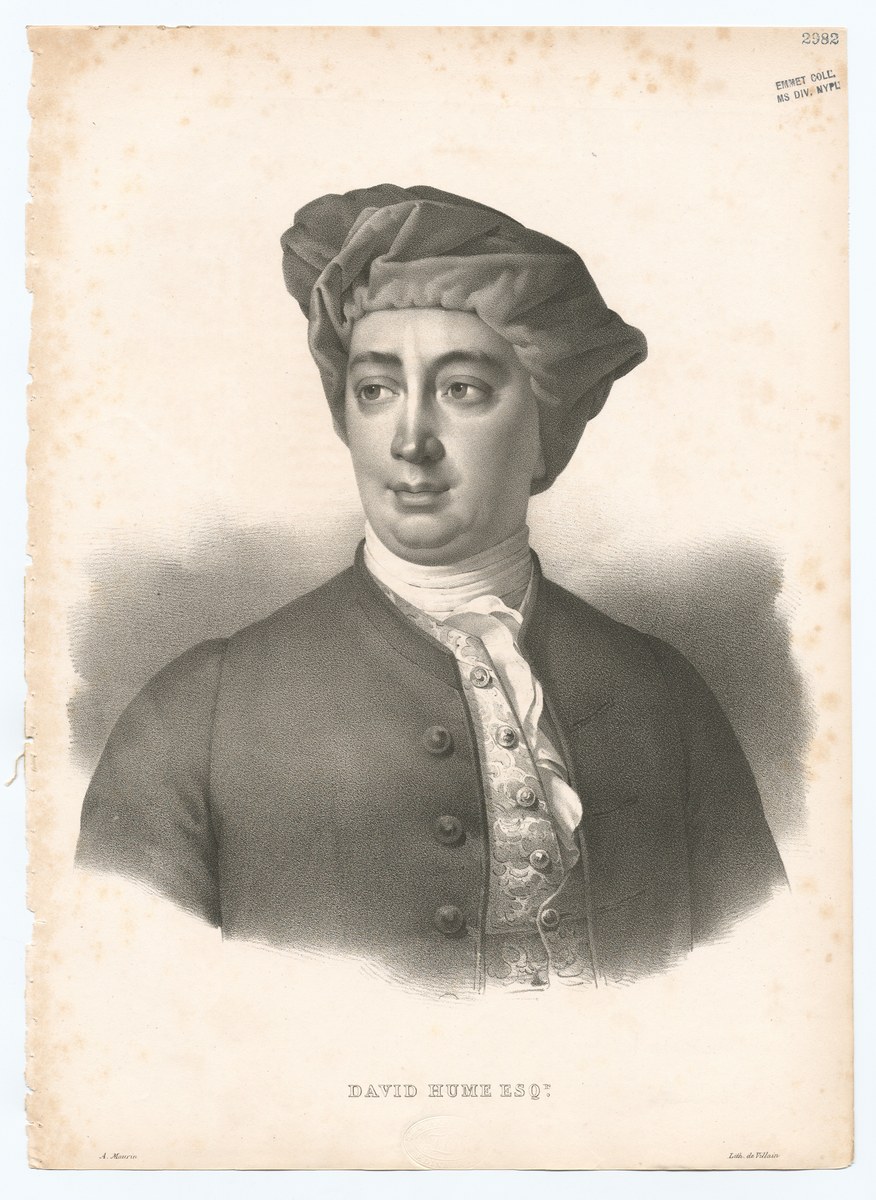
A. Maurin (lithograph), printed by Villain, 'David Hume Esqr.', c. 1820, lithograph, New York Public Library, Emmet Collection of Manuscripts Etc. Relating to American History (EM2982), public domain · Lithographic portrait lettered 'DAVID HUME ESQr.' with 'A. Maurin' at lower left and 'Lith. de Villain' at lower right, an early nineteenth-century French print made well after Hume's death; held by the New York Public Library (Emmet Collection of Manuscripts Etc. Relating to American History, item EM2982). The scan was downscaled once from 3,528 x 4,831 pixels to 876 x 1,200 pixels; nothing was upscaled. Shown as a later print depiction, not as a documented sitting. Caveat: the New York Public Library item page was behind an anti-bot challenge, so the museum-side record could not be opened; the date 1820 is as transcribed on the Wikimedia Commons file page from the library record, and the basis rests on the age of the print (the lithographer Antoine Maurin and the printer both lived and worked in nineteenth-century France, so the print is far older than 1931 whatever its exact year). · Public domain (early nineteenth-century lithograph; New York Public Library scan)
철학자 · 근세
데이비드 흄
1711–1776
주요 업적 분야
아직 성격 매칭에 포함되지 않았습니다 — 기록된 근거가 성격 모델 전체를 다루기에는 충분하지 않습니다. 이 페이지의 다른 모든 내용은 자유롭게 확인하실 수 있습니다.
핵심 특성
주요 업적
《인간 본성에 관한 논고》(1739~40)와 두 편의 《탐구》에서 마음과 도덕에 관찰과 경험이라는 실험적 방법을 적용하려 했으며, 이 업적은 스탠퍼드 철학 백과사전과 스코틀랜드 국립미술관이 스코틀랜드 계몽주의의 중심에 놓는 작업이다.
여섯 권의 《영국사》(1754~62)를 집필했으며, 인터넷 철학 백과사전은 이 책이 그에게 철학자로서의 명성에 못지않은 역사가로서의 명성을 안겨 주었다고 평가한다.
《정치 논집》(1752)에 실린 화폐와 무역에 관한 에세이는 중상주의에 맞선 경험적 논거를 내놓았으며, 이코노립은 이를 고전경제학의 한 토대로 평가한다.
삶의 장면들
1744~45년 에든버러 대학 도덕철학 교수직에 지원했을 때 반대자들이 《논고》의 '위험한 명제' 목록을 돌리자, 그는 항목별로 반박하는 익명의 《한 신사가 친구에게 보낸 편지》를 냈지만 시 목사 15명 중 12명이 반대표를 던졌고 결국 지원을 철회했다.
이 일화는 공개적 대결을 밀어붙이기보다 글로 반박한 뒤 물러서는 태도와 부합한다. 갈등 감내
《논고》가 거의 주목받지 못하자 그는 내용보다 문체가 문제였다고 판단하고, 제1권을 더 짧은 《인간 지성에 관한 탐구》(1748)로, 제3권을 《도덕 원리에 관한 탐구》(1751)로 고쳐 썼다.
이는 첫 시도가 실패했을 때 목표가 아니라 작업의 형식을 바꾸는 태도와 부합한다. 적응력
전환점
대학 교수직에서 거듭 배제된 그는 1752년 에든버러 변호사 도서관의 사서가 되었고, 스탠퍼드 철학 백과사전에 따르면 이 자리가 준 자료 접근 덕분에 역사가로서의 경력을 시작해 1754년 《영국사》 제1권을 냈다.
이는 주어진 자리를 활용해 새로운 작업의 기반을 마련하는 태도와 부합한다. 자원 활용 성향
비슷한 인물
전체적인 프로필이 이 사람과 닮은 사람들이에요.
출처
- David Hume (Q37160), verified live via the Wikidata API (2026-11-05): label 'David Hume', description 'Scottish philosopher, economist, and historian (1711-1776)', born 26 April (Old Style) / 7 May 1711, died 25 August 1776, citizenship Kingdom of Great Britain, Korean label 데이비드 흄. Orientation only; not used as support for any row.
- Stanford Encyclopedia of Philosophy, 'David Hume' (Life and Works section read in full, about 1,500 words). CANONICAL SIGNIFICANCE SOURCE: gives the Treatise of Human Nature (1739-40), the Enquiries, the Essays and Political Discourses, the six-volume History of England (1754-62), his unsuccessful bids for the Edinburgh (1745) and Glasgow (1751) chairs, the Advocates Library post from 1752, his repeated revision of his works to the end of his life and the posthumous Dialogues concerning Natural Religion (1779).
- Internet Encyclopedia of Philosophy, 'David Hume' (Life section and the history section read in full, about 4,000 words). Independent scholarly account with Hume's own letters quoted as evidence: the 1744-45 chair candidacy and the 'Letter from a Gentleman', the rewriting of the Treatise as the Enquiries, the reception and later revision of the History, the withdrawn essays of 1756-57 and the held-back Dialogues; states that in his own day he had at least as much impact as a historian as a philosopher.
- Encyclopaedia Britannica, 'David Hume' by Maurice Cranston (public-web portion read, about 2,300 words; the rest sits behind a paywall and was not opened). Early life, the La Fleche years, the Treatise (with a critical verdict that it is oversubtle, confusing and marred by willful extravagance), the 1744 chair bid, the wandering years as tutor and secretary to earn leisure for study, and the 1748 and 1751 rewritings.
- Library of Economics and Liberty (Econlib), 'David Hume', by David R. Henderson (entry read in full, about 600 words). Hume's essays on money and trade in Political Discourses as an empirical argument against mercantilism and a building block of classical economics; also records an error (his 'creeping inflation' notion) and that Adam Smith ignored his price-specie-flow argument. Independent economist's assessment with a critical note.
- Adam Smith, 'Letter from Adam Smith, LL.D. to William Strahan, Esq.' (Kirkaldy, 9 November 1776), account of Hume's last illness, as reproduced on Econlib (about 4,500 words read of the letter). Near-contemporary eyewitness account by a close friend, admiring in tone; used only for documented work habits and conversation in his last months.
- The Scotsman, 'Edinburgh University renames David Hume tower over racist comments', by Elsa Maishman, 13 September 2020 (article read in full, about 600 words). COUNTER-VOICE: reports the university statement and the student petition on Hume's remarks on race, and the historian Felix Waldmann's evidence that Hume was involved in a slave-trade transaction; used as critical context for the profile, not scored as a trait.
- National Galleries of Scotland, 'David Hume, 1711 - 1776. Historian and philosopher', by Allan Ramsay, 1766 (PG 1057), collection record read in full. Holder's statement that Hume was the most influential figure of the Scottish Enlightenment, a sceptic who set himself to scrutinise religious belief, morals and the mind by experience and observation; also records the 1753 footnote on race and the public debate about it. Used for significance and as the holder record for the discarded painting route.