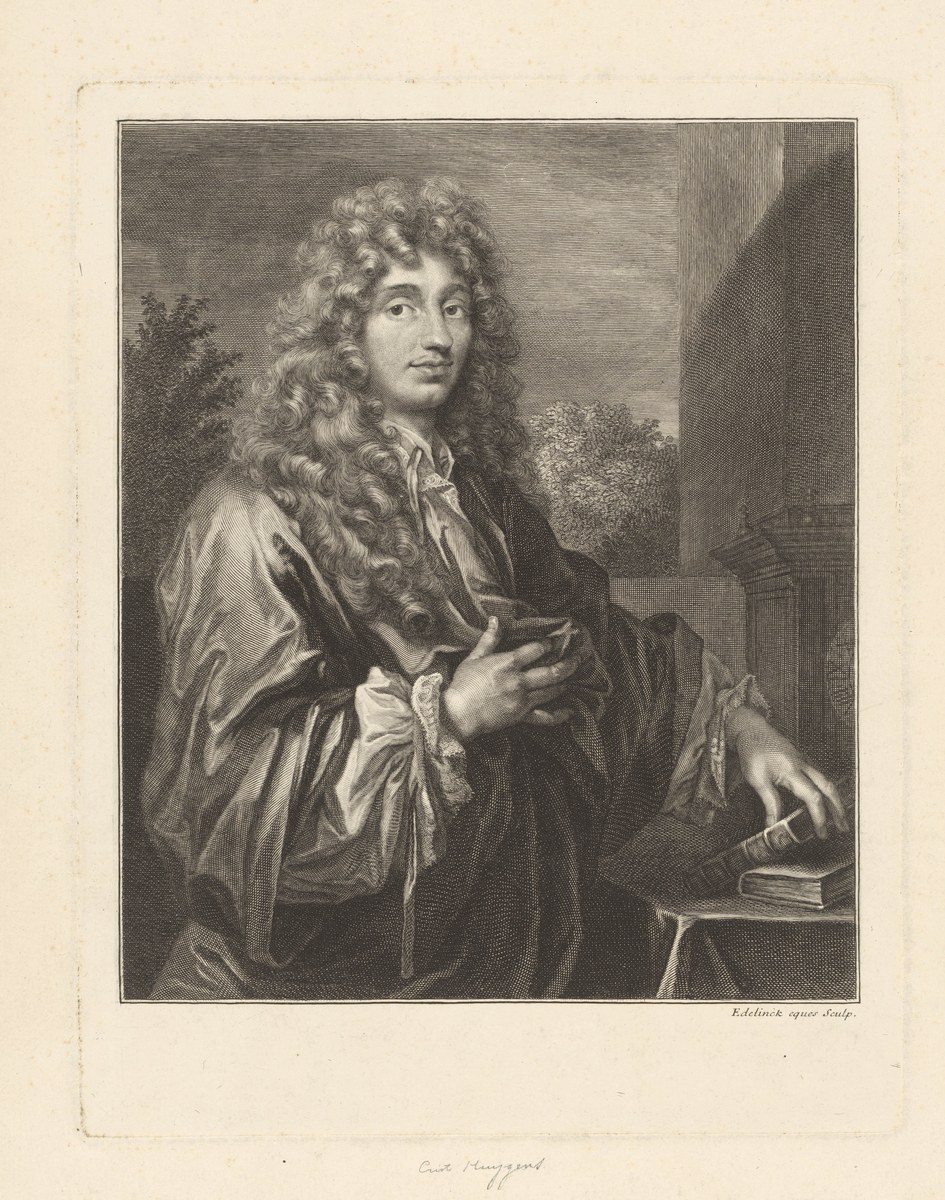

Gerard Edelinck, after a drawing by Jacques-Antoine Friquet de Vauroze, Portrait of Christiaan Huygens, engraving, 1687-1688, Rijksmuseum, Amsterdam, RP-P-BI-7524, Public Domain · Engraving of Christiaan Huygens by Gerard Edelinck after a drawing by Jacques-Antoine Friquet de Vauroze, made about 1687-1688, Rijksmuseum, Amsterdam, object RP-P-BI-7524 (the portrait that was later printed facing the title page of Huygens's Treatise on Light, 1690, according to the museum). The museum record carries a Public Domain mark. This is a printed portrait made during his lifetime from another artist's drawing; there is no documented sitting, so it is classed as a later depiction rather than a likeness. The file is the museum's 5090 x 6464 pixel image downscaled to 945 x 1200 with no upscaling. · Public domain (engraver Gerard Edelinck d. 1707; Rijksmuseum Public Domain Mark)
핵심 특성
주요 업적
그는 《빛에 관한 논고》(1678년 집필, 1690년 출간)에서 빛의 파동설을 내놓았고, 이 책의 2차 파면 원리는 그의 이름으로 불린다. 또 형제와 함께 만든 망원경으로 토성의 위성 타이탄과 토성 고리의 참모습을 발견했다.
그는 1656년 진자시계를 만들어 시간 측정의 정확도를 크게 높였고, 《진자시계》(1673)에서 진자의 수학을 정리했다. 수십 년 동안 바다에서 시험한 해상 시계는 경도 문제를 풀지 못했다.
그는 탄성 물체의 충돌 법칙을 밝혀 데카르트의 규칙이 틀렸음을 보였고, 1657년 확률에 관한 논문을 썼으며, 1666년부터 새로 생긴 파리 왕립과학아카데미의 주요 회원으로 활동했다.
삶의 장면들
그는 바다에서 경도를 재기 위한 시계 연구를 수십 년간 이어갔다. 1660년대에 시계를 바다에서 시험했고, 시계공과 네덜란드 동인도회사의 자금으로 만든 새 시계를 1685, 1686, 1690년에 시험했지만 배의 움직임에 너무 민감해 만족스럽지 못하다는 평가를 받았다.
이는 거듭된 실망스러운 시험에도 하나의 실용적 문제에 꾸준히 매달린 모습과 일치한다. 끈기
1651년 첫 출판물에서 그는 그레고리오 데 생뱅상이 주장한 원의 구적법을 반박했고, 《빛에 관한 논고》 서문에서는 이 책의 증명이 기하학만큼 확실하지는 않지만 예측한 현상이 실험으로 확인되면 높은 개연성에 이른다고 썼다.
이는 엄밀한 증명과 개연적 추론을 신중하게 구분한 모습과 일치한다. 분석적 엄밀성
전환점
몇 해 동안 주로 수학 연구에 몰두하던 그는 1655년 형제와 함께 렌즈를 갈기 시작했고, 1년쯤 뒤 토성의 위성을 발견하고 고리를 알아보았다. 이는 정밀한 시간 측정으로 이어져 1656년 진자시계를 낳았다.
이는 관측상의 문제를 풀기 위해 기구 제작으로 나아간 수학자의 모습과 일치한다. 실험 성향
비슷한 인물
전체적인 프로필이 이 사람과 닮은 사람들이에요.
출처
- Christiaan Huygens (Q39599), verified live via the Wikidata API (2026-11-01): label 'Christiaan Huygens', description 'Dutch mathematician, physicist and astronomer (1629-1695)', born 14 April 1629, died 8 July 1695 (a second value 8 June is also listed), citizenship Dutch Republic, Korean label 크리스티안 하위헌스, images include the Caspar Netscher painting. Orientation only; not used as support for any row.
- Christiaan Huygens (English Wikipedia), fetched for orientation on dates, family and the list of works. Not used as support for any scored row or card.
- MacTutor History of Mathematics, University of St Andrews, 'Christiaan Huygens' biography, read in full. CANONICAL SIGNIFICANCE SOURCE: Dutch mathematician who patented a pendulum clock (1656) and laid foundations of mechanics, with work in astronomy and probability; lens grinding and the detection of a moon of Saturn (1655) and the true shape of the rings (Systema Saturnium, 1659); De Ratiociniis in Ludo Aleae (probability); Horologium Oscillatorium (1673) with the tautochronism of the cycloid and the first study of the dynamics of bodies rather than particles; refutation of Descartes's laws of impact; founding-era leadership at the Academie Royale des Sciences from 1666; Traite de la lumiere (1678) arguing for a wave theory of light; sea trials of marine clocks in 1662 and 1686; wrongly criticised Newton's theory of colour in 1672 and did not accept universal gravitation; correspondence with Leibniz, who 'learnt much of his mathematics' from him. Scholarly institutional biography; the closing praise ('the greatest mechanist of the seventeenth century') quotes the Dictionary of Scientific Biography and is retrospective.
- Encyclopaedia Britannica, 'Christiaan Huygens' (John Herivel), read in full: founded the wave theory of light, discovered the true shape of Saturn's rings and contributed to dynamics; discovered a satellite of Saturn in March 1655 with a telescope built on his new lens-grinding method; Horologium Oscillatorium (1673) with a theory of curvature and the solution of pendulum and centrifugal-force problems; collision results obtained in 1656 but unpublished until 1669 and proofs only after his death; founding member of the French Academy of Sciences in 1666, with a pension larger than that of any other member; Traite de la lumiere (largely complete by 1678) published in 1690 together with a mechanical theory of gravity that 'was never taken seriously'; 'great talent rather than genius of the first order' as a mathematician; his dynamics and optics were overshadowed by Newton for almost the whole of the eighteenth century and recovered in the nineteenth. Independent encyclopaedic voice and a critical counter-voice.
- H. J. M. Bos, 'Huygens, Christiaan', Complete Dictionary of Scientific Biography (via Encyclopedia.com), read in the biographical and the mathematics and horology sections: the Huygens family tradition and Christiaan's home education (a lathe at thirteen); an allowance from his father let him devote himself to the study of nature and he declined the diplomatic career natural to his family; 1651 refutation of Gregory of St Vincent's circle quadrature; 1657 probability treatise; lens grinding with his brother from 1655 and the discovery of the satellite and the ring of Saturn; pendulum clock 1656, tautochronism of the cycloid, evolutes and centre of oscillation; longitude work from 1660 with sea tests after 1663 and a manual for seamen; a spring-regulated clock about which 'a controversy with Hooke ensued' and 'priority disputes with Hooke and others'; his mathematics 'may be called conservative'; he rejected Cavalieri's indivisibles and stayed sceptical of Leibniz's new methods; admired the Principia but strongly disagreed with it; dedicated the Horologium Oscillatorium to Louis XIV, which 'occasioned some disapproval in Holland'. The same Encyclopedia.com page also carries a second short Gale entry that was read for the 1669 collision-law report to the Royal Society. Scholarly specialist source.
- EBSCO Research Starters, 'Christiaan Huygens', read in full: improved telescopes ground with his brother, Titan and a ring that 'nowhere touched the planet', a coded message to protect priority of the ring discovery, the 1657 probability treatise, the pendulum clock as his 'greatest original invention', marine clocks given extensive sea trials that 'proved an ultimate failure in determining longitude', a Cartesian upbringing from which he broke with the master, his rejection of action at a distance in favour of mechanical explanations, his wave theory of light not accepted as the fundamental explanation in his own or the next century, and a significance paragraph noting that his brilliance was less apparent for being so close to Newton and Descartes. Independent educational reference with a critical element.
- World History Encyclopedia, 'Christiaan Huygens' (Mark Cartwright, 2023), read in full: instruments made with his brother Constantijn, the 1658 paper on the rings at the Montmor Academy, the pendulum clock of 1657 built with the clockmaker Salomon Coster and a preface to the Horologium that credited Galileo with the original idea, the 1665 mariners' manual, sea trials in the 1660s and, with Johannes van Ceulen and funding from the Dutch East India Company, trials in 1685, 1686 and 1690 that were deemed unsatisfactory because the clock was too sensitive to the sea's movement. Popular reference; used for the collaboration and the sea-trial sequence.
- Christiaan Huygens, Treatise on Light (Project Gutenberg, S. P. Thompson translation), preface read in full: he says he wrote it in France and communicated it to the Royal Academy of Science in 1678, published it twelve years later, and delayed publication partly through being 'often turned aside either by business or by some new study'; that the demonstrations 'do not produce as great a certitude as those of Geometry' but reach high probability when predicted phenomena are confirmed by experiment; and that he hopes others will go further. Self-report by the author (a primary source); used only to corroborate how he described his own method, never as sole support for a row.
- Rijksmuseum, Amsterdam, collection record RP-P-BI-7524, 'Portret van Christiaan Huygens', engraving by Gerard Edelinck after a drawing by Jacques-Antoine Friquet de Vauroze (1687-1688), read via the museum's open linked-data record (Public Domain mark). Portrait record only; the museum note that Huygens's letters show Friquet initiated the print and that it first appeared facing the title page of the Traite de la lumiere in 1690 is not used for any row.