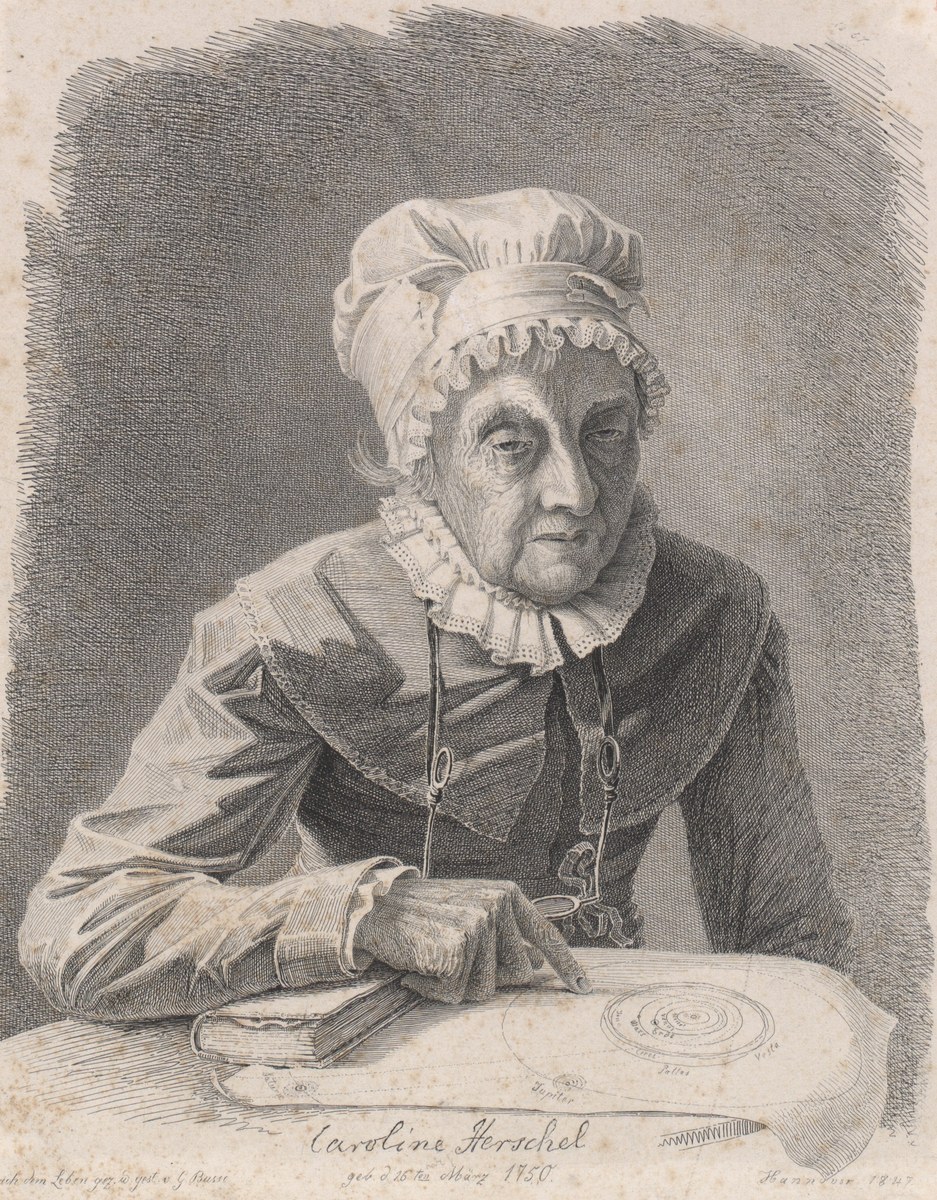

G. Busse (Georg Heinrich Busse), portrait of Caroline Herschel, Hannover, 1847. ETH-Bibliothek Zurich, Bildarchiv, Portr_11026-092-SF (Public Domain Mark) · Portrait print 'Caroline Herschel, geb. d. 16ten Marz 1750', drawn from life and engraved by G. Busse (Georg Heinrich Busse, 1810-1868), Hannover, 1847, when she was 97; ETH-Bibliothek Zurich image archive, record Portr_11026-092-SF. The print's own inscription reads 'Nach dem Leben gez. und gest. v. G. Busse, Hannover 1847' (drawn and engraved from life). The file is the museum-supplied scan of the whole sheet downscaled from 2179 x 2790 pixels to 937 x 1200; no upscaling and no retouching. · Public domain (marked with the Public Domain Mark by the ETH-Bibliothek; 1847 print by an artist who died in 1868)
천문학자 · 근세
캐롤라인 허셜
1750–1848
주요 업적 분야
아직 성격 매칭에 포함되지 않았습니다 — 기록된 근거가 성격 모델 전체를 다루기에는 충분하지 않습니다. 이 페이지의 다른 모든 내용은 자유롭게 확인하실 수 있습니다.
핵심 특성
주요 업적
독일 태생의 천문학자로, 1786년부터 1797년까지 혜성 여덟 개를 발견했다. 영국 왕립 그리니치 박물관은 그를 혜성을 발견한 최초의 여성으로 기록하며, 그는 오빠 윌리엄과 함께 2,400개가 넘는 천체를 찾아낸 탐사에 참여했다.
1798년 왕립학회가 펴낸 그의 《플램스티드 관측 항성 색인》은 플램스티드의 항성 목록을 바로잡고 빠진 별들을 보탰으며, 마이클 호스킨은 이를 관측자들이 온전히 신뢰할 수 있는 저작으로 만들었다고 평가한다.
1822년 윌리엄이 세상을 떠난 뒤 약 2,500개 성운의 개정 목록을 편찬했고, 1828년 왕립천문학회는 그에게 여성 최초로 금메달을 수여했으며 1835년에는 명예회원으로 추대했다.
삶의 장면들
플램스티드의 항성 목록을 관측 기록과 대조해 바로잡는 데에는 그리니치 박물관이 '고된 20개월'이라 부르는 시간이 들었고, 1798년의 색인에는 빠진 별과 정오표가 더해졌다.
이는 더디고 꼼꼼한 기록 대조를 끝까지 이어간 사람의 모습과 부합한다. 디테일 지향
1797년 마지막 혜성을 발견했을 때 그는 천문대장 네빌 매스켈린에게 직접 알리려고 거의 30마일을 말을 타고 달려갔다.
이는 자신의 발견을 오빠에게 맡겨 두지 않고 최고 권위자에게 직접 알린 관측자의 모습과 부합한다. 선제적 행동력
전환점
그는 바스에서 윌리엄의 연주회를 위한 가수로 훈련받았으나 오빠의 관심이 천문학으로 옮겨 가면서 그 길로 들어섰고, 1782년경 음악을 접었으며 1787년에는 조지 3세가 조수로서의 그에게 연 50파운드의 봉급을 내렸다.
이는 상황이 바뀌자 새로운 일을 위해 다시 배운 사람의 모습과 부합한다. 적응력
비슷한 인물
전체적인 프로필이 이 사람과 닮은 사람들이에요.
출처
- Caroline Herschel (Q76948), verified live via the Wikidata API (2026-11-02): label 'Caroline Herschel', description 'German-British astronomer (1750-1848)', born 16 March 1750, died 9 January 1848, Korean label 캐롤라인 허셜. Orientation only; not used as support for any row.
- Royal Museums Greenwich, 'Caroline Herschel' topic page, read in full. CANONICAL SIGNIFICANCE SOURCE: a museum overview that presents her as an astronomer who 'battled against prejudice' to become 'an accomplished and respected member of the astronomical community', the first woman to discover a comet (1786, eight in all), who checked and corrected Flamsteed's star catalogue (published 1798 with an index and extra stars; it took 'a gruelling 20 months'), swept the sky with a telescope William made her and found three nebulae by 1783, later catalogued more than 2,500 nebulae, was granted a salary of GBP 50 by George III in 1787, received the Royal Astronomical Society gold medal (1828) and honorary membership (1835) and a Prussian gold medal, and who with William found more than 2,400 objects over twenty years. Museum popular overview; celebratory in tone.
- MacTutor History of Mathematics (University of St Andrews), 'Caroline Lucretia Herschel' biography, read in full: her father's encouragement and her mother's opposition to educating daughters, her years as a servant-like household worker, joining William in Bath in 1772, training as a singer, learning English and applied mathematics, becoming his research assistant who reduced and calculated his observations 'with notable accuracy', eight comets between 1786 and 1797 found by methodical sweeping, the 1798 Index to Flamsteed's Observations (with 560 omitted stars), the 2,500-nebulae catalogue after William's death, her gold medal (1828) and honorary memberships, her modesty, and the limits the biography itself notes (applied rather than pure mathematics, her own research pausing between 1798 and 1822, a subordinate position to William). Independent university biography; draws on her journals and the Herschel family memoir.
- Dictionary of National Biography (1891), entry 'Herschel, Caroline Lucretia' (Wikisource transcription), read: eight comets between 1786 and 1797, five of undisputed priority; three nebulae found in 1783 including the companion of the Andromeda nebula; nightly work reading clocks, recording and calculating for William; arranging the British Catalogue stars in one-degree zones for his sweeps; the Index to Flamsteed (1798, Royal Society); a later zone catalogue of nebulae and clusters, unpublished, called her most valuable undertaking because it served John Herschel; the 1828 medal she was 'more shocked than gratified' by; and her insistence that she 'did nothing' for her brother. Late-Victorian reference compiled largely from her own journals and the family memoir, so close to her own account and period in its framing.
- Royal Astronomical Society, 'History of women at the RAS' (women.ras.ac.uk), read: Caroline Herschel was the first woman presented with the Society's gold medal (1828, 'the society's greatest honour'); at the presentation James South credited her as an original observer and not only her brother's assistant and praised 'the unconquerable industry of the sister'; the Council's 1835 recommendation to add 'Miss Caroline Herschel and Mrs Somerville' to the honorary members was carried unanimously. Learned-society institutional page; a contemporary-judgement perspective independent of the Herschel family.
- Science Museum Group Collection, people record 'Caroline Lucretia Herschel 1750-1848', read: discoverer or co-discoverer of eight comets; in 1783 found the companion of the Andromeda nebula; with William helped raise the known nebulae from little over a hundred to more than two thousand; from 1796 corrected errors in Flamsteed's British Catalogue over close to two years; a royal pension in 1787; an invitation to Greenwich from the Astronomer Royal in 1799; after 1822 revised the whole nebulae catalogue in Hanover; recognised by the Astronomical Society and by a Prussian science medal at 96. Museum biographical record.
- Physics Today (AIP), review of Michael Hoskin's 'The Herschel Partnership as Viewed by Caroline' and Caroline Herschel's autobiographies, read in full: the partnership called 'the most productive partnership astronomy has ever known'; William usually observed and she recorded; she was given a sweeping telescope and began recording sweeps in August 1782; her Flamsteed index with errata made the catalogue one 'in which observers could have full confidence' (Hoskin); she had to feed William during mirror-polishing; she is 'very self-effacing' yet admitted that publication 'flattered my vanity not a little'; her nephew John Herschel wrote that she had 'nothing of mathematical genius' but 'extraordinary powers of application'. Independent scholarly book review; the reviewed book is the main modern scholarly account, which was not opened.