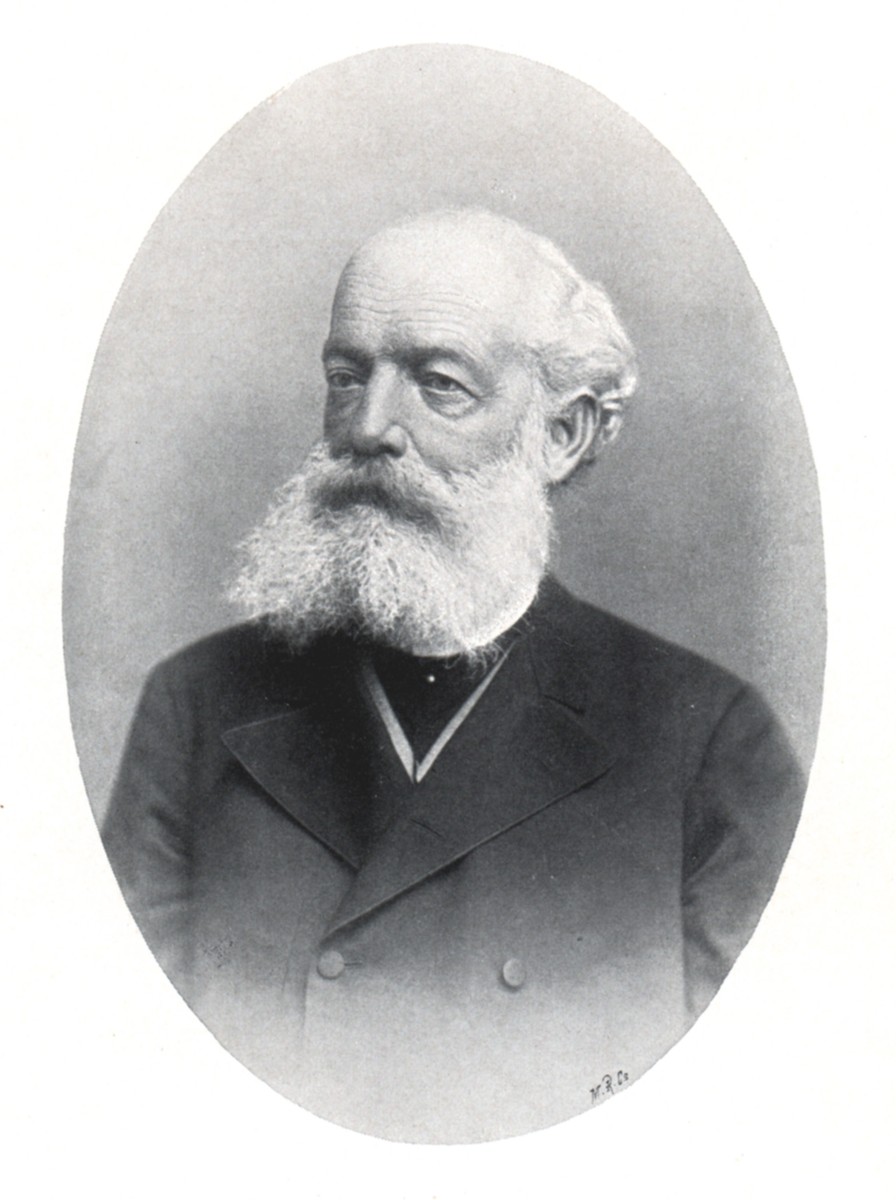

Unidentified photographer, Portrait of August Kekule, before 1896, Dibner Library Scientific Identity portraits, Smithsonian Institution Libraries (SIL14-k001-07) · Portrait photograph of August Kekule by an unidentified photographer, a print 11.9 x 8.2 cm dated by the holder 'prior to 1896', in Scientific Identity: Portraits from the Dibner Library of the History of Science and Technology, Smithsonian Institution Libraries (SIL14-k001-07), published on the Smithsonian Flickr Commons stream with the statement 'No known copyright restrictions'. The page carries the printed caption 'August von Kekule' and his signature, which identifies the sitter, and the picture is a printed plate, so it is a reproduction of a photograph from before his death. The basis is age: it was made no later than 1896 by a photographer who is not known, so any copyright term (a few decades after publication for an anonymous work in Germany, at most 120 years from creation in the United States) ended before 1996, and no restoration applies. The file is the Wikimedia Commons copy of the Smithsonian upload (original 2032 x 3074 pixels), cropped to the oval portrait and downscaled only, to 896 x 1200; no upscaling. · Public domain by age (made before 1896, photographer unknown); Smithsonian Libraries: no known copyright restrictions
화학자 · 19세기
아우구스트 케쿨레
1829–1896
주요 업적 분야
아직 성격 매칭에 포함되지 않았습니다 — 기록된 근거가 성격 모델 전체를 다루기에는 충분하지 않습니다. 이 페이지의 다른 모든 내용은 자유롭게 확인하실 수 있습니다.
핵심 특성
주요 업적
1857~58년 탄소가 4가이며 탄소 원자가 사슬로 연결된다고 제안해 유기화학 구조 이론의 토대를 놓았고, 이를 4권짜리 교과서에 상술했다. 아치볼드 쿠퍼도 비슷한 시기에 비슷한 생각에 이르렀다.
1865년 벤젠의 탄소 여섯 개가 고리를 이룬다고 제안했다. 논란이 컸지만 더 나은 이론으로 대체되지 않았고, 브리태니커에 따르면 독일 화학 산업 성장의 과학적 토대가 되었다.
겐트와 1867년부터는 본에서 연구 그룹을 이끌고 가르쳤으며, 본에서는 대형 신축 실험실을 맡았다. 그의 첫 박사과정 학생 아돌프 폰 바이어는 훗날 노벨상을 받았다.
삶의 장면들
리비히가 세상을 떠난 뒤 뮌헨 후임으로 초청받았으나 사양하고 첫 박사과정 학생인 아돌프 폰 바이어를 추천했다.
연구 학파의 수장으로서 제자를 요직에 추천한 모습과 일치한다. 주도 성향
1858년 겐트로 초빙되어 프랑스어로 화학을 가르쳤으며, 그는 프랑스어를 완전히 익힌 것으로 전해진다.
나라와 강의 언어를 옮겨 다닐 수 있었던 사람의 모습과 일치한다. 적응력
전환점
1865년 겐트에서 교과서를 집필하던 중 벤젠의 고리 구조를 제안해 사슬 이론을 방향족 화합물로 확장했다.
구조 체계로 아직 설명하지 못한 문제까지 확장해 간 이론가의 모습과 일치한다. 시스템적 사고
비슷한 인물
전체적인 프로필이 이 사람과 닮은 사람들이에요.
출처
- August Kekulé (Q76784), verified live via the Wikidata API (2026-11-02): label 'August Kekulé', description 'German organic chemist (1829-1896)', born 7 September 1829, died 13 July 1896, citizenship Germany, Korean label present. Orientation only; not used as support for any row.
- 'August Kekule von Stradonitz', Encyclopaedia Britannica, read in full. CANONICAL SIGNIFICANCE SOURCE: says he 'established the foundation for the structural theory in organic chemistry'; his most important single contribution was the structural theory of organic composition (articles of 1857 and 1858, the Lehrbuch der organischen Chemie from 1859) in which tetravalent carbon atoms link into chains, that Couper published a substantially similar theory nearly simultaneously and Butlerov expanded it but that 'it was predominantly Kekule's ideas that prevailed'; that his 1865 cyclic benzene proposal was 'much contested but was never replaced by a superior theory' and gave the scientific basis for the expansion of the German chemical industry; his posts at Heidelberg (1856), Ghent (1858, teaching in French) and Bonn (full professor from 1867); that he led research groups at Ghent and Bonn and declined Liebig's Munich chair in favour of his first doctoral student Adolf von Baeyer; and that the dream stories he told in 1890 have been contested. Admiring in tone; the dream caveat is the only critical note.
- 'August Kekule and Archibald Scott Couper', Scientific Biographies, Science History Institute, read in full: says Kekule and Couper independently recognised in 1858 that carbon atoms link directly to form chains, that his 1857 theory of tetravalent carbon underlay the finding, that he trained at Giessen under Liebig after intending to become an architect, worked as assistant in France, Switzerland and England, taught at Heidelberg, Ghent and Bonn where he 'oversaw the establishment of a chemical institute', was 'a good lecturer, well liked by his many students', wrote his textbook, and told much later of the omnibus and Ghent fireside daydreams ('As he told the story much later'); records that Couper's paper was presented to the French Academy a few weeks after Kekule's was published. Institutional biography; modest in tone and careful to mark the dreams as later reminiscence.
- 'Kekule, Friedrich August', Encyclopedia of World Biography, via Encyclopedia.com, read in full: says he was 'not a master experimentalist' but 'an inspired pedagogue' whose mind was keyed to theory and to the architecture of organic molecules, that he grasped tetravalency and the linking of carbon into long chains, that his Paris, London, Heidelberg, Ghent and Bonn years followed an initial architecture course at Giessen, and that his students came from all over Europe and went on to lead professorships and industrial laboratories; quotes his own 1890-style account of the snake image; cites Anschuetz's 1929 biography as the definitive study. Reference biography; admiring, partly a retelling of his own account.
- William B. Ashworth Jr., 'August Kekule', Scientist of the Day, Linda Hall Library, read in full: explains the benzene problem and the ring proposal of 1862 (published 1865), says his fame in the history of science rests on the 1890 account of the daydream of a snake biting its tail, that 'most historians see no reason to doubt it' because it came from his own mouth before his peers, but that 'others, however, are skeptical' and wonder whether he was buttressing a claim to priority for the ring. Institutional science-library essay; the neutral voice on the dream controversy.
- Guenter Paulus Schiemenz, 'Das Hexagon, das Tetraeder und Legenden um August Kekule', Mitteilungen der Fachgruppe Geschichte der Chemie, Gesellschaft Deutscher Chemiker (1989), read in part (the sections on the 1890 Benzolfest and the snake and Ouroboros legends; the tetrahedron section was not read): a critical history-of-chemistry article, in German, arguing that later writers built the Ouroboros, Slavic-imagination and murder-trial-ring explanations for the snake image on repetition without support in Kekule's own words, quoting Wotiz's doubt that the printed 1890 speech text is fully authentic, and noting that Kekule's biographer Anschuetz, not Kekule, linked the 1850 trial ring to the later vision, 'with all caution', as a pure possibility. Used as the critical voice that the dream story is not a firm basis for scoring.
- 'Portrait of August Kekule (1829-1896), Chemist', Scientific Identity: Portraits from the Dibner Library of the History of Science and Technology, Smithsonian Institution Libraries (SIL14-k001-07), Smithsonian Flickr Commons record read for the portrait review only: unidentified photographer, 11.9 x 8.2 cm, dated 'prior to 1896', rights statement 'No known copyright restrictions'. Not used for any row.