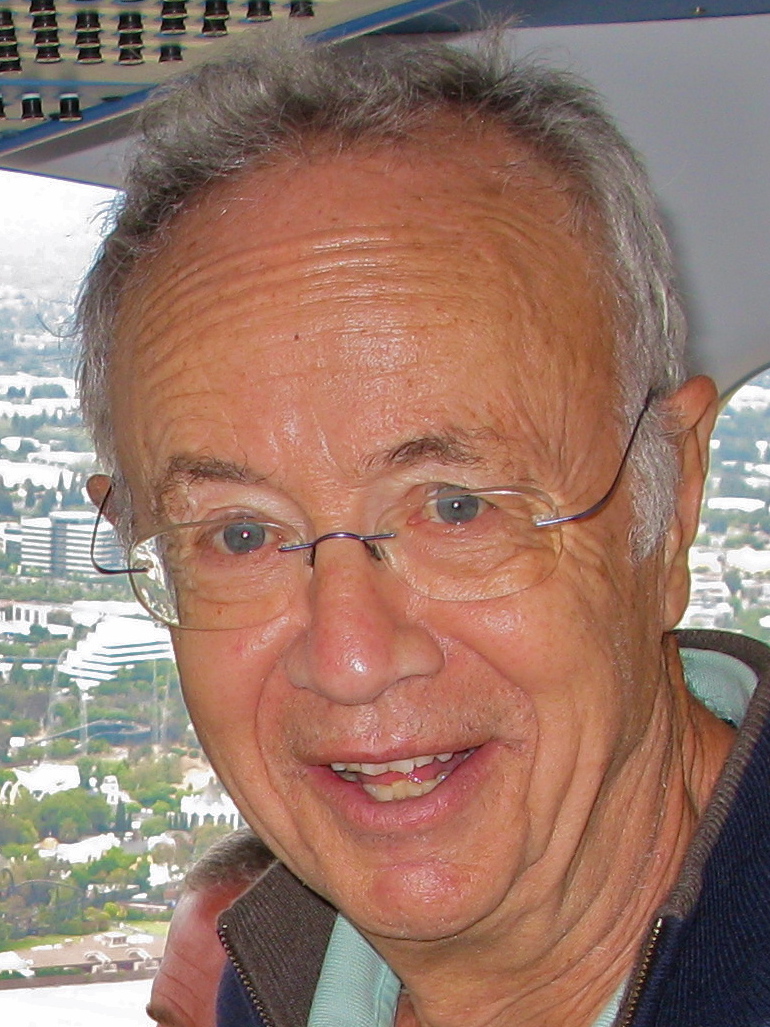

Photo: Steve Jurvetson, 7 June 2009, CC BY 2.0, cropped from the original on Wikimedia Commons · Wikimedia Commons, 'Intel Inside (3607903903) (cropped).jpg' -- a crop (made on Commons) of the photograph 'Intel Inside' by Steve Jurvetson, taken 7 June 2009 aboard an airship approaching Intel's headquarters (caption: 'Approaching Intel HQ by zeppelin with Andy Grove'), uploaded by him to Flickr on 8 June 2009 under CC BY 2.0; the Flickr page shows no other copyright notice; Commons crop 770 x 1027 pixels, extracted at native resolution from the 3518 x 2823 original and saved unchanged (never upscaled). · CC BY 2.0
핵심 특성
주요 업적
그로브는 1979년부터 인텔 사장, 1987년부터 1998년까지 최고경영자(CEO), 1997년부터 2005년까지 이사회 의장을 지냈다. 사장 시절에는 1980년대 중반 인텔이 D램 메모리 사업에서 철수하고 마이크로프로세서에 집중한 결정의 중심에 있었고, CEO로서는 인텔을 PC용 마이크로프로세서의 지배적 업체로 이끌었다. 《타임》은 1997년 마이크로칩의 성능과 혁신 가능성이 놀랍도록 커지는 데 가장 큰 책임이 있는 사람으로 그를 꼽아 '올해의 인물'로 선정했다.
1985년 그로브는 새로 내놓은 386 마이크로프로세서를 다른 칩 업체에 라이선스하지 않기로 해 인텔을 이 칩의 유일한 공급처로 만들었고, 컴퓨터역사박물관은 이를 위험하고 비정통적인 결정이라고 설명한다. 인텔은 1991년 마케팅 책임자 데니스 카터가 제안한 '인텔 인사이드' 캠페인을 시작해 부품을 소비자가 아는 브랜드로 만들었고, 인텔 프로세서와 마이크로소프트 소프트웨어의 조합은 '윈텔'로 불리게 되었다.
그로브는 인텔에서 문제를 정면으로 따지는 '건설적 대립'과 매우 계량적인 목표관리를 중심으로 경영 문화를 만들었다. 이 방식은 인텔에서 이를 배운 존 도어가 훗날 OKR이라는 이름으로 널리 퍼뜨렸다. 그의 생각은 『하이 아웃풋 매니지먼트』(1983)와 『편집광만이 살아남는다』(1996)에 담겼고, 후자의 '전략적 변곡점'이라는 표현은 경영 용어가 되었다. 그는 스탠퍼드대 경영대학원에서도 강의했다.
삶의 장면들
1994년 말 펜티엄 칩의 결함이 알려지자 인텔은 처음에는 교체가 필요하다는 점을 입증한 고객에게만 새 칩을 주었고, 그로브는 일반 사용자에게는 영향이 없다고 주장했다. IBM이 펜티엄 PC 출하를 중단하고 비판이 커지자 인텔은 조건 없는 교환을 발표하고 4억 7,500만 달러를 따로 떼어 두었다. 《타임》은 그로브가 주말 동안 참모들과 상의한 끝에 방침을 바꾸었다고 전한다.
공개적으로 옹호하던 입장을 고객 반응 때문에 지키기 어려워지자 뒤집는 리더의 모습과 일치하지만, 이번 전환은 한동안 지체된 뒤에야 이루어졌다. 입장 수정 성향
테들로에 따르면 인텔이 RISC 칩을 내세우고 그로브 자신도 홍보 영상에 출연하던 때, 마케팅 책임자 데니스 카터를 비롯한 임원 두 사람이 '앤디, 그렇게 하시면 안 됩니다'라며 주력 설계를 버리면 가장 수익성 높은 사업 가운데 하나를 잘라 내게 된다고 맞섰다. 이들이 논쟁에서 이겼고, 그로브는 훗날 자신이 그 사업에서 거의 손을 뗄 뻔했다고 말했다.
부하 직원의 직설적인 반박을 받아들이고 그 논쟁에서 설득당할 수 있었던 경영 방식과 일치하며, 이는 테들로가 그로브 본인의 이야기를 바탕으로 전한 내용이다. 갈등 감내
전환점
일본 업체들이 메모리 칩 가격을 낮추면서 인텔의 이익은 1984년 1억 9,800만 달러에서 1985년 200만 달러 미만으로 줄었고, 스탠퍼드의 사례 연구는 1984년 말 인텔 최고경영진이 D램을 접을지 결정해야 했던 상황을 다룬다. 인텔은 이후 D램에서 철수해 마이크로프로세서에 집중했다. 버겔먼의 연구는 공식 전략이 바뀌기 전에 이미 중간 관리자들과 제조 자원 배분이 마이크로프로세서 쪽으로 옮겨 가 있었다고 밝히며, 당시 사장이던 그로브는 훗날 자신과 무어가 '새 CEO라면 무엇을 하겠느냐'를 따져 본 끝에 결정했다고 말했다.
창업 사업이 여전히 회사의 정체성이던 때 새로운 사업에 회사의 미래를 걸 의지와 일치하지만, 이 전환은 아래에서부터도 추진되었다. 위험 감수
비슷한 인물
전체적인 프로필이 이 사람과 닮은 사람들이에요.
출처
- Andrew Grove (Q432929) -- verified live via the Wikidata API (2026-10-16): English label 'Andrew Grove', description 'Hungarian-born American businessman, engineer and author (1936-2016)', instance of human, born 2 September 1936, died 21 March 2016, citizenship United States and Hungary, Korean label present. Orientation only; not used as support for any row.
- Andrew Grove -- English Wikipedia article, opened for orientation and to cross-check dates and offices (president 1979, chief executive 1987, chairman 1997), the Doerr-at-Intel lineage of the objectives-based management later called OKRs, and his list of books. Orientation only; not used as support for any trait row, and its statements about his character were not relied on.
- Computer History Museum, David C. Brock, 'Remembering Andy S. Grove', CHM Blog, 21 March 2016 -- museum historian's tribute and career summary: hired by Moore at Fairchild in 1963 and tackling the MOS problem with his group; Intel's inside, operational force; president, then chief executive from 1987 to 1998 and chairman from 1997 to 2005; Intel's dominance in PC microprocessors ('Wintel'); constructive confrontation, the 'late list' and highly quantitative management by objectives; his management books. CANONICAL SIGNIFICANCE SOURCE. Read in full. Institutional and admiring, written on his death; it lists Strategy Is Destiny as written 'with' Burgelman although Stanford lists Burgelman as sole author, and its passages on his early life, health and philanthropy were not used.
- California Museum, California Hall of Fame, 'Andrew S. Grove' inductee page (class of 2009; biography current as of induction) -- hall-of-fame summary: president 1979, later chief executive and chairman; Intel's profitability and share of PC microprocessors; Time's Man of the Year citation; his semiconductor textbook and his teaching at Berkeley and the Stanford business school; medical philanthropy (not used). Award-body prose and admiring; read in full.
- Intel Corporation, 'Andrew S. Grove 1936 - 2016' (Business Wire release on the company's investor site, 21 March 2016) -- the company's own obituary statement: offices held, a 'critical role in the decision to move Intel's focus from memory chips to microprocessors', the 386 and Pentium, revenue growth under him, his management books, and a tribute from chairman Andy Bryant. Self-published and promotional, so used only to cross-check dates and offices; it dates Only the Paranoid Survive to 1999, which every other source contradicts (1996). Read in full.
- Walter Isaacson, 'Andrew Grove: Man Of The Year', Time, 29 December 1997 -- the managing editor's cover essay naming Grove 1997 Man of the Year as 'the person most responsible for the amazing growth in the power and innovative potential of microchips': Intel's market value and profits in 1997, the traits Time sees in him (paranoia, entrepreneurial optimism, 'a sharpness tinged with arrogance'), his term 'strategic inflection points', and the new economy the microchip drove. Independent journalism but an admiring, award-style essay; read in full (free archive text).
- Joshua Cooper Ramo, 'Andrew Grove: A Survivor's Tale', Time, 29 December 1997 (reporting with Daniel Eisenberg) -- the Man of the Year profile, built on interviews with Grove and named associates (venture capitalists John Doerr and Arthur Rock, AMD chief executive Jerry Sanders, analysts, former teachers): the sodium finding at Fairchild, Intel's cubicle culture, discipline and Grove's temper, the 1981 '125% solution', the 1994 Pentium flaw and reversal, his twice-yearly strategy reports to the board, and a rival's complaint. Independent but favourable and an occasion piece; read in full. The childhood, family, health, wealth and philanthropy passages were not used.
- Brent Schlender, 'Why Andy Grove can't stop', Fortune, 10 July 1995 -- cover profile of Grove as chief executive pushing a PC platform standard (Intel Architecture Labs, native signal processing, motherboards, cable modems) and the resulting tension with Microsoft and PC makers; quotes Gordon Moore, Craig Barrett, Paul Otellini, former Intel vice president Jack Carsten and analyst Michael Slater; describes his earlier scepticism about PCs and the 1994 Pentium episode. Independent business journalism, mixed in tone; read in full. Its passages on his youth and family were not used.
- Richard S. Tedlow, 'The education of Andy Grove', Fortune, 19 December 2005 -- essay by the Harvard Business School historian who then wrote Grove's biography, drawing on interviews and unpublished documents including Grove's notebooks: his self-education as a manager from 1969, the mid-1980s exit from memory chips, the 386 sole-source decision, the 1990 'Intel Inside' pitch, the 1991 RISC episode and 'helpful Cassandras', the 1994 Pentium recall, and his board-governance work as chairman. Substantive, but written by an author who has said he came to admire Grove, and much of it relays Grove's own accounts; read in full. The childhood and cancer passages were not used.
- The New York Times obituary 'Andrew S. Grove, Longtime Chief of Intel, Dies at 79', 21 March 2016 (read as republished by CNBC, whose copy carries the byline Jonathan Kandell and the label 'More from the New York Times') -- long obituary: Harvard's David Yoffie, an Intel director, on his influence and 'creative confrontation'; Craig Barrett's 2004 'two-by-four' remark; the Wall Street Journal's 2002 description of confrontation at Intel and Fortune's 1984 'toughest bosses' listing; the unpaid-overtime response to cheap Japanese memory chips; the i432 miss and his 2001 Wired remark about the microprocessor; the Pentium reversal at $475 million; AMD's Jerry Sanders on Intel. Independent and fairly balanced; read in full. Its private-life and health passages were not used.
- KQED, 'Former Intel CEO Andy Grove Dies at Age 79', 21 March 2016 (report that credits material from former Associated Press technology writer Jordan Robertson) -- obituary report: the 'bet-the-company gamble' of moving from memory chips to microprocessors in the mid-1980s; Stanford's Robert Burgelman calling him 'one of the most incisive thinkers' and saying Intel would not have been Intel without him; the description of him as combative and vindictive to those who crossed him; the Pentium handling and the later no-questions-asked exchange; offices held and books. Independent news report; read in full. Biographical and health passages not used.
- Laura Sydell, 'Digital Pioneer Andrew Grove Led Intel's Shift From Chips To Microprocessors', NPR Morning Edition, 22 March 2016 (transcript read as carried on the Public Radio East site; NPR's own page timed out) -- radio obituary: Gordon Moore recalling that Grove said 'I want to come too' in 1968, Stanford historian Leslie Berlin on Grove as the person who made day-to-day operations work, and archived audio of Grove and Moore on the question of what a new CEO would do about memory chips. Independent journalism; short; read in full. Its correction note calls Grove 'Intel's first employee', which other sources dispute.
- Sean Silverthorne, 'The History and Influence of Andy Grove' (interview with Richard S. Tedlow), HBS Working Knowledge, 29 October 2006 -- the biographer on Grove's self-education as a manager, the Intel culture ('knowledge power' over 'position power', arguing about issues rather than people), the 'pressure cooker', his notebooks and self-criticism, and the Pentium floating-point failure. Institutional and admiring: Tedlow says his admiration and affection 'must have colored the account to some degree'. Read in full; the early-life interpretation was not used.
- Stanford Graduate School of Business, case study 'Intel Corporation (A): The DRAM Decision' by Robert Burgelman -- catalogue abstract of the teaching case on the decision Intel's top management faced at the end of 1984 on whether to exit the DRAM business, the shift of Intel's core business from memory to microprocessor-based logic products, and top management's capacity for 'strategic recognition'. Institutional abstract only (the case text is sold by the school and was not opened); Burgelman is a long-time collaborator of Grove's, so this is not a fully independent voice. Read in full.
- Stanford Graduate School of Business, abstract of Robert A. Burgelman, 'Fading Memories: A Process Theory of Strategic Business Exit in Dynamic Environments' (March 1994) -- research abstract: Intel's internal selection environment shifted scarce manufacturing resources from memory to microprocessors before official corporate strategy changed, because of inertial forces and the actions of middle-level managers. Institutional abstract only (the article itself was not opened); it shows the pivot was not only a top-management act.
- Stanford GSB Staff, 'What Do You Do When Industry Dynamics Fundamentally Change?', Stanford GSB Insights, 1 June 1996 -- school summary of Burgelman and Grove's paper 'Strategic Dissonance', using the Pentium flaw and the mid-1980s DRAM exit as examples: Intel's initial reluctance to replace flawed chips, the Intel Inside campaign (April 1991) that changed customers' expectations, the no-questions-asked exchange announced several weeks after the crisis began, the managers returning from Japan who first signalled the memory problem, and that the two had researched together since 1989 and taught together since 1992. Institutional summary of a paper Grove co-wrote, so partly self; read in full.
- Stanford Graduate School of Business, book page for Robert A. Burgelman, 'Strategy is Destiny: How Strategy-making Shapes a Company's Future' -- publisher-style summary: a twelve-year study inside Intel made possible by his teaching collaboration with Grove since 1988, the role of mid-level managers in turning Intel from a memory company into a microprocessor company in the late 1970s and early 1980s, the decision to abandon the founding business, and Grove's orchestration of strategy during the PC boom. Read in full; used to see how close Burgelman was to Grove and to attribute authorship (Burgelman alone).
- Computer History Museum, event page 'Richard S. Tedlow, Harvard Business School Professor and Historian, Leads the Intel 386 Case' (26 January 2009) -- museum event description: under Grove and Moore the personal computer market changed with the October 1985 launch of the Intel 80386, and Intel's decision to be the sole source of the 386, ending 'second-sourcing', is described as risky and unorthodox. Institutional event copy rather than an analysis; read in full.
- Kirkus Reviews, review of Tim Jackson's 'Inside Intel: Andrew Grove and the Rise of the World's Most Powerful Chip Company' (issue of 15 August 1997) -- trade review of a critical outside account written with minimal company cooperation: Intel under Grove playing rough with defecting employees and rivals, using litigation to keep an edge, and trying to stonewall the 1994 Pentium disclosure, while praising its technical and capital-investment strengths. Secondary and about a book, not first-hand; used as the adversarial perspective. Read in full; the book itself was not opened.
- Kirkus Reviews, review of Richard S. Tedlow's 'Andy Grove: The Life and Times of an American' (issue of 15 September 2006) -- trade review calling the biography 'ultimately unsurprising', noting that Tedlow criticises Grove's stock-option stance yet is clearly an admirer, and that the central idea is Grove's willingness to adapt and change. Used only to calibrate how admiring the main biographer is. Read in full; the book itself was not opened.
- Andrew S. Grove, interviews by Arnold Thackray and David C. Brock, Los Altos, 14 July and 1 September 2004 (Chemical Heritage Foundation oral history transcript no. 0293, Science History Institute PDF) -- SELF account: the Fairchild research collaboration with Bruce Deal, Edward Snow and Desmond Fitzgerald, how he reshaped his role at Fairchild in 1967, his determination not to build another Fairchild at Intel, his reading of Drucker's 'ideal chief executive' as an outside man, a man of thought and a man of action (Noyce, Moore and himself), and his view of microprocessor strategy as 'strategic recognition'. Read the abstract and the Fairchild and Intel sections (about pages 18 to 34); the education sections were skimmed and not used. Self-testimony, never sole support for a row.
- Jean C. Jones, interviews by David C. Brock by telephone, 8 March, 5 April and 15 June 2006 (Chemical Heritage Foundation oral history, Science History Institute PDF) -- COLLEAGUE first-hand account by Gordon Moore's long-time assistant: Grove's sense of command and rough, businesslike style in Intel's first year, his monthly progress reports, his deference to Moore, his confrontations with Noyce, and Moore's confidence in Grove's direction when Intel left memory chips. Read the passages on Grove, Moore and Noyce; she labels some interpretations as supposition and those were weighed lightly, and passages on colleagues' private lives and on Grove's hearing were not used.
- Wikimedia Commons file page 'Intel Inside (3607903903) (cropped).jpg' (with its parent file 'Intel Inside (3607903903).jpg' and the photographer's Flickr page 'Intel Inside') -- checked for the portrait's licence: photograph by Steve Jurvetson, taken 7 June 2009 and uploaded to Flickr on 8 June 2009, released by him under CC BY 2.0 with no further copyright notice; the Commons parent file carries a Flickr-licence review pass and neither page has a restriction or personality-rights template; the Commons crop (770 x 1027) was extracted from the 3518 x 2823 original at its native resolution. Not used for any scoring.