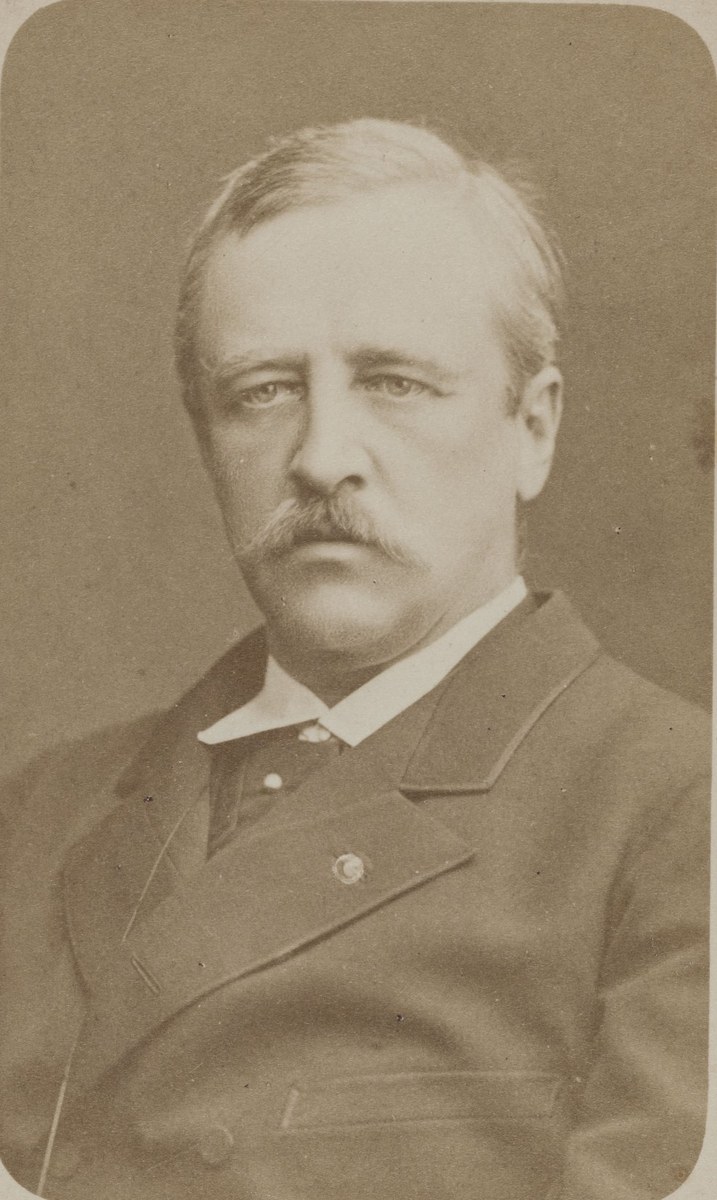
Ernest Charles Appert (photographer), portrait of Adolf Erik Nordenskiöld, albumen carte de visite, 1860-1890. Musée Carnavalet - Histoire de Paris, PH22367, CC0 Paris Musées. Cropped and downscaled. · Albumen carte-de-visite photograph of Adolf Erik Nordenskiöld by the Paris studio of E. Appert (Ernest Charles Appert), dated by the museum between 1860 and 1890, held by the Musée Carnavalet - Histoire de Paris (inventory PH22367, 8.4 x 5.7 cm print on a 10.5 x 6.3 cm mount). The mount is printed 'E. APPERT' and the verso carries the sitter's name handwritten as 'Nordenskyold'. The file is the photograph area cropped from the museum's 1337 x 2160 pixel image and downscaled to 717 x 1200 (no upscaling). · CC0 1.0 as stated on the Paris Musées collections item page for the Musée Carnavalet record (the photographer died in 1890, so the photograph is also old by age)
탐험가 · 19세기
아돌프 에리크 노르덴셸드
1832–1901
주요 업적 분야
아직 성격 매칭에 포함되지 않았습니다 — 기록된 근거가 성격 모델 전체를 다루기에는 충분하지 않습니다. 이 페이지의 다른 모든 내용은 자유롭게 확인하실 수 있습니다.
핵심 특성
주요 업적
1878~80년 베가호 탐험을 지휘했다. 노르웨이를 출발해 아시아 북극 해안을 따라 태평양에 이른 이 항해를 브리태니커는 북동항로의 첫 성공적 통과로 설명하며, 1880년 귀환한 그에게 오스카르 왕은 남작 작위를 내렸다.
1857년부터 1883년까지 스피츠베르겐, 그린란드, 카라해 등으로 약 열 차례의 북극 탐험을 이끌거나 참여했으며, 자연과학자 팀을 동행시켜 과학 조사를 북극 탐험의 일부로 만들었다. 『과학 인명사전』은 다섯 권으로 된 베가호 보고서가 본격적인 극지 연구의 시작이라고 평가한다.
베가호 항해 뒤에는 지도의 역사로 눈을 돌려 『복제 지도 도감』(1889)과 『페리플루스』(1897)를 펴냈다. 『과학 인명사전』은 이 책들이 지도 제작사 연구의 토대를 놓았다고 평가한다. 그가 모은 약 2만 4천 장의 지도와 4천여 종의 문헌은 오늘날 헬싱키의 노르덴셸드 컬렉션이 되어 1997년 유네스코 세계기록유산에 올랐다.
삶의 장면들
베가호로 출항하기 전인 1875년과 1876년에 카라해 예비 항해로 예니세이강 하구까지 갔고, 앞선 항해 기록과 노르웨이 어부들의 카라해 항해 일지를 연구했다.
이러한 사전 준비는 계획 지향적 접근과 부합하지만, 자료는 이전 탐험에서의 물자 부족도 함께 기록하고 있다. 계획 지향
1872~73년 스피츠베르겐 탐험에서는 얼음과 폭풍으로 극점 행군용 순록이 흩어지고 구조선이 도착하지 못해, 25명분 물자로 67명이 조립식 오두막에서 겨울을 났다. 그런데도 기상 관측 자료를 모았고 봄에는 일부 대원이 얼음 위로 나섰다.
이 일화는 높은 위험 노출과 끈기와 부합하지만, 자료는 그가 위험을 어떻게 저울질했는지는 말하지 않는다. 위험 감수
전환점
베가호 항해 뒤에는 지질학과 현장 탐험에서 지도의 역사로 중심을 옮겨, 베가호 책의 인세를 책과 지도를 사는 데 쓰고 『복제 지도 도감』과 『페리플루스』를 펴냈다.
현장 탐험에서 새로운 학문 분야로의 이 전환은 폭넓은 지적 범위와 부합하지만, 한 평가는 이 분야에서의 심각한 오류도 기록한다. 분야 횡단성
비슷한 인물
전체적인 프로필이 이 사람과 닮은 사람들이에요.
출처
- Adolf Erik Nordenskiöld (Q156749), verified live via the Wikidata API (2026-11-06): English label 'Adolf Erik Nordenskiöld', description 'Finland Swedish baron, geologist, mineralogist and Arctic explorer (1832-1901)', Korean label 아돌프 에리크 노르덴스키욀드 (the Korean Wikipedia article is titled 아돌프 에리크 노르덴셸드), born 1832-11-18, died 1901-08-12, citizenship Sweden and the Grand Duchy of Finland. Orientation only; not used as support for any row.
- Complete Dictionary of Scientific Biography entry 'Nordenskiold, (Nils) Adolf Erik' by George Kish (Gale, reproduced on Encyclopedia.com; read in full including its bibliography). CANONICAL SIGNIFICANCE SOURCE: first Arctic voyage 1857 (Spitsbergen), five more Spitsbergen voyages and eight other expeditions 1864-86, the Vega voyage of 1878-79 that achieved the Northeast Passage, scientific work made an integral part of Arctic exploration with careful planning, equipment and staff, five Vega volumes that began serious polar studies, chief of mineralogy at the Swedish national museum from 1858, the Facsimile-atlas (1889) and Periplus (1897) as foundations of the history of cartography, and influence on two generations of Scandinavian scientists. Reference-work biography by the author of the standard English biography; admiring, but says his theoretical geology is now only of historical interest.
- P. Andrew Karam, 'Baron Nils Adolf Erik Nordenskiold', Science and Its Times (Gale, reproduced on Encyclopedia.com; read in full). COUNTER-VOICE: after the Vega voyage he turned to the history of maps and, in the entry's words, made some significant discoveries but also serious blunders; he accepted maps as authentic too readily, bought several forged maps, based statements on documents later found to be fakes, and attributed to old mapmakers knowledge they could not have had, which reduced his credibility; the entry still concludes that he contributed tremendously. Also: ten voyages 1858-1883, he did not set out to expand an empire, and his Voyage of the Vega was a popular and scientific narrative translated into several languages. Secondary encyclopaedia entry with no cited instances beyond the map errors.
- Encyclopaedia Britannica, 'Adolf Erik, Baron Nordenskiöld' (revised November 2025; read in full): settled in Stockholm in 1858, curator of mineralogy at the Swedish State Museum, led Spitsbergen expeditions in 1864, 1868 and 1872-73, a Greenland inland-ice expedition in 1870, preliminary Kara Sea voyages in 1875 and 1876, then the Vega (sailed 21 July 1878, frozen in near the Bering Strait from late September to 18 July 1879, reached Stockholm 24 April 1880 and was created a baron); in 1883 he penetrated far into the Greenland ice and is said to be the first to break through the southeast Greenland sea-ice barrier. Short reference article; celebratory, no criticism.
- Robert MacDonald, 'Arctic Profiles: Nils Adolf Erik Nordenskiold (1832-1901)', Arctic (journal of the Arctic Institute of North America, University of Calgary), pp. 388-389 (two-page PDF read in full; volume and year are not printed on the extract). Independent polar-research profile: eight further Arctic trips besides the Vega; he chose scientists from across Scandinavia, many of whom sailed with him again; the 1872-73 winter expedition (backed by businessmen hoping to exploit phosphate deposits) in which ice and a storm scattered the reindeer meant for the Pole march and a failed relief left 67 men on supplies for 25 in a prefabricated hut; the 1875 Yenisei journey; Vega preparations including study of earlier voyage records; Sami skiers on the 1883 Greenland ice cap; later life as museum administrator, author of the Facsimile Atlas and adviser to Nansen's Greenland crossing. Includes a candid account of the hardships and of commercial backing.
- National Library of Finland (Helsinki University Library): Maire Aho, 'A. E. Nordenskiold Collection included in the Unesco Memory of the World Program', Tietolinja News 1/1999, and the Library's 'A. E. Nordenskiöld Collection' collection page (both read in full). He was 'very orderly' in acquiring maps, spending the royalties of his Vega narrative on books and maps and using other works as exchange material; the collection holds about 4,000 titles and 24,000 maps (an almost complete Ptolemy series, 123 incunabula), was inscribed in UNESCO Memory of the World in 1997, and passed to Helsinki in 1902 only because no buyer was found abroad or in Sweden; the sale terms kept it whole and open to scholars from any country. The Aho article also names his three financial guarantors for the Vega (King Oscar II, Oscar Dickson, Alexander Sibiryakov) and says the long stay in the ice yielded data of a quality not matched until the 1930s. Institutional, admiring.
- Urban Wrakberg, 'A. E. Nordenskiöld in Swedish memory: the origin and uses of Arctic heroism', Acta Borealia 36(2), 2019 (only the abstract was read, via the British Library catalogue record; the full article was not available). CRITICAL FRAMING: polar heroes were built for national honour and youth education; Nordenskiöld, with the help of others, navigated the drift ice, the international republic of science and the Swedish, Finnish and Russian national scenes and was turned into a national hero in Finland and Sweden. Used only to bound hero-narrative claims, not as behavioural evidence.