Maya Angelou
93% Profile Match
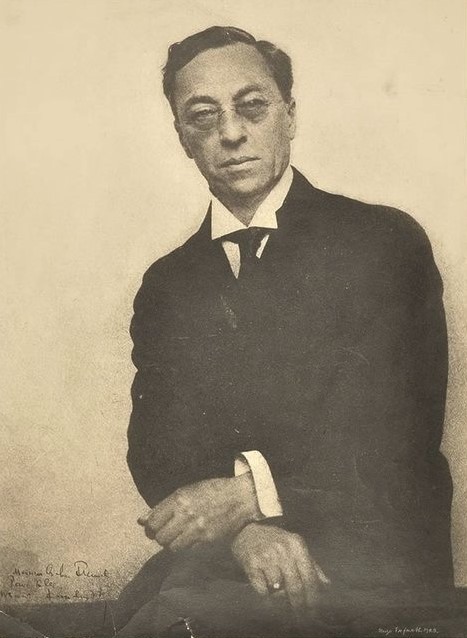
Photo: Hugo Erfurth, 1923, public domain · Wikimedia Commons, 'Wassily Kandinsky 1923 by Hugo Erfurth.jpg' -- photograph by Hugo Erfurth (1874-1948), 1923, bearing Kandinsky's handwritten dedication to Paul Klee; original 467 x 638 pixels, used unchanged and not resized or cropped. Rights basis: author died 1948 (life+70 expired end of 2018), 1923 work so also US public domain by the pre-1931 rule. The Centre Pompidou's own print record (AM 81-65-1094, inscribed 'HUGO ERFURTH 1923') names no copyright statement on the underlying photograph; its digital file was not used. · Public domain (author died 1948; Commons tag PD-old-auto-expired)
painter · 20th Century
1866–1944
Not yet included in personality matching — the documented evidence doesn't yet cover enough of the personality model. Everything else on this page is fully available.
Between about 1908 and 1913 he moved from landscapes toward painting with no recognisable subject, hoping colours, lines and shapes could work as a visual language like music. Britannica calls him one of the first creators of pure abstraction, while noting he was not its only founder.
In June 1911 he proposed to Franz Marc an almanac, "the document of our modern art". It became the Blue Rider book, two exhibitions and a loose group of artists, mixing painting with music, theatre, folk art, children's art and ethnography.
He set out a theory of colour and form in Concerning the Spiritual in Art and taught it at the Bauhaus from 1922 to 1933. His Weimar survey underlay the Bauhaus pairing of red, yellow and blue with the square, triangle and circle, and Point and Line to Plane appeared in 1926.
After hearing a Schoenberg concert in Munich on 2 January 1911 he wrote to the composer on 18 January; he later gave Schoenberg a set of woodcuts, made him a Blue Rider member and arranged a guest performance in St Petersburg.
Consistent with someone who reached out to people whose work he admired and turned contact into joint projects. Proactive Agency
At the Weimar Bauhaus he ran a survey on which colours people matched to which forms; most respondents agreed with his reasoning and the result became a school trademark, though Oskar Schlemmer was among the critics and the source says his 'scientific' findings came from introspection.
Consistent with a drive to turn intuitions about colour and form into a teachable system, with the limits of that system openly contested. Systems Thinking
In 1896, near his thirtieth birthday, he turned down a law professorship at Dorpat and went to Munich to become a painter, after studying law and economics and working in a printing house; Britannica draws partly on his own later recollection.
Consistent with a willingness to change course late and stay with a new path, though the evidence rests partly on his own recollection. Persistence
People whose overall profiles resemble theirs.