Leonardo da Vinci
94% Profile Match
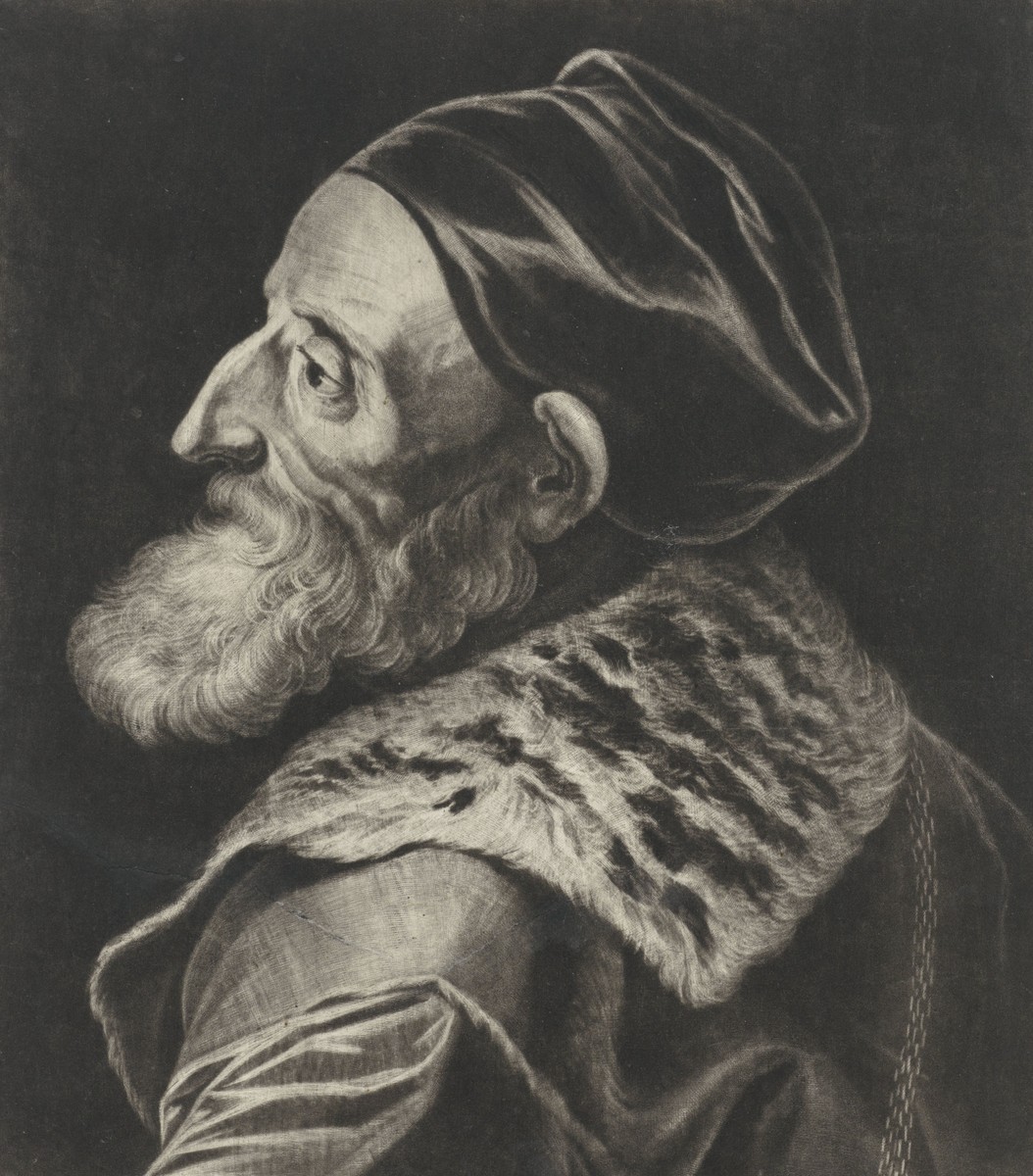
Jan Thomas, 1661, mezzotint after Titian; Rijksmuseum, Amsterdam (RP-P-1910-1486), Public Domain, cropped and downscaled from the original · Rijksmuseum, Amsterdam, collection record RP-P-1910-1486, 'Zelfportret van Titiaan' (Self-portrait of Titian): mezzotint and engraving by Jan Thomas (named on the print) after a painting by Titian, dated 30 March 1661 (inscribed 'Il vero ritratto del unico Titiano', dedicated to the Empress Eleonora, Vienna), plate 314 x 245 mm; the museum's record states 'Copyright: Public domain', and the Commons file of the museum's scan is tagged CC0 (original 5544 x 7108 pixels). The print was cropped to the plate image (the caption block and paper margins removed) and downscaled once to 1054 x 1200 (never upscaled). A later print after Titian's own self-portrait (a profile like the Prado's self-portrait, though the record does not name the painting copied), not a likeness drawn from life by the printmaker. · Public Domain (Rijksmuseum record states Public domain; CC0 digital file; mezzotint of 1661)
painter · Early Modern
1490–1576
Not yet included in personality matching — the documented evidence doesn't yet cover enough of the personality model. Everything else on this page is fully available.
He made himself the dominant painter of Venice. The National Gallery says his Assunta for the Frari, displayed in 1518, was a revolutionary watershed in Venetian altarpiece design and calls him the greatest painter of 16th-century Venice, and the National Gallery of Art says he was regarded from his own lifetime as the supreme master of colour.
The National Gallery says he was the first painter to have a mainly international clientele. He painted portraits of emperors, popes, doges and princes, became Charles V's principal painter after their 1530 meeting, painted mythologies for Alfonso d'Este at Ferrara and, from about 1551, the six Ovid mythologies he called 'poesie' for Philip II of Spain.
In his last decades he developed a much freer use of the brush, which the National Gallery says pushed his art to the edge of abstraction in works such as The Death of Actaeon and the Pieta intended for his own tomb. The National Gallery of Art says Rubens, Van Dyck and Velazquez were deeply indebted to his example.
In a letter of 22 September 1559 Titian told Philip II that the two Diana pictures had taken him more than three years because he was never satisfied with his efforts and always sought to polish and enhance them. A letter from the Spanish ambassador in Venice that August had said he would bring them to perfection within twenty days because he wanted to resolve 'a few little things that others wouldn't notice'.
This is consistent with reworking a picture repeatedly until it met his own standard. Perfectionism
Modern scholars describe a family-based workshop in Venice in which assistants completed barely sketched canvases and replicated Titian's successful compositions. The 17th-century biographer Carlo Ridolfi, quoted by Antonio Paolucci, says Titian would leave the keys in the studio so that disciples could copy his finest works and would finish the copies 'by his hand' on his return, and the National Gallery of Art says his involvement at the start and end of such work makes it hard to separate autograph from workshop.
This is consistent with delegating repeated work to assistants while keeping his own hand at the start and the finish. Collaboration
From the late 1550s Titian radically revised his style and technique, the National Gallery says, developing a much freer use of the brush and a less descriptive representation of reality. By the late 1560s and early 1570s he had pushed his art to the edge of abstraction; in The Death of Actaeon, painted mostly when he was in his mid-eighties, he added scumbled touches sometimes with his fingers and left parts in different states of completion.
This is consistent with a willingness to keep changing his technique late in life. Experimentation
People whose overall profiles resemble theirs.