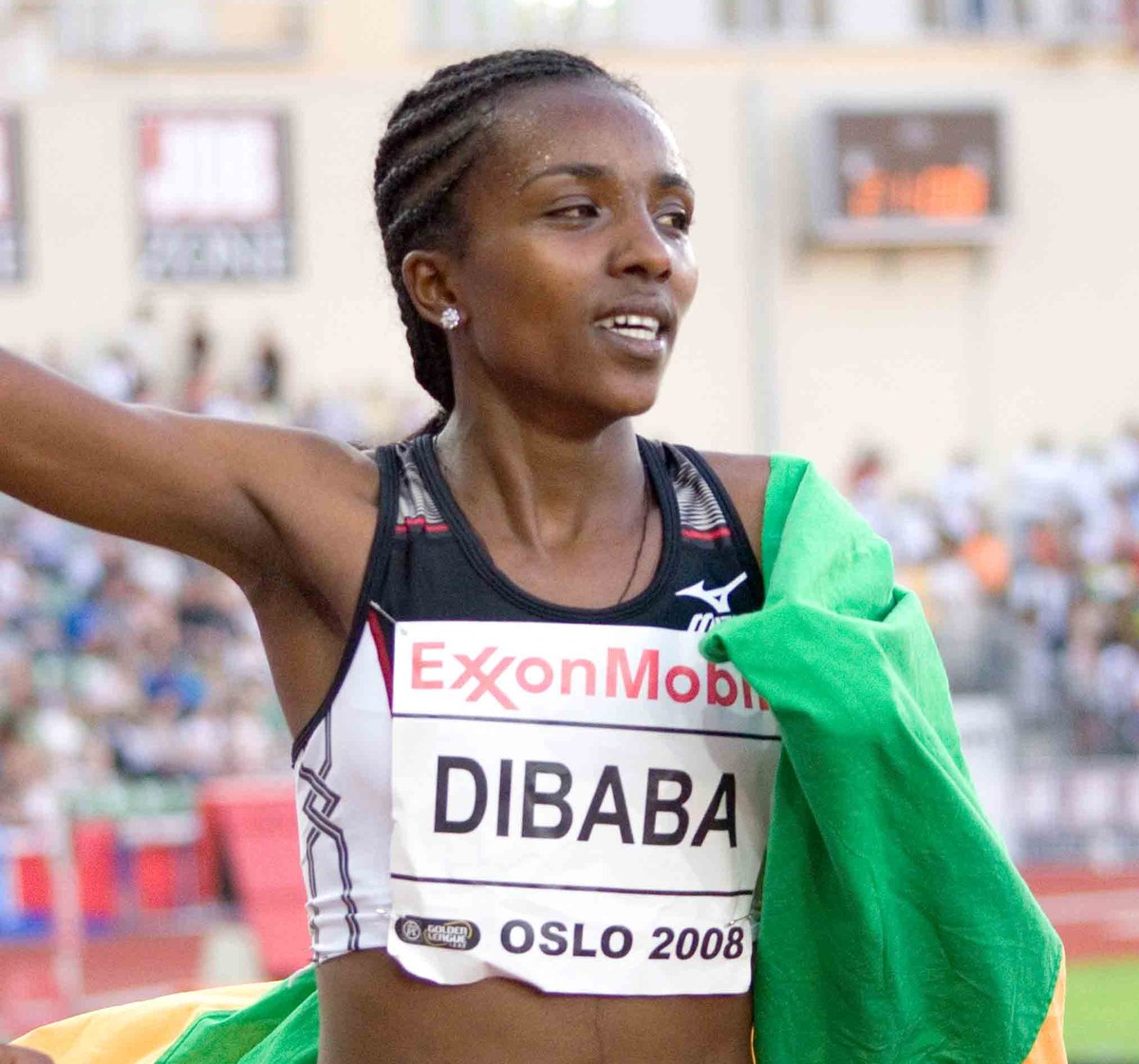

Photo: Ragnar Singsaas, Bislett Games 2008, Oslo, CC BY-SA 2.0, cropped from the original · Wikimedia Commons file 'Tirunesh Dibaba Bislett Games 2008.jpg': photograph by Ragnar Singsaas of Tirunesh Dibaba after her 5,000 m world record at the Bislett Games in Oslo, 2008 (her race bib reads DIBABA OSLO 2008), published on Flickr under CC BY-SA 2.0 and licence-reviewed on Commons in 2008; original 2215 x 3322 pixels, cropped by this project to head and chest and reduced to 1200 x 1121 pixels, never enlarged · CC BY-SA 2.0
athlete · Contemporary
Tirunesh Dibaba
b. 1985
Known For
Not yet included in personality matching — the documented evidence doesn't yet cover enough of the personality model. Everything else on this page is fully available.
Trait Constellation
Key Achievements
At the 2008 Beijing Olympics she became the first woman to win both the 5,000 m and 10,000 m, and in 2012 she became the first woman to win the Olympic 10,000 m at two consecutive Games.
Won the 2003 world 5,000 m title as the youngest world champion in her sport, the 5,000 m and 10,000 m double at the 2005 world championships, world cross-country titles and a 2013 world 10,000 m title, and set the 5,000 m world record of 14:11.15.
Moved up to the marathon after her track career, debuting in London in 2014 and winning the 2017 Chicago Marathon in 2:18:31, her first marathon victory.
Moments That Reveal Them
In the 2012 Olympic 10,000 m she sat in the pack for most of the last eight laps, took the lead about 530 m from the finish and won by the second-largest margin in the event's Olympic history.
This is consistent with a race plan, agreed with her coaches and carried out as she described it. Planning Orientation
At Chicago in 2017 she led from the gun without pacemakers, zig-zagged to stop rivals drafting behind her and pulled clear after 30 km.
This is consistent with a runner who takes control of races and aims to beat rivals outright. Competitiveness
Turning Points
After winning the 2012 Olympic 10,000 m she announced a marathon plan, debuted over the distance in London in 2014, and after her 2017 Chicago win said she would not return to the track.
This is consistent with a willingness to change events and rebuild her racing around a new distance. Adaptability
Similar People
People whose overall profiles resemble theirs.

Bette Davis

Benito Juarez

Warren Buffett

Octavia Butler

Elizabeth I of England
Opposite Profile
Not a rival — a different profile shape worth a look.

Leonardo da Vinci
Sources
- Tirunesh Dibaba (Q6003), verified live via the Wikidata API (2026-11-02): label 'Tirunesh Dibaba', description 'Ethiopian long distance track athlete', born 1985-06-01, no death date (living), citizenship Ethiopia, Korean label present. Orientation only; not used as support for any row.
- Encyclopaedia Britannica, 'Tirunesh Dibaba' (print view, revised 28 May 2026), read in full: Ethiopian distance runner who at the 2008 Beijing Olympics became the first woman to win gold in both the 5,000 m and 10,000 m, and who won the 10,000 m again in London in 2012, the first woman to win the event at two consecutive Olympics; Olympic medals 2004 (bronze 5,000 m), 2008 (two golds), 2012 (gold 10,000 m, bronze 5,000 m), 2016 (bronze 10,000 m); 2003 world junior cross-country title, junior 5,000 m world record and the world 5,000 m title (youngest-ever world champion in her sport); the 2005 world distance double; world cross-country titles; 2013 world 10,000 m title; half-marathon debut in 2012, first marathon in 2014 and first marathon win in Chicago in 2017. CANONICAL SIGNIFICANCE SOURCE. Concise; the passages on marriage and injuries were not used.
- Joerg Wenig (IAAF), 'Dibaba is back writing Olympic history again', World Athletics news (4 August 2012), read in full: report on her 10,000 m win at London 2012 (30:20.75, a sprint over the last 500 m), with her own account that the Ethiopian team agreed a tactic with its coaches before the race, that she had planned to go at 600 or 500 m and waited until 500 m, and that she was nominated only as a reserve for the 5,000 m. The federation's own writer, so favourable; the race facts are checkable and the quoted plan is her own account. Passages on her injuries and marriage were not used.
- LetsRun.com, '2012 Olympic Women's 10,000: Tirunesh Dibaba Makes The Case For Being The Greatest Ever' (3 August 2012), read in full: an independent athletics site's lap-by-lap race analysis showing Dibaba waiting in fourth for most of the last eight laps, moving up with about three laps left and taking the lead about 530 m from the finish to win by the second-largest margin in Olympic 10,000 m history; says she was nine for nine in 10,000 m races and held the 5,000 m world record (14:11.15); quotes her and the rivals Kipyego and Cheruiyot, including Kipyego's attempt to take the kick away from her; reports she announced her plan to run a marathon. Enthusiastic commentary ('greatest ever'), so the superlatives are the writers' opinion; the splits and results are factual.
- Cathal Dennehy (IAAF), 'Dibaba dominates and Rupp times it right to win in Chicago', World Athletics report (8 October 2017), read in full: race report of her first marathon win (2:18:31, her third career marathon, almost two minutes clear of Brigid Kosgei), saying she led from the start without pacemakers, towed a group through 10 km in 32:28 and halfway in 1:08:48, zig-zagged to stop rivals drafting, and pulled away after 30 km; quotes her that she ran without pacemakers, that she 'worked very hard', that she skipped an award ceremony after the London world championships to prepare, and that the marathon would be her sole focus. A federation report by a staff journalist; favourable but tactically specific. A fuller account of the personal best of 2:17:56 is only mentioned in passing.
- Sean Ingle, 'Dibaba confident of meeting London Marathon demands' (The Guardian, 11 April 2014, as republished by Gulf Times), read in full: pre-race profile at her marathon debut saying she had trained intensively for five months, had asked Haile Gebrselassie to share his marathon experience, had withdrawn from the 2013 London race, and that the bookmakers were sceptical of her chances; includes her own remarks that the change of event was difficult but she had done her best. Independent national newspaper; short preview, and the training claim is her own.
- Laureus World Sports Awards, 2006 Sportswoman of the Year nominee profile of Tirunesh Dibaba, read in full: credits her 2005 world cross-country short and long titles and the world 5,000/10,000 m double in Helsinki, notes a closing 400 m of 58.33 s in the 10,000 m, and quotes her saying that she stuck with her usual programme without increasing distance and did not allow anything outside running to interrupt her training. An award body's promotional profile quoting her own words; self-report, favourable.
- Athletics Illustrated, 'Tirunesh Dibaba where is the recognition?' (2013), read in full: an opinion note after her 2013 world 10,000 m win summarising her record (a perfect 11 for 11 in 10,000 m races, five world cross-country golds, three world 10,000 m titles and two Olympic ones) and listing her personal bests and her Olympic, world and world cross-country medals; relays a LetsRun article. Short, partly derivative opinion, used only to corroborate the results list.