
Sequoyah
94% Profile Match
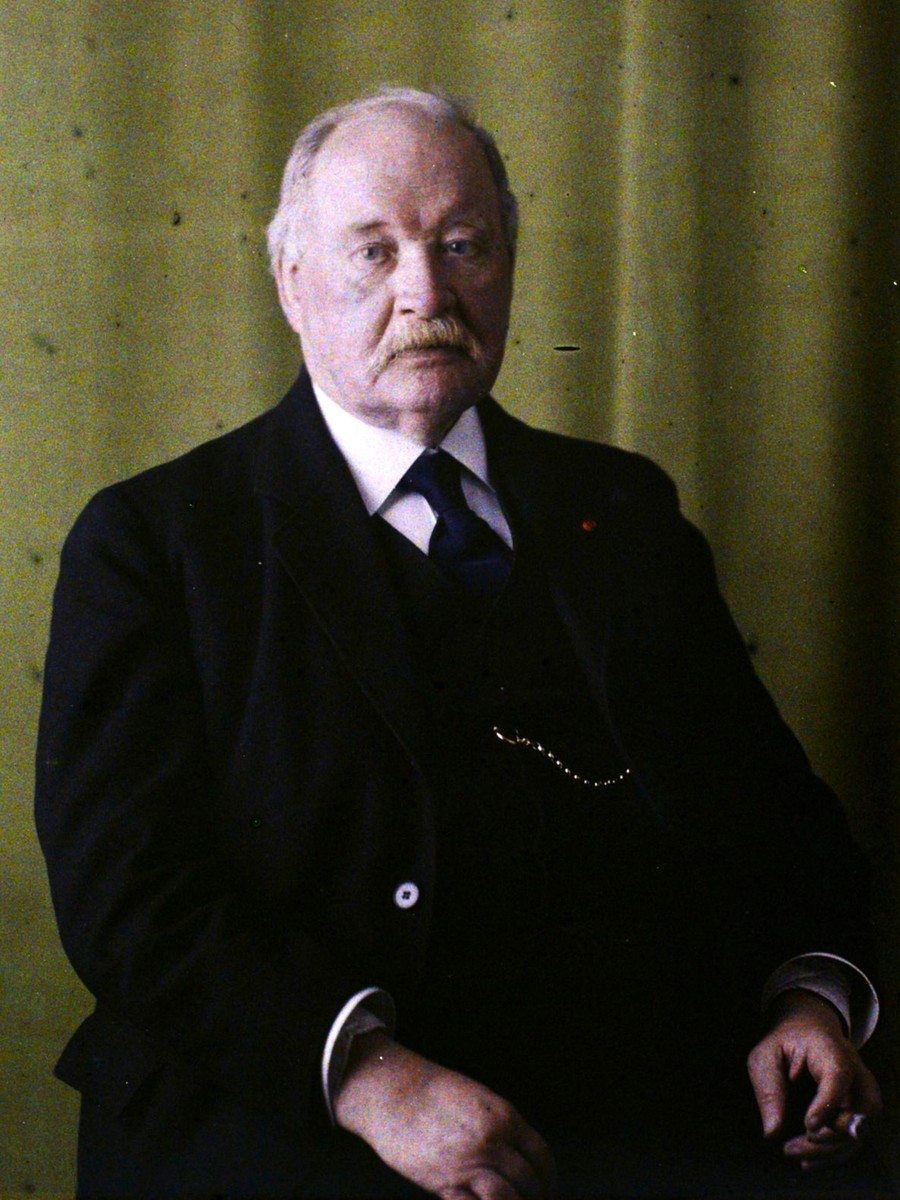
Auguste Leon, Albert Kahn Museum, Archives of the Planet, 10 May 1922, public domain (CC-00) · Autochrome photograph of Svante Arrhenius taken by Auguste Leon on 10 May 1922 at Albert Kahn's property in Boulogne, France (Archives of the Planet, Albert Kahn Museum, Hauts-de-Seine departmental collections, inventory A31436). The collection page states the licence as freely reusable (CC-00, public domain), the operator and the date; the Commons file '1922 Svante Arrhenius.jpg' carries a public-domain tag. Original download 1186 x 1582, reduced (downscaled only) to 900 x 1200. Caveat: the collection title names him 'Monsieur Svante Arrhenius' but the on-plate note spells the name differently; identity rests on the museum's own title. · Public domain (CC-00, Albert Kahn Museum)
chemist · 19th Century
1859–1927
Not yet included in personality matching — the documented evidence doesn't yet cover enough of the personality model. Everything else on this page is fully available.
In his 1884 thesis he proposed that salts dissolved in water split into electrically charged ions, a theory the Uppsala faculty did not appreciate and that won him the 1903 Nobel Prize in Chemistry after more than ten years of dispute.
In 1889 he studied how temperature changes the speed of a reaction and proposed that only energetically activated molecules react, the idea behind the activation energy and the equation that bears his name.
In 1896 he calculated how changes in atmospheric carbon dioxide would alter ground temperature, estimating a 5 to 6 degree rise from a doubling; contemporaries largely dismissed it and it was revived in the later twentieth century.
After his thesis received the lowest passing grade in 1884, he had it printed and sent it to Clausius, van't Hoff and Ostwald; Ostwald travelled to Uppsala to meet him.
This is consistent with persisting and seeking outside judgement after a dismissive local assessment. Persistence
Over decades he contested Walther Nernst's Nobel Prize and quarrelled with Paul Ehrlich over method, in what a historian describes as polemics he seemed to thrive on.
This is consistent with a high tolerance for open scientific conflict. Conflict Tolerance
In 1905, declining a professorship offered in Berlin, he became director of the new Nobel Institute for Physical Chemistry in Stockholm, where collaborators from Sweden and abroad came to work with him.
This is consistent with choosing an independent base at home over a prestigious post abroad. Need for Autonomy
People whose overall profiles resemble theirs.




Not a rival — a different profile shape worth a look.
