
Sequoyah
94% Profile Match
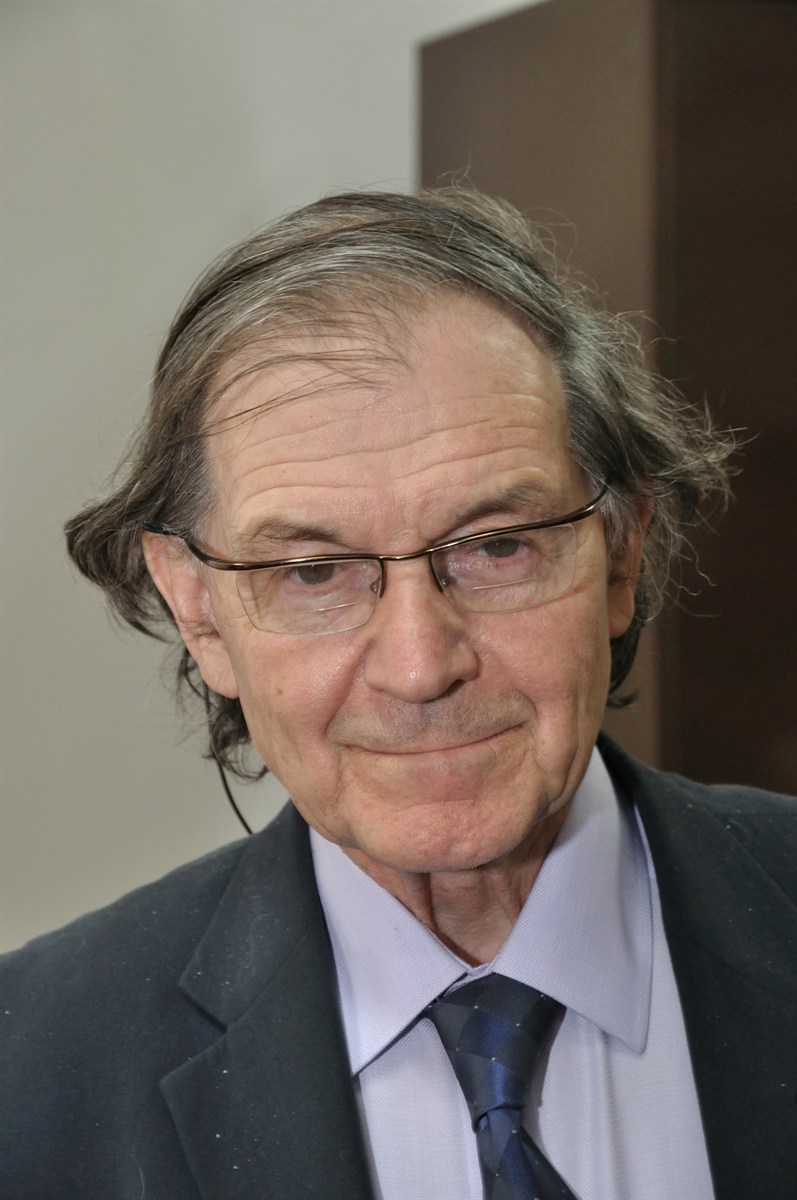
Photo: Biswarup Ganguly, 2011, CC BY 3.0 · Wikimedia Commons, 'Roger Penrose 9558.JPG' -- photograph by Biswarup Ganguly, taken 7 January 2011 (the photographer's sibling files of that date are named for Science City, Kolkata) and uploaded to Commons by the photographer himself ('Own work', 10 January 2011, a single file version, Nikon D90); published under CC BY 3.0 (originally also GFDL) with attribution required. Original 2848 x 4288 pixels (6,455,603 bytes; the downloaded file's SHA-1 1719fc78 matches the Commons record); saved here downscaled once to 797 x 1200 pixels (no crop, never upscaled). · CC BY 3.0
physicist · Contemporary
b. 1931
Not yet included in personality matching — the documented evidence doesn't yet cover enough of the personality model. Everything else on this page is fully available.
In January 1965 Roger Penrose published a proof that black holes can really form. Without assuming spherical symmetry, he introduced the concept of a trapped surface and, using topological methods, showed that once one has formed, collapse to a singularity cannot be prevented within general relativity. The Royal Swedish Academy of Sciences says the paper is still regarded as the most important contribution to the general theory of relativity since Einstein, and in 2020 it awarded Penrose half of the Nobel Prize in Physics.
With Stephen Hawking, Penrose extended the result to cosmology. The Nobel Committee for Physics says their 1970 work showed that, under reasonable assumptions, a past singularity is inevitable in the Big Bang model, and MacTutor reports that the two shared the Wolf Prize in Physics, which the Royal Society cites for showing the necessity of cosmological singularities. The Committee also credits Penrose with the diagrams that bear his name, which use conformal transformations to fit infinite space and time into a finite picture and are indispensable in the study of curved space-times.
Penrose also invented twistor theory, which the Royal Society calls a key tool in quantum theory, and discovered a non-periodic form of tiling that bears his name. MacTutor says that after years of work he found non-periodic tilings that need only two tiles, and the Royal Society notes that Penrose tiling has since been observed experimentally in quasicrystals.
In the Nobel Committee's retelling of his own recollection, the key to showing that black holes can form came to Penrose in autumn 1964, on a walk with a colleague in London. When they stopped talking to cross a side street, an idea flashed into his mind, and later that afternoon he searched for it in his memory; the idea, which he called trapped surfaces, was the key he had unconsciously been searching for. The Committee notes that Penrose tells the story himself in two books.
This is consistent with solving a problem by inventing a new concept rather than extending a standard calculation. Creative Originality
In 1994 Penrose and Stephen Hawking debated at the Isaac Newton Institute in Cambridge, and the debate was published in 1996 as The Nature of Space and Time. MacTutor quotes Penrose's own contribution: Hawking said he is a positivist, whereas Penrose calls himself a realist, and he compared the exchange to the debate between Bohr and Einstein, with Hawking in Bohr's role and himself in Einstein's.
This is consistent with defending a philosophical position of his own even against a close scientific collaborator. Independent Thinking
From 1989 Penrose added a second, contested line of work on the mind. His books The Emperor's New Mind (1989) and Shadows of the Mind (1994) argued that conscious acts are not computable, and with the anaesthesiologist Stuart Hameroff he proposed that they arise from gravitation-induced collapses of quantum states in microtubules. The Stanford Encyclopedia of Philosophy reports influential criticism, including Max Tegmark's estimate that such states would decohere in under a trillionth of a second, and a published exchange with Grush and Churchland in 1995, while concluding that the proposal should be neither celebrated too quickly nor dismissed offhandedly.
This is consistent with sustaining a long-running, contested line of work while answering critics in print. Persistence
People whose overall profiles resemble theirs.




Not a rival — a different profile shape worth a look.
