Nelson Mandela
93% Profile Match
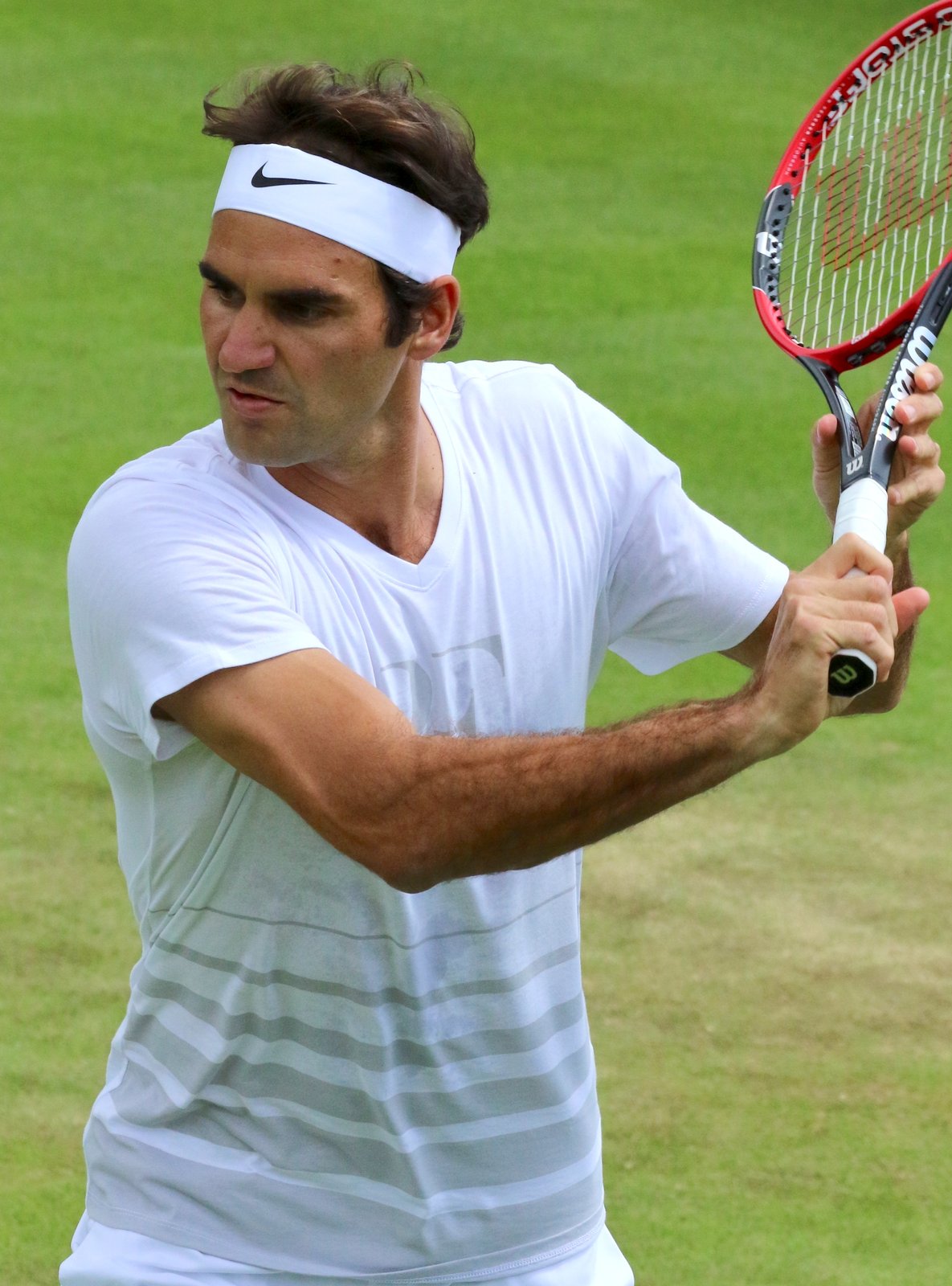
Photograph by si.robi (Flickr), 2016, licensed CC BY-SA 2.0; resized from the original. Derivative is shared under the same licence. · Wikimedia Commons file 'Federer WM16 (37)' (Wimbledon Championships, 27 June 2016), downsized from 2725 x 3679 pixels · CC BY-SA 2.0
athlete · Contemporary
b. 1981
Not yet included in personality matching — the documented evidence doesn't yet cover enough of the personality model. Everything else on this page is fully available.
Federer won 20 Grand Slam men's singles titles, the first at Wimbledon in 2003, and retired in 2022 with that total. He won a record eighth Wimbledon singles title in 2017, and his 2009 French Open win completed a career Grand Slam; the 2017 Australian Open, his 18th major, came at 35 after six months away from competition.
From 2 February 2004 to 17 August 2008 Federer spent 237 consecutive weeks at No. 1 in the ATP rankings, the longest unbroken run since the rankings began in 1973. The next longest, by Jimmy Connors, lasted 160 weeks.
In November 2014 Federer and Stan Wawrinka led Switzerland to its first Davis Cup title, a 3-1 win over France in Lille. Wawrinka won the opening singles and the two won the doubles; Federer beat Richard Gasquet in straight sets to clinch the tie.
During practice with Benoit Paire in Cincinnati in August 2015, Federer began running forward to return serves from the service line, hitting half-volleys and moving to the net. He said he wanted to keep the points short, and his coach Severin Luthi had asked them to play more games. The tactic, nicknamed SABR (Sneak Attack By Roger), appeared in that tournament's matches, including the first-set tiebreak of the final against Novak Djokovic. Boris Becker, Djokovic's coach, called it 'almost disrespectful'; Federer replied it was not.
Trying an untested tactic in practice, then using it in matches and defending it against public criticism, is consistent with experimentation; the account is Federer's own, relayed by reporters. Experimentation
At the 2018 Australian Open Federer said the Grand Slams' revenue-sharing agreement with the players 'has run its course', that players had to 'rally, get back together again, put in the effort', and that 'when the players don't talk, nothing gets done'. Sky Sports noted he had been president of the ATP Player Council in 2012, when talk of a boycott preceded larger prize-money increases, especially for early-round losers.
Speaking publicly for the player group and urging players to organise, after six years as council president, is consistent with leadership drive. Leadership Drive
After losing in the second round at Wimbledon in 2013 to the 116th-ranked Sergiy Stakhovsky, his worst Grand Slam loss in over ten years, Federer tested a larger 98-square-inch prototype racket for about a month, then said he would return to his old 90-square-inch frame through the US Open. In 2014 he moved to a bigger-headed racket, which ESPN later credited with helping him drive returns against Rafael Nadal's serve instead of slicing them. His ranking had fallen from No. 2 to No. 6 over the 2013 season.
Changing equipment and later his return tactics after a poor season, rather than waiting for form to return, is consistent with adaptability; the 2013 reversal shows the change was not made without hesitation. Adaptability
People whose overall profiles resemble theirs.