Sequoyah
88% Profile Match
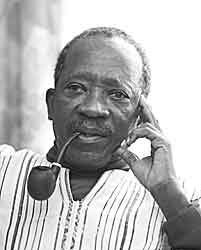
Photo: Guenter Prust, 1987, CC BY 3.0 · Wikimedia Commons file 'Ousmane Sembene (1987) by Guenter Prust.jpg': photograph by Guenter Prust of Ousmane Sembene on a visit to Berlin on 18 November 1987, uploaded by the photographer's account in November 2012 with his own statement that the work is his and that credit to him is required. Licensed CC BY 3.0. The original file is 201 x 250 pixels (6 KB); it is saved unchanged, never enlarged. The photographer's page foto-prust.de was not opened. Small but concrete: creator, date, place and licence are all stated on the file page by the photographer himself. A statue photograph in the Commons category (Laurent Mongis, 2017) was rejected because it does not show the person. · CC BY 3.0
film director · 20th Century
1923–2007
Not yet included in personality matching — the documented evidence doesn't yet cover enough of the personality model. Everything else on this page is fully available.
Often called the 'father of African cinema', the Senegalese writer and director made La Noire de... (Black Girl, 1966), regarded as the first major film by an African filmmaker.
Having concluded that books reach few people where illiteracy prevails, he turned to film, and with Mandabi (1968) he made the decision to film in the Wolof language.
He was also a novelist, from Le Docker noir (1956) to God's Bits of Wood (1960), and his later films include Ceddo, Camp de Thiaroye and Moolaade, which won the Un Certain Regard prize at Cannes.
After returning from Moscow he toured remote villages with a projector, setting up chairs and holding discussions late into the night.
This is consistent with a self-started effort to reach his audience directly. Proactive Agency
Ceddo (1977) was banned in Senegal, officially over the spelling of its title according to some accounts; he then made no film for nearly a decade before Camp de Thiaroye (1988).
This is consistent with a willingness to keep making contested films despite a heavy cost to his output. Conflict Tolerance
Around 1960, after establishing himself as a novelist, he turned to cinema in order to reach the African audience that could not read French, and studied in Moscow.
This is consistent with a motivation to reach a wider audience shaping his choice of medium. Impact Motivation
People whose overall profiles resemble theirs.