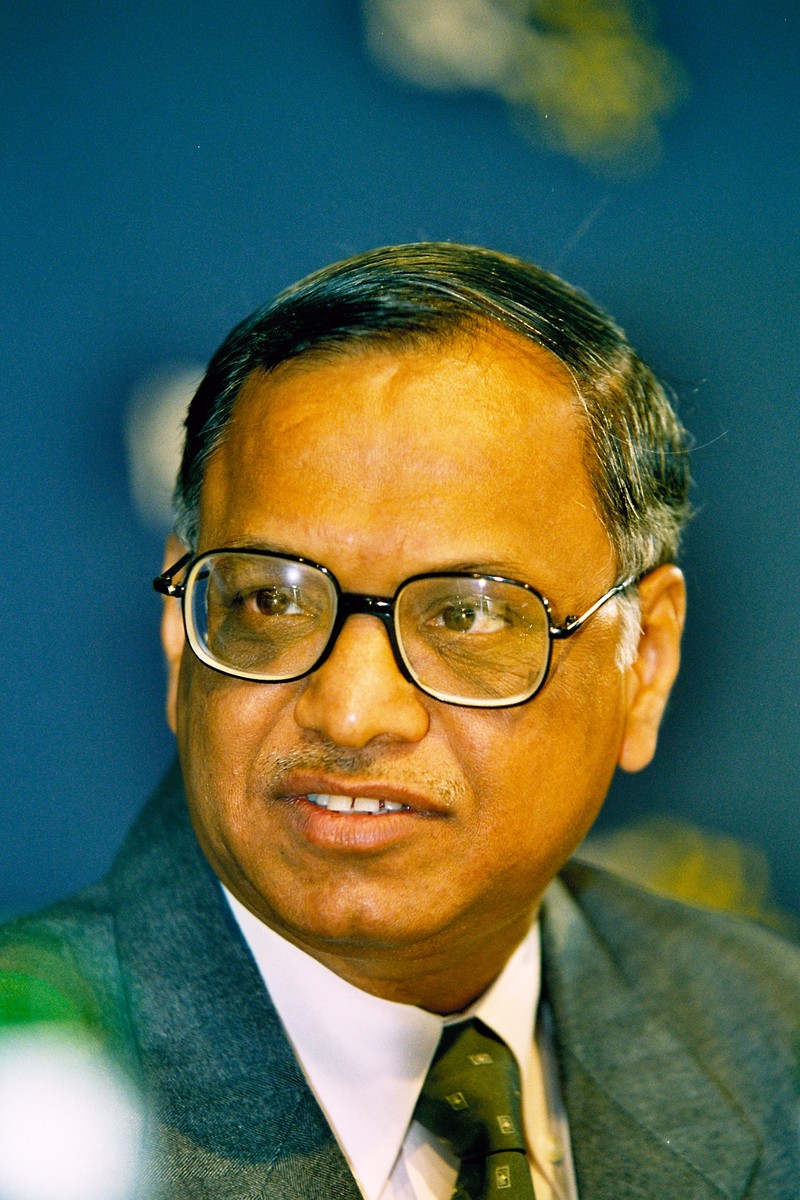
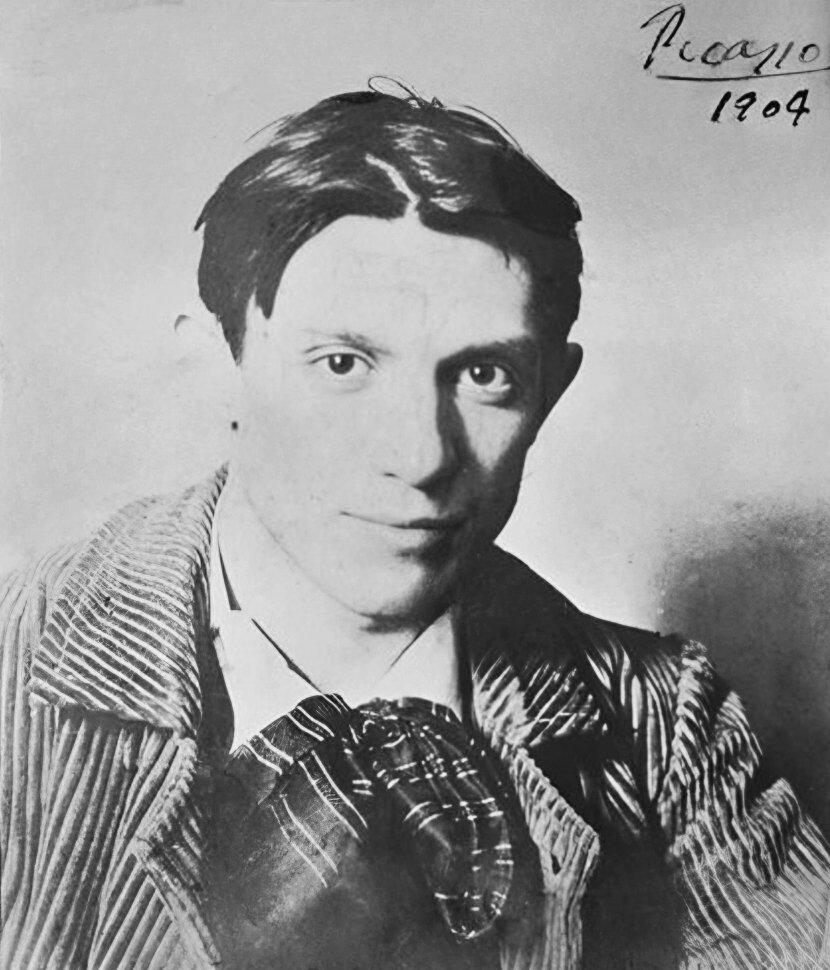
Photo: St. Gallen Symposium / Universitätsarchiv St.Gallen (HSGN 028/01586), 2001, CC BY-SA 4.0 · Wikimedia Commons, '31. ISC-Symposium-N.R. Narayana Murthy-HSGN 028-01586.jpg' -- portrait photograph of N. R. Narayana Murthy at the 31st St. Gallen Symposium, 2001, from the University of St. Gallen archive (Universitätsarchiv St.Gallen, reference HSGN 028/01586). The Commons page states that media uploaded by the archive are released under CC BY-SA 4.0 and records a volunteer-reviewed permission ticket from the copyright holder (live check 2026-10-24). Original 1400 x 2100 pixels (1.74 MB; stored with an orientation flag, rotated upright on processing); stored file downscaled once to 800 x 1200, no crop, never upscaled. Caveats: the licence rests on the archive's statement on Commons and the permission ticket, which could not be inspected here. Alternatives not used: the 2014 'Narayana Murthy CIF' file (own-work upload, camera date wrong, only 529 x 771 in the cropped version) and Indian government photographs (open licence but taken at political meetings). · CC BY-SA 4.0
entrepreneur · Contemporary
N. R. Narayana Murthy
b. 1946
Known For
Not yet included in personality matching — the documented evidence doesn't yet cover enough of the personality model. Everything else on this page is fully available.
Trait Constellation
Key Achievements
He co-founded Infosys in Bangalore in 1981 with six colleagues, starting with 10,000 rupees, and was its chief executive for two decades until 2002.
Infosys developed its Global Delivery Model under his leadership, splitting projects between work done on the client's site and work done at remote development centres in India; revenue grew over 80 percent a year from 1998 to 2001.
In March 1999 Infosys became the first India-registered company listed on a US stock exchange, NASDAQ, which also allowed it to offer employee stock options through depositary receipts.
Moments That Reveal Them
In the 1980s he made over 200 trips to government offices in Delhi for permits, and the company waited a full year for permission to buy its first computer.
This is consistent with persistence through a slow licensing system. Persistence
In 2017 he and other founders questioned the board over executive pay, a former finance chief's severance and the Panaya acquisition; the board called his campaign misguided, the chief executive resigned, and the board was later reshaped.
This is consistent with a willingness to stay in an open dispute with his own former company, with sources divided on whether it helped. Conflict Tolerance
Turning Points
After a first direct data link to the United States in 1989 and India's early-1990s deregulation, Infosys's early offshore experiments turned into a model that became a competitive advantage.
This is consistent with an ability to hold on to an early idea until conditions made it commercially workable. Opportunity Sensing
Similar People
People whose overall profiles resemble theirs.

Simón Bolívar

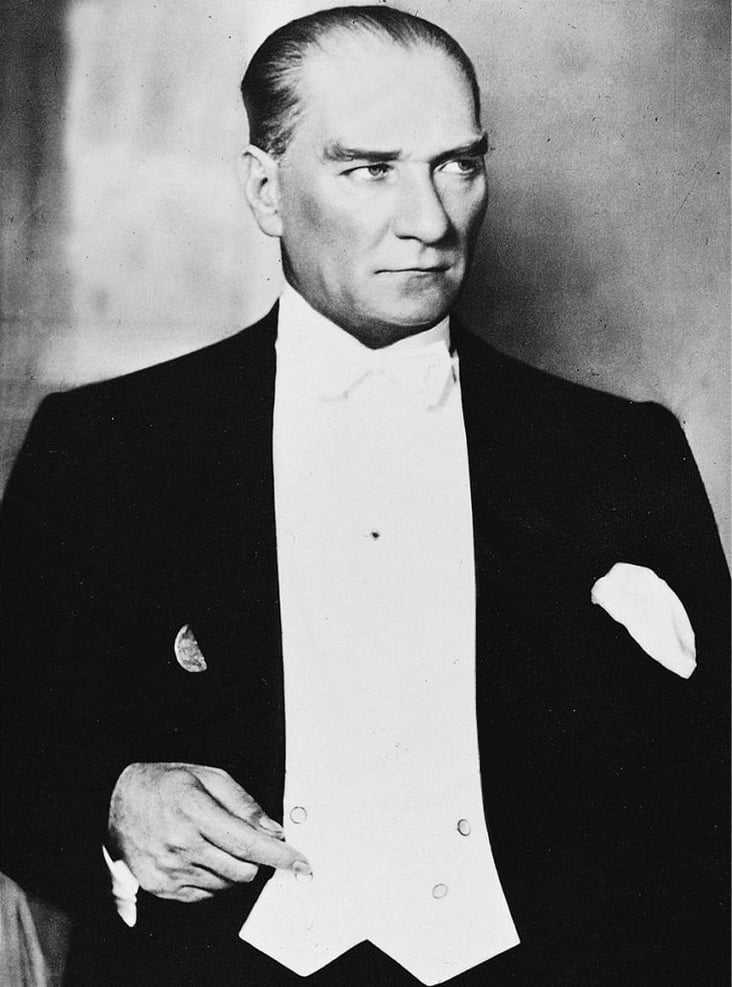
Mustafa Kemal Atatürk

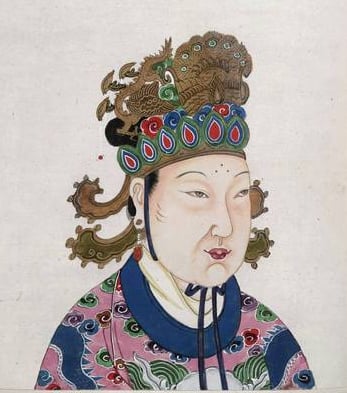
Wu Zetian

Mahatma Gandhi

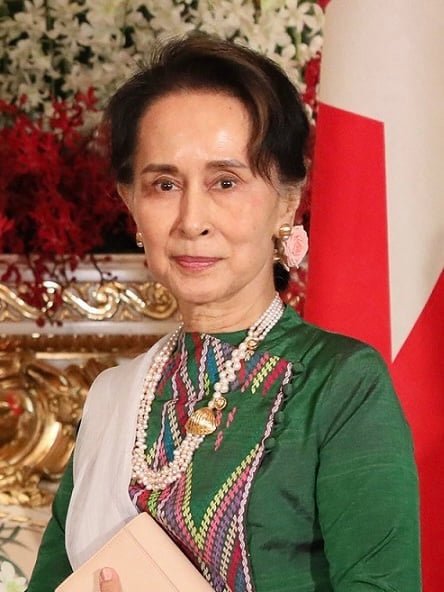
Aung San Suu Kyi
Sources
- N. R. Narayana Murthy (Q1398708) -- verified live via the Wikidata API (2026-10-24): English label 'N. R. Narayana Murthy', description 'Indian businessman', Korean label '나라야나 무르티', born 20 August 1946, no death date, citizenship India. Orientation only; not used as support for any row. (The search for 'Narayana Murthy' alone also returns an unrelated film actor; this item is the Infosys co-founder, confirmed by its date of birth and occupation claims.)
- Chris Trimble, 'Infosys: Maintaining an Edge', Tuck School of Business at Dartmouth case no. 2-0026 (2008, read in full as PDF): the 1981 founding with 10,000 rupees pooled from family and six co-founders, the first computer waiting a full year for government permission, over 200 trips to Delhi government offices in the 1980s against one in the 1990s, early attempts at the global delivery model with code sent by courier and fax, the first direct data link to the United States in 1989, deregulation and falling telecom costs in the 1990s, Murthy's description of the model as splitting work between on-site and remote activities, revenue growth of over 80 percent a year from 1998 to 2001, and the 1999 NASDAQ listing. CANONICAL SIGNIFICANCE SOURCE. Academic teaching case by an outside professor; it quotes Murthy's own statements for values and the model, which are treated as self-account, while the historical sequence is the author's.
- 'Infosys Technologies Ltd. History', International Directory of Company Histories vol. 38 (St. James Press, 2001), reproduced by FundingUniverse (read in full): 1981 founding, 1987 first US office, 1992-1993 Indian public offerings, SEI capability-maturity certifications, the offshore and Global Delivery Model, repeat-business share, the 11 March 1999 NASDAQ listing as the first India-registered company on a US exchange, the employee stock option plan using ADRs, and fiscal 1998-2000 revenue figures. Reference-work company history compiled from trade-press reports; independent of the company's own narration but second-hand.
- Asia Society, 'Mr. Narayana Murthy and Infosys: A Case Study of Indian Values' (read in full): Infosys's founding in 1981, the March 1999 NASDAQ listing, Murthy's own interview answers about a 1990 meeting at which colleagues considered a buy-out offer, introducing higher salaries and a stock option plan to keep staff, and his statements on transparency to investors. Mostly the subject's own interview answers presented by a think-tank; counted as self-account and used only with other sources.
- Bloomberg (via Gulf News), 'Investors lose $3.5b as Infosys ex-CEO spars with founder', 2017 (read in full): Vishal Sikka's resignation after a year of acrimony between the board and founders led by Murthy; the founders' questions on Sikka's pay, executive severance and the Panaya acquisition; the Infosys statement blaming Murthy's 'continuous assault' and calling his letter factually inaccurate; Murthy's reply that his concern was the deteriorating standard of corporate governance; Murthy as CEO for two decades to 2002 and his return in 2013. Wire report carrying both sides, including the board's counter-voice.
- Outlook India (PTI), 'My Main Concern Was Board's Poor Governance, Not Personal Gain, Says Narayana Murthy', 30 August 2017 (read in full): Murthy's investor-call account of his objections to the severance paid to a former chief financial officer and to the handling of the Panaya investigation, the board's earlier statement calling his campaign 'misguided', the board resignations and Nandan Nilekani's return as chairman, and the founders' 12.75 percent stake. News agency report of the subject's own statements alongside the board's accusation; his motives are as he states them.
- YourStory, 'The year that was at Infosys: Tussle took spotlight as Founder took on CEO', 30 December 2017 (read in full): the 2014 handover to Sikka, differences in style between Murthy and Sikka over strategy, the Panaya and Skava acquisitions and the CFO severance, the board calling his letter factually inaccurate, over 70 former employees petitioning against the board's treatment of him, and the writer's judgment that Murthy was right to ask questions but that the dispute damaged the company. Startup-press retrospective; mixed supportive and critical commentary.
- Wikimedia Commons file page '31. ISC-Symposium-N.R. Narayana Murthy-HSGN 028-01586.jpg' (live check 2026-10-24) -- checked for the portrait: photograph from the University of St. Gallen archive, 2001, CC BY-SA 4.0.