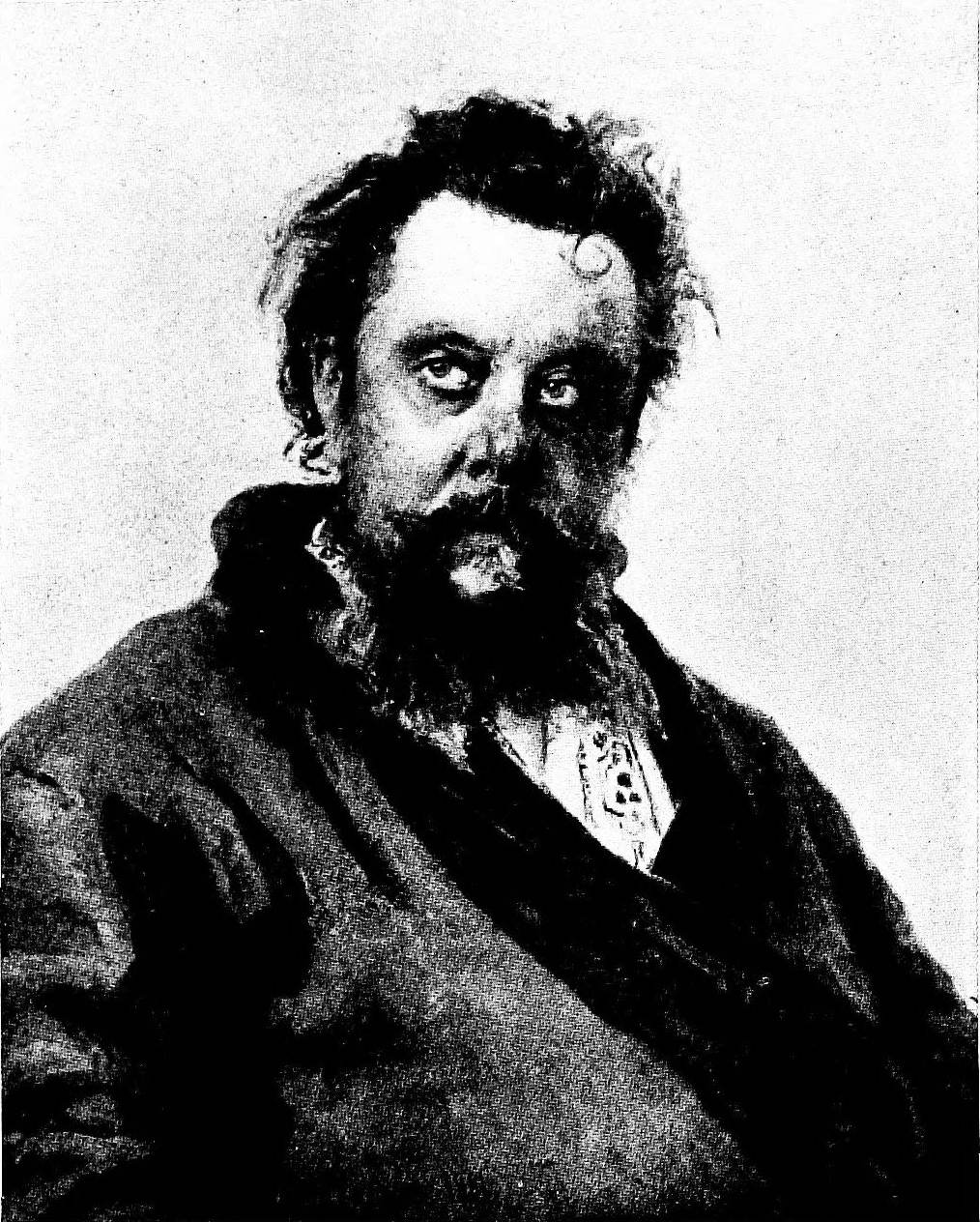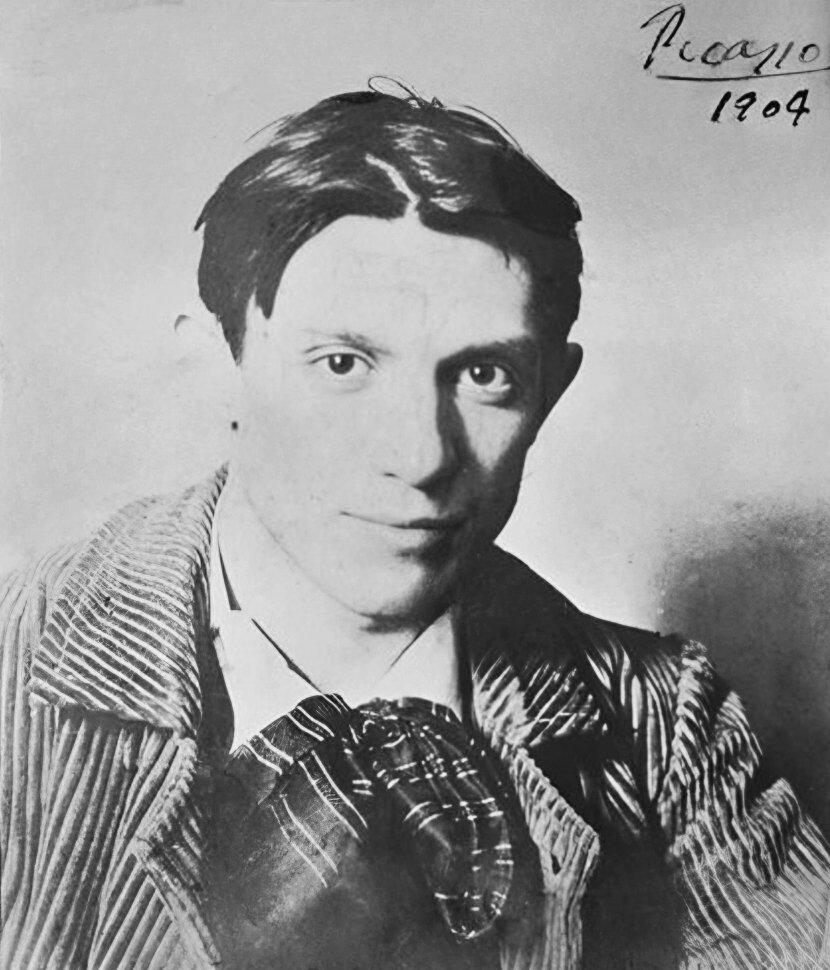

After Ilya Repin, portrait of Modest Mussorgsky (1881), reproduced as the frontispiece of M. Montagu-Nathan, Moussorgsky (London: Constable, 1916); via Project Gutenberg, public domain · Frontispiece halftone plate in M. Montagu-Nathan, Moussorgsky (London: Constable and Company, 1916), captioned 'MOUSSORGSKY / From a portrait by Repin', reproducing Ilya Repin's 1881 oil portrait of Mussorgsky painted from life in four sittings in a St Petersburg military hospital; taken from the Project Gutenberg edition of the book (eBook 77855), which was prepared from Internet Archive images. The file is Gutenberg's cleaned plate image at 1014 x 1264 pixels, used as is: not resized and not upscaled. The painting itself hangs in the Tretyakov Gallery; its image terms do not apply to this 1916 reproduction, and the holder's record was not used. · Public domain: 1916 London book reproduction of an 1881 painting by Ilya Repin (died 1930); Project Gutenberg states that no United States copyright exists in the work
composer · 19th Century
Modest Mussorgsky
1839–1881
Known For
Not yet included in personality matching — the documented evidence doesn't yet cover enough of the personality model. Everything else on this page is fully available.
Trait Constellation
Key Achievements
His opera Boris Godunov, begun in 1868 from Pushkin and Karamzin and finished in 1869, is the work at the centre of his reputation; after the opera house rejected it he reworked it, and a revised version was staged in 1874. He is generally acclaimed the finest of the Russian composers known as the Mighty Five.
Written in 1874 after a memorial exhibition of his friend Viktor Hartmann's drawings, his piano suite Pictures at an Exhibition became widely known through Ravel's 1922 orchestration.
His song cycles such as The Nursery and Songs and Dances of Death (1875) set unusual characters in distinctive speech rhythms, while Khovanshchina and other works were left unfinished at his death in 1881 and were edited or completed by colleagues, chiefly Rimsky-Korsakov.
Moments That Reveal Them
After the Imperial Operatic Committee rejected Boris Godunov, he spent 1871 reconstructing it, adding a Polish act with a love interest, moving the Kromy forest scene to the end and adding new episodes.
This is consistent with working on a rejected score until it could reach the stage. Persistence
After visiting the February 1874 memorial exhibition of Viktor Hartmann's work, he composed Pictures at an Exhibition over the following months, completing it in June 1874.
This is consistent with trying a new kind of piano music in response to a single stimulus. Experimentation
Turning Points
In September 1868 he began Boris Godunov, writing his own libretto from Pushkin and Karamzin; the first version was complete within a year and became the centre of his career.
This is consistent with a turn to large-scale work shaped by his own ideas rather than by his circle's advice. Creative Originality
Similar People
People whose overall profiles resemble theirs.

Elizabeth Cady Stanton

Franz Kafka

Duke Ellington

James Joyce

Leonardo da Vinci
Opposite Profile
Not a rival — a different profile shape worth a look.
Theodore Roosevelt
Sources
- Modest Petrovich Mussorgsky (Q132682), verified live via the Wikidata API (2026-11-06): label 'Modest Petrovich Mussorgsky', description 'Russian composer (1839-1881)', birth recorded as 9 March 1839 (Gregorian) with older-style and 1835 variants, death 16 March 1881 (Julian) / 28 March (Gregorian), citizen of the Russian Empire, Korean label 모데스트 무소륵스키. Orientation only; not used as support for any row.
- 'Modest Petrovich Mussorgsky', Encyclopedia of World Biography (Gale; copy on Encyclopedia.com; read in full). CANONICAL SIGNIFICANCE SOURCE: calls him generally acclaimed the finest of the Russian composers known as the Mighty Five, whose operas, above all Boris Godunov (begun 1868, first version finished 1869, then redrawn in 1871-72), explored human emotions 'in a new and forthright manner' and mark a crossroads in the history of opera; lists Khovanshchina (begun 1872, unfinished), Sorochinsk Fair (finished by Liadov and Karatygin), The Marriage (completed by Cherepnin in 1909), Pictures at an Exhibition (1874, orchestrated by Ravel in 1922) and Songs and Dances of Death (1875); says he often started projects with enthusiasm and bogged down in self-doubt, denied belonging creatively to any group, and that the doctrinaire Rimsky-Korsakov complained of the 'absurdity, ugliness, and illogic' of much of his music. Health and drinking remarks in the entry are not used.
- M. Montagu-Nathan, Moussorgsky (London: Constable and Company, 1916; Masters of Russian Music series; Project Gutenberg eBook 77855, read for the biographical chapters, the Boris, Pictures and Night on the Bare Mountain passages and the frontispiece caption). Early English biography by a historian of Russian music, partly admiring and partly condescending (calls most of his piano music of historical interest only): records that Boris was begun on 6 September 1868 and completed within a year, that the Imperial Operatic Committee rejected it in 1870 for, among other things, the lack of a female role and the novelty of the music, that he reconstructed it through 1871 guided by Stasov, Hartmann, Nikolsky and Rimsky-Korsakov (adding the Polish act and moving the Kromy scene), the shared 'Mlada' project of 1872, his Hartmann suite written after a memorial exhibition in spring 1874 and the posthumous editing of his works by Rimsky-Korsakov. The Gutenberg edition is the PD source of the portrait plate captioned 'MOUSSORGSKY / From a portrait by Repin'.
- N. A. Rimsky-Korsakov, My Musical Life (English translation by Judah A. Joffe, ed. Carl Van Vechten, New York: Knopf, 1923; IMSLP scan with poor OCR, read in the passages on Mussorgsky: the early 1860s circle, the 1871-72 shared rooms, his songs, his refusal of harmony and counterpoint, the changes after Boris). Memoir of a close colleague who later edited his scores and a self-interested, sometimes hostile witness: says he was a fine pianist and singer but knew little of orchestration, that Balakirev and Cui treated him as a lesser light, that the circle first ridiculed and then declared 'needless' the sciences of harmony and counterpoint, that he 'went through life without them' regarding his ignorance as a virtue, that his best 'ideal style' passages in Boris came from his unfinished Salammbo, and that after Boris he grew haughtier and more obscure. First-person account of another composer, so used for observed behaviour only, with the interpretations treated as his opinion.
- Marina Frolova-Walker, 'Musorgsky's Pictures at an Exhibition (1874)', lecture notes, Gresham College (24 September 2020; PDF read in full, 7 pages). Scholarly lecture by a Cambridge professor: calls the suite a conceptual work with no precedent in his own or other Russian piano music, written in a burst after Stasov's February 1874 memorial exhibition of Viktor Hartmann, bound up with his admiration for Liszt (who had praised his song cycle The Nursery) and his refusal of a Stasov-funded trip to meet him; describes his realist method of choosing an unusual character and giving it distinctive speech patterns in music; presents Taruskin's reading of the 'Two Jews' movement as caricature and her own alternative (a counter-voice) and notes that private letters contain antisemitic remarks typical of the time, which are context and are not scored here.
- 'Pictures at an Exhibition', Encyclopaedia Britannica (article read in full, short). Says the ten-movement work was composed in 1874 for piano as a memorial to Viktor Hartmann after a retrospective exhibition of Hartmann's drawings, became better known in Ravel's 1922 orchestration, was tidied up for printing in 1886 by Rimsky-Korsakov, and that the recurring Promenade represents the composer himself; its caption names the Tretyakov painting 'Modest Mussorgsky, portrait by Ilya Repin, 1881'.
- Boston Symphony Orchestra, program note 'Pictures at an Exhibition' (page read in full). Orchestra program note giving Mussorgsky's dates, the June 1874 composition of the piano suite, its 1886 publication by Bessel in a version 'heavily edited by Rimsky-Korsakov', the obscurity of the piece until Ravel's 1922 orchestration for Koussevitzky and the earlier orchestrations; its birth and death dates are given in the Gregorian calendar and differ from Wikidata's primary values.
- Royal Ballet and Opera Collections, 'Boris Godunov [1896]' work record (page read, short). Institutional catalogue note: the original Boris Godunov of 1868-69 had seven scenes in four acts; a revised nine-scene version (six from the original, three new) was the first performed, in 1874; Rimsky-Korsakov re-orchestrated it in 1896 and again in 1906-08 and his 1908 version was the standard one for many years; the original 1869 work was first performed in 1928.