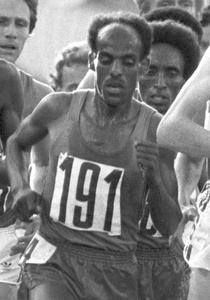

Photo: Valeriy Shustov, RIA Novosti archive, image #585168, 1 August 1980, CC BY-SA 3.0, cropped from the original · Wikimedia Commons file 'RIAN archive 585168 5,000m race.jpg': RIA Novosti archive photograph by Valeriy Shustov of the 5,000 m race at the Moscow Olympics, 1 August 1980, in which the caption identifies the runner wearing bib 191 as Miruts Yifter; original 1024 x 676 pixels, cropped by this project to the runner wearing 191 (210 x 300 pixels), never enlarged · CC BY-SA 3.0
athlete · 20th Century
Miruts Yifter
1944–2016
Known For
Not yet included in personality matching — the documented evidence doesn't yet cover enough of the personality model. Everything else on this page is fully available.
Trait Constellation
Key Achievements
Won both the 5,000 m and the 10,000 m at the 1980 Moscow Olympics with a sprint launched about 300 m from the finish, which earned him the nickname 'Yifter the Shifter'.
Took 10,000 m bronze at the 1972 Munich Olympics, won at the All-African Games and the first African Championships, and won the 5,000 m and 10,000 m double at the IAAF World Cups of 1977 and 1979.
Inspired later Ethiopian distance runners, among them Haile Gebrselassie, who followed his Moscow races, and after retiring coached athletes in Ethiopia and Canada.
Moments That Reveal Them
In the Moscow 5,000 m final he was boxed in on the last lap until a team-mate stepped aside on the back straight, and he launched his kick with about 300 m left, covering the last 200 m in 27.2 seconds.
This is consistent with carrying out a move he had rehearsed rather than improvising. Planning Orientation
At a 1971 United States v Africa meeting in North Carolina he started his sprint a lap early against Steve Prefontaine, and the next day he beat Frank Shorter over 10,000 m.
This is consistent with a willingness to commit to a long sprint despite the risk of fading. Risk Tolerance
Turning Points
After Ethiopia joined the boycott of the 1976 Montreal Games, which kept him out of the Olympics, he went on to win the 5,000 m and 10,000 m double at the IAAF World Cups of 1977 and 1979 before the 1980 Olympic double.
This is consistent with continuing to compete at the top after a missed Olympics. Persistence
Similar People
People whose overall profiles resemble theirs.

Yi Sun-sin

Maya Angelou

Elizabeth I of England

Ruth Bader Ginsburg

Wangari Maathai
Opposite Profile
Not a rival — a different profile shape worth a look.
Hildegard of Bingen
Sources
- Miruts Yifter (Q225913), verified live via the Wikidata API (2026-11-01): label 'Miruts Yifter', description 'Ethiopian long distance runner', born 1944-05-15, died 2016-12-22, Korean label present. Orientation only; not used as support for any row.
- Olympedia, 'Miruts Yifter' athlete biography and results, read in full: his talent was noticed after he joined the Ethiopian Air Force (following factory work and carriage driving); 1972 Munich 10,000 m bronze and a missed 5,000 m after arriving late; the 1976 boycott; 1980 Moscow 5,000 m and 10,000 m gold; 1973 All-African Games 10,000 m gold and 5,000 m silver; both distances at the 1979 African Championships; Ethiopia's team gold at the 1982 and 1983 cross-country championships; later emigration to Canada and coaching; birth date 15 May 1944 from his passport, with 1938 also seen and an age-dispute listing. CANONICAL SIGNIFICANCE SOURCE: the standard Olympic results archive. Concise and factual.
- Jason Henderson, 'Winner of Moscow Olympics distance double passes away', Athletics Weekly (23 December 2016, updated 2025), read in full: obituary with the Moscow 10,000 m (27:42.69, final 200 m in 26.8) and 5,000 m (13:20.91, final 200 m in 27.2, a teammate stepping aside on the back straight), the 300 m kick, his 1971 United States v Africa matches, the 1972 Munich bronze and the unexplained missed 5,000 m heat, four World Cup wins, a 62:57 half-marathon best in 1977, team cross-country golds and his later coaching, and that his birth year is reported anywhere from 1938 to 1944. Independent athletics press; a tribute, so favourable.
- Bob Ramsak, 'Miruts Yifter, Moscow double winner and one of Ethiopia's greatest athletes, has died' (IAAF tribute, December 2016, republished on RunBlogRun), read in full: results including the 1977 and 1979 World Cup doubles, his habit of surging and slowing to confuse opponents, practising a move with 300 m to go, Haile Gebrselassie's tribute, and his coaching in Ethiopia and Canada. The page also carries a separate unsourced commentary about his treatment after 1972 and his age, which was not used. Written by a friend and long-time federation writer, so admiring.
- Elshadai Negash, 'Miruts Yifter - Bekele reminds me of myself', IAAF (World Athletics), 14 August 2004, read in full: an interview with Yifter at the Ethiopian team base before the Athens Games, in which he describes practising the 300 m kick for Moscow and watching rivals until five laps remained, rejects rumours of drug use, and talks about coaching. Self-report in his own words, relayed by the federation's writer; the claims about his jailing and defection in it were not used.
- Len Johnson, 'The day I beat Yifter', Runner's Tribe (13 January 2017), read in full: a rival-runner's column by a former Melbourne Age athletics writer who raced Yifter at a Finnish half-marathon; describes how Yifter held his kick until the last 300 m at Moscow, his 1979 World Cup 10,000 m win by 40-50 m after sitting behind Craig Virgin, the 1981 World Cross Country race in which he sprinted a lap early, a list of rivals beaten by his finish, and that his birth year is uncertain. Independent first-person observer; anecdotal and affectionate but not fawning.
- Jeff Benjamin, 'Craig Virgin reflects on Miruts Yifter', RunBlogRun (January 2017), read in full: American distance runner Craig Virgin, who raced Yifter in the 1979 World Cup, says he coined the nickname 'Yifter the Shifter', that rivals felt no tactic could stop him, and that the 1980 boycott kept the two from meeting at Moscow. A rival's retrospective praise in a short interview piece; no race detail.