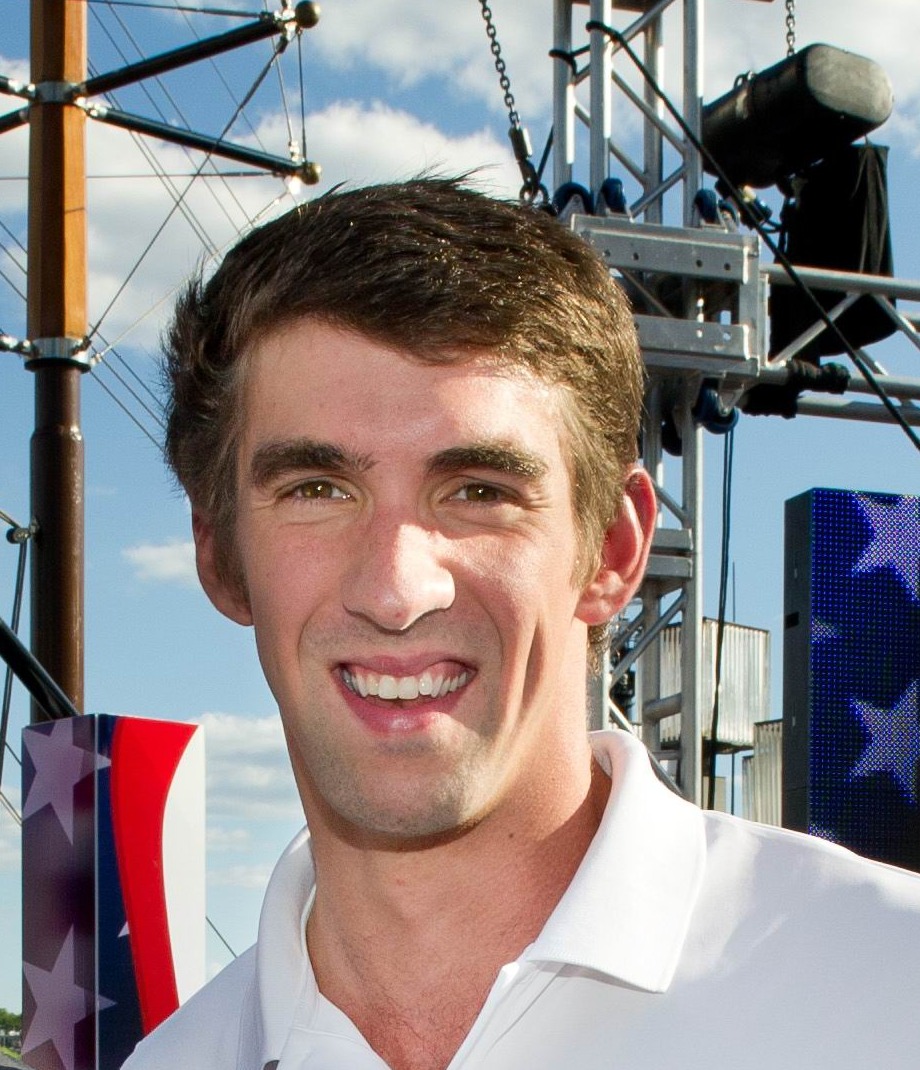
Photo: Jay Baker / Maryland GovPics (Government of Maryland), 10 September 2012, CC BY 2.0, cropped from the original · Wikimedia Commons, 'Maryland Olympians Celebration (7982573613).jpg' -- photograph from the Maryland GovPics Flickr stream (Government of Maryland) captioned 'by Jay Baker at Baltimore, MD.', taken 10 September 2012 at the Maryland Olympians Celebration in Baltimore; Commons licence CC BY 2.0 with a FlickreviewR pass dated 4 August 2016, and the live Flickr page (opened 2026-10-15) shows licence 'Some rights reserved' (CC BY 2.0) with the same caption; original file 4256 x 2832 pixels, cropped to a 920 x 1070 head-and-shoulders area that excludes the other person in the frame, with no resizing and no upscaling. · CC BY 2.0
athlete · Contemporary
Michael Phelps
b. 1985
Known For
Not yet included in personality matching — the documented evidence doesn't yet cover enough of the personality model. Everything else on this page is fully available.
Trait Constellation
Key Achievements
He competed at five Olympics from 2000 to 2016 and won 28 medals, 23 of them gold; Olympedia lists these as the Olympic best marks, and the International Swimming Hall of Fame puts them 10 medals and 14 golds ahead of the next-best totals.
At the 2008 Beijing Games he entered eight events and won all eight, setting seven world records and passing Mark Spitz's 1972 total of seven golds at one Games; the 100 m butterfly was decided by one hundredth of a second.
Over his career he set 39 world records, and at Rio 2016 he won the 200 m individual medley for a fourth straight Games, which Swimming World describes as a first for any swimmer, male or female, in a single event.
Moments That Reveal Them
In the 2008 Olympic 200 m butterfly his goggles filled with water on the dive, leaving him to swim with limited vision, and he still won in world-record time. Swimming World says this fitted his coach Bob Bowman's practice of giving him unforeseen problems to solve, and the Reuters profile recalls Bowman letting him race one of his first national junior meets without goggles.
This is consistent with an athlete who adjusts to an unplanned problem mid-race, although the sources credit the coach's deliberate preparation as much as the swimmer's own response. Adaptability
In Beijing, Bowman made sure Phelps knew of Milorad Cavic's remark that it would be bad for the sport if he won eight golds. In the 100 m butterfly Cavic led with about ten metres left; Phelps took an extra half-stroke into the wall and won 50.58 to 50.59, keeping the eight-gold bid alive.
This is consistent with a competitor who answers a rival's challenge with a sharper effort, though the sources credit much of the prompting to the coach. Competitiveness
Turning Points
After finishing fifth in the 200 m butterfly at the 2000 Olympics with no medal, he was handed a workout sheet from Bowman marked 'Austin, WR'; at the 2001 Spring Nationals he set the 200 m butterfly world record (1:54.92) while still 15, and he won his first world title that summer.
This is consistent with turning an early setback into a concrete, quickly met target, with the coach setting the target and Phelps saying he redoubled his efforts. Persistence
Similar People
People whose overall profiles resemble theirs.

Benito Juarez

Bette Davis

Oscar Niemeyer

Octavia Butler

John D. Rockefeller
Sources
- Michael Phelps (Q39562) -- verified live via the Wikidata API (2026-10-15): English label 'Michael Phelps', description 'American swimmer (born 1985)', born 30 June 1985, no date of death, citizenship United States, Korean label present. Orientation only; not used as support for any row.
- Olympedia (olympedia.org), 'Michael Phelps' athlete biography and Olympic results -- the Olympic historians' database: 28 Olympic medals (23 gold, 3 silver, 2 bronze) over 2000-2016 described as the best marks in Olympic history, the eight-medal Games of 2004 and 2008, the 2004 attempt at eight golds and the eight golds of Beijing 2008, the 2012 and 2016 programmes, the retirement after London and the return for Rio, and the Sports Illustrated Sportsperson of the Year listing. CANONICAL SIGNIFICANCE SOURCE. Statistical and biographical reference; passages outside his sporting record were not used. Read in full.
- International Swimming Hall of Fame (ishof.org), 'Michael Phelps' honoree page -- Hall of Fame summary of his career: the Olympic debut at 15, world records in the 200 m butterfly, 100 m butterfly and both individual medleys, the eight-event Athens programme, the eight golds and seven world records of Beijing 2008 including the 0.01-second 100 m butterfly and the extra half-stroke at the wall, the career totals (28 Olympic medals, 23 golds, 39 world records) and the fourth straight 200 m individual medley title at Rio. CANONICAL SIGNIFICANCE SOURCE (second). Institutional and celebratory in tone, written in the year of his induction; its closing paragraph is not used. Read in full.
- Michael E. Ruane (The Washington Post, via NBC News), 'As days wear on, Phelps feels refreshed', 12 July 2004 -- reported piece from the 2004 US Olympic Trials: seventeen races in seven days, coach Bob Bowman's account of post-race lactate tests showing faster recovery and his decision to keep the numbers from his swimmer, with the USA Swimming director of physiology, Olympic head coach Eddie Reese, former Michigan coach Jon Urbanchek ('blue-collar work ethic') and Mark Spitz commenting. Independent reporter with named expert voices; Bowman's explanation is labelled by him as a theory. Read in full.
- Kevin Van Valkenburg, 'No time for excuses', The Baltimore Sun, 30 April 2008 -- reporter's feature observing his Ann Arbor training 100 days before Beijing: a two-hour morning practice and an afternoon workout each day, 20,000 metres in a single practice, grumbling but completing the set, his own admission of uneven training the previous year, the 2004 public goal of eight golds, and refusing to stop swimming a film take until he touched the wall. Independent beat reporting with Phelps and Bowman quotations; passages outside his training were not used. Read in full.
- Sports Illustrated staff, 'Olympic Training Towns: Ann Arbor, Mich.', 27 February 2008 -- short magazine report on his Michigan training base: leg-strengthening drills, paddle work and non-kicking butterfly done as self-imposed resistance because competition did not always challenge him, the Michigan coaching culture, and training partner Erik Vendt's remark about training beside him. Independent magazine reporting, brief. Read in full.
- Sports Illustrated staff, 'Sportsman of the Year: Michael Phelps', 2 December 2008 -- long magazine feature for the award: the Beijing aftermath, Bowman on the pressure of the eight-gold quest and on his swimmer's training ('he can't work any harder'), the plan to rework his programme for 2012 with the 400 m individual medley dropped, and the magazine's remark that he tinkers to stay engaged. Admiring national feature; its passages outside his training and racing were not used. Read in full.
- World Aquatics (formerly FINA), 'Coaches Clinic, Day 1: Inspiring and sharing winning tips', Windsor, Ontario, 4 December 2016 -- governing-body report on Bob Bowman's opening talk to the Swimming Coaches' Golden Clinic: Phelps trained 365 days a year for six years before the 2004 Olympics, his 'unbelievable work ethic', training times often on or under world-record pace, and Bowman's description of him as a notorious descender in training. The governing body relays the coach's own account of his swimmer. Read in full.
- Matt Rees (SwimSwam), 'Bowman Shares Pre-Olympic Michael Phelps Workouts At ASCA Convention', 7 September 2017 -- trade-press summary of Bowman's remarks to the American Swimming Coaches Association: best training in 2002-04, about 80,000 yards a week at Michigan in 2004-08, only about half of training attended and two Saturday practices before London 2012, hand-written workouts 7, 14, 30 and 60 days out from each Olympics. The coach's own account relayed by a swimming-news site, so partly secondhand. Read in full.
- John Lohn (Swimming World), 'Ranking the 20-Greatest Swims of Michael Phelps' Career', republished 30 September 2023 from the archive -- editor's list of his defining races, selected with Bowman who comments on several: the 2000 Trials, the 'Austin, WR' note written the day after Sydney, the 2004 200 m freestyle against Thorpe and van den Hoogenband, the goggles failure in the 2008 200 m butterfly, the 0.01-second 100 m butterfly and its extra half-stroke, Rome 2009 against Cavic, the 2012 200 m medley tactic against Lochte, the 2015 breaststroke best and the fourth straight 200 m medley title, plus the editor's note that he was not fully dedicated to training before London. Trade-press editor working with the coach; admiring but specific. Read in full.
- Swimming World archive, 'Michael Phelps, Bob Bowman Talk to Media Before Final Meet', 26 July 2012 -- transcript of the London press conference: his comparison of conditioning with Beijing, dropping one event, the decision to swim the 400 m individual medley again, the teammate criticism of his preparation and his reply, and Bowman's remark on his focus under pressure. Self and coach statements in a press setting; used for the programme changes and the Clary episode, never as sole support. Read in full.
- Reuters (published by the Kyiv Post), 'The Greatest Olympian and his coach', 12 August 2012; also reprinted by The New Times, Kigali -- wire profile built on Bowman's recollections: three target times set at age 11, adversity deliberately created in practice and meets, a junior meet raced without goggles, the goggles that filled with water in Beijing, a rival's remark passed on before a race, and the London Games. Coach-sourced and admiring; passages outside his training and racing were not used, and its figure of up to 70 km a week before London conflicts with the coach's later account and is not used. Read in full.
- Wire report datelined Columbus, Ohio, 'Phelps fine-tuning himself for London Games', Bangor Daily News, 8 March 2012 -- preview of his London preparation: Bowman conceding he lost focus for a couple of years after Beijing, three weeks of altitude training in Colorado Springs, and a more selective choice of events. Wire credit not shown on the page; used only for the coach's statement and the programme choices. Read in full.
- Paul Newberry (Associated Press), 'Phelps Says Teammate Apologized Over Comments', CBS Baltimore, 26 July 2012 -- short wire report that Michigan training partner Tyler Clary apologised after a newspaper quoted him questioning Phelps's work ethic, and that Phelps said no apology was needed. Independent wire report of a critical teammate voice. Read in full.
- Evan Pioch (NBC4 Washington), 'U.S. Swimmer Questions Phelps' Work Ethic', 26 July 2012 -- local-news report quoting Clary's remarks to the Riverside Press-Enterprise about a lack of preparation, with Clary's apology and Phelps's reply. Secondary report of a quoted interview about the same incident as the wire report above, so the two are one incident, not two. Read in full.
- Wikimedia Commons file 'Maryland Olympians Celebration (7982573613).jpg' and its Flickr source page (Maryland GovPics, caption 'by Jay Baker', 10 September 2012, licence shown as Creative Commons Attribution 2.0) -- opened to check the portrait's licence. Not used for any scoring.