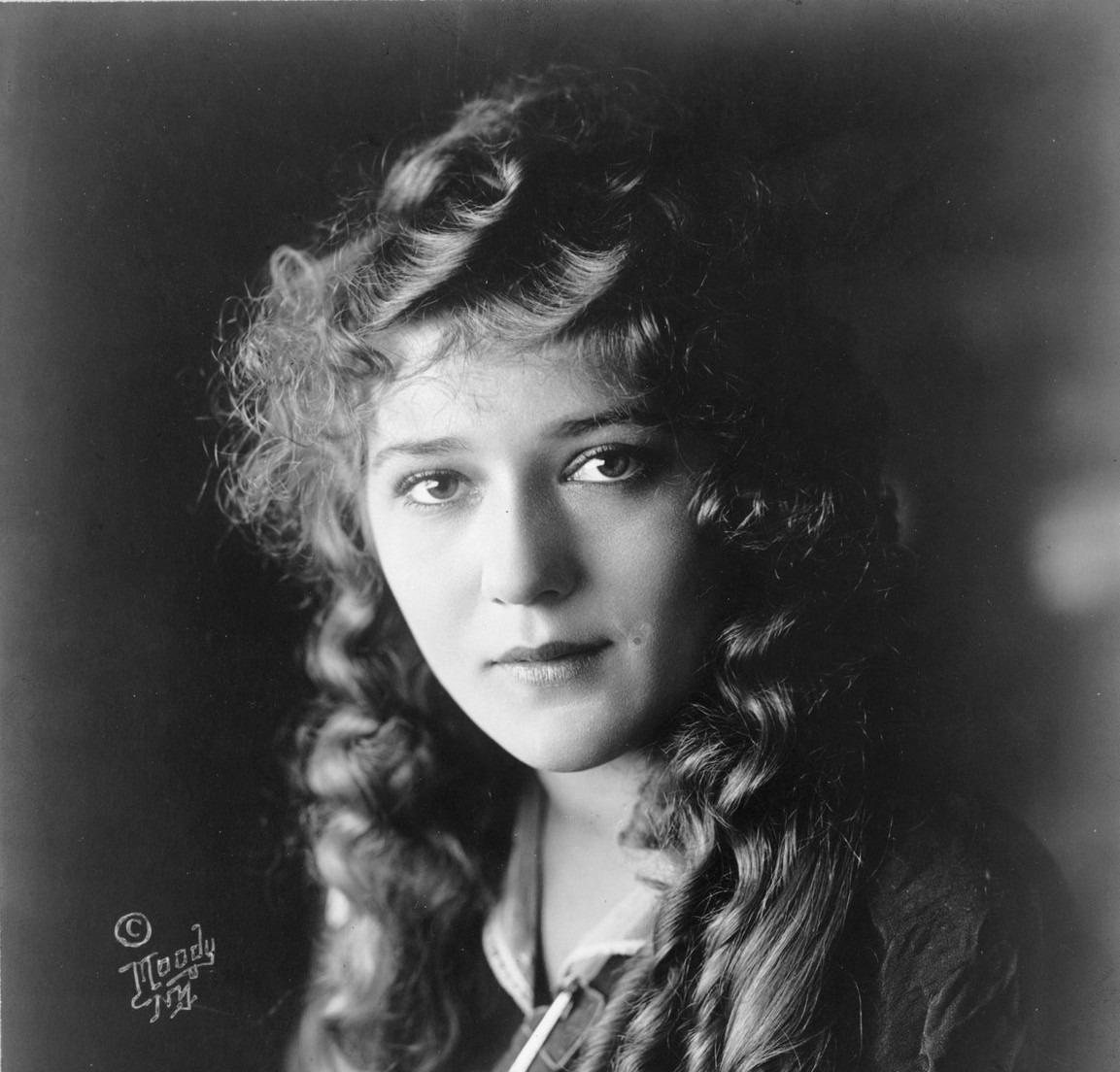

Rufus Porter Moody (1873-1922), 'Mary Pickford, head-and-shoulders portrait, facing front', photographic print, between 1910 and 1920; Library of Congress Prints and Photographs Division (LC-USZ62-117995); studio copyright notice 'Copyright by Moody, New York' (photographer died 1922) · Library of Congress Prints and Photographs Division, biographical-file portrait photograph (LC-USZ62-117995; digital ID cph.3c17995; control no. 97510062), Moody, New York · Public domain
Trait Constellation
Key Achievements
Mary Pickford began in Biograph one-reelers in 1909 and by the mid-1910s was one of the most popular and best-paid film stars in the world, known as 'America's Sweetheart'. Film historians describe her as a pioneer of a more naturalistic style of screen acting suited to the close-up camera. Tess of the Storm Country (1914) played on four continents, and by 1917 her films were drawing audiences from California to England and Japan.
In 1919 Pickford, Charlie Chaplin, Douglas Fairbanks and D. W. Griffith founded United Artists, a distribution company through which performers and filmmakers could control and share in the profits of their own films. Pickford had already won her own production unit in 1916, which film scholar Gaylyn Studlar describes as a first for a Hollywood star. She remained a United Artists owner, serving as an executive from 1935, until she sold her stock in 1956.
In 1927 Pickford was one of the 36 founders of the Academy of Motion Picture Arts and Sciences, and at the second awards, held in 1930, she won Best Actress for her first sound film, Coquette (1929). In 1921 she had helped found the Motion Picture Relief Fund, now the Motion Picture & Television Fund, and in 1932 she spearheaded its Payroll Pledge Program.
Moments That Reveal Them
In the summer of 1907, fifteen-year-old Gladys Smith, a touring actress, went to the office of Broadway producer David Belasco again and again and was told to come back tomorrow. Accounts differ on the details: a 2005 PBS documentary has her finally storming in and shouting that her life depended on seeing him, while Terry Ramsaye's 1926 history has her bursting onto his stage during a rehearsal. In both versions she joined his company, and Belasco gave her the stage name Mary Pickford.
This episode is consistent with the profile's high proactive agency: she acted to force an opening rather than waiting to be called. Proactive Agency
In 1918, while Adolph Zukor was out of town, Pickford put Stella Maris into production, playing both a wealthy invalid and Unity Blake, an abused orphan servant who walks with a limp, a part Zukor would not have approved. When he returned and found her on set in costume he was dismayed, and she reassured him that her character died before the end. The film was widely praised, and the PBS documentary says Zukor conceded that the performance was 'the most remarkable' of her career.
This is consistent with the profile's risk tolerance: she committed to an unconventional role her producer was likely to oppose, although later experiments such as Rosita (1922) were less well received by her fans. Risk Tolerance
Turning Points
By 1915 Pickford and her mother had concluded that her films were helping Paramount sell its other releases. After negotiations in 1916 that made national news, her contract with Zukor gave her a share of the profits through a production company in her name and a larger say over her films, and she began choosing material such as Poor Little Rich Girl (1917). From a salaried star she had become a producer, a position she carried first to First National in 1918 and then into United Artists in 1919.
This is consistent with the profile's strong autonomy need: she pressed for ownership and control of her work, not only a higher salary. Need for Autonomy
Similar People
People whose overall profiles resemble theirs.


Che Guevara

Aung San Suu Kyi

Nellie Bly

Mahatma Gandhi

T. E. Lawrence
Opposite Profile
Not a rival — a different profile shape worth a look.
Charles Darwin
Sources
- Mary Pickford (Q104109) -- verified live via wbgetentities (2026-10-04): en label 'Mary Pickford', description 'Canadian actress and producer (1892–1979)', P569 8 Apr 1892 (a second claim gives 1893), P570 29 May 1979, citizenship Canada (Q16), instance of human, ko label '메리 픽퍼드', P18 'Mary Pickford cph.3c17995u.jpg'. Orientation only; not used as support for any row.
- Mary Pickford -- English Wikipedia article (read 2026-10-04 via action=raw). Orientation only: used to locate leads (Motion Picture Relief Fund, film-donation history, the 1930 Oscar controversy) and never as support for a scored row.
- Sue Williams (writer/director), 'Mary Pickford', PBS American Experience, aired 4 April 2005 -- full documentary transcript read. SCHOLAR perspective (non-self): narration plus interviews with biographers Eileen Whitfield and Scott Eyman and film historians Tino Balio, Jeanine Basinger, Kevin Brownlow, Robert Cushman and Kathryn Fuller-Seeley, with archival clips of Pickford, Fairbanks, Zukor and Chaplin quoted. Used for her 1907-1919 career moves, the 1915-16 salary and production-unit negotiation, Stella Maris, the formation of United Artists, the 1920s Lubitsch/Rosita and Coquette episodes, and the later decline. Its passages on her marriages, her family's drinking, her own drinking and her mother are not used as trait evidence.
- PBS American Experience, 'The Long Decline' (feature article accompanying the 2005 Mary Pickford film) -- scholarly/editorial overview (non-self), read in full. Used for the sound-era transition (Coquette), the shift in audience taste, and her 1930s-50s attempts at producing and radio; its remarks on drinking and family are not used.
- PBS American Experience, 'Women on Screen' (interview excerpts with film historians Jeanine Basinger, Scott Eyman, Kevin Brownlow and Eileen Whitfield on Pickford's appeal, her working method with D. W. Griffith and her audience) -- scholar perspective (non-self), read in full.
- The Canadian Encyclopedia, 'Mary Pickford' (article by the encyclopedia's editors) -- national reference entry (non-self), read in full: Toronto birth, stage career, Biograph and IMP, United Artists and the Mary Pickford Company, the Motion Picture Relief Fund (1921), the Academy (1927), Coquette, her 1934 Toronto return and later citizenship. Its mention of her later alcoholism and depression is not used.
- Adolph Zukor with Dale Kramer, The Public Is Never Wrong: The Autobiography of Adolph Zukor (New York: G. P. Putnam's Sons, 1953), Internet Archive full text (Media History Digital Library scan) -- COUNTERPARTY perspective (her employer and negotiating opponent, writing self-interestedly about himself, but non-self about Pickford). Read locally: his 1913 recruitment of her at Delmonico's and the $500-a-week contract, the 1914-15 salary negotiation against a serial offer, the 1916 contract and the Mary Pickford Company inside Famous Players, her disclosure of the First National offer in 1918, and his account of her leaving. His comments on her private life are not used.
- Benjamin B. Hampton, A History of the Movies (New York: Covici-Friede, 1931), Chapter 8 'The Pickford Revolution', Internet Archive full text -- PERIOD industry historian (non-self) who personally negotiated with Mary and Charlotte Pickford in 1916 while trying to merge Paramount with V-L-S-E; an interested participant but independent of both Pickford and Zukor. Read pp. 146-160: the exhibitors' 'wrap everything around her neck' remark, the January 1915 contract, the demand for a Mary Pickford company, fewer and better pictures sold outside the program system, and the dispute over whether her Famous Players contract was still in force.
- Terry Ramsaye, A Million and One Nights: A History of the Motion Picture (New York: Simon and Schuster, 1926), Internet Archive full text -- PERIOD film historian (non-self), read in the passages on her 1907 Belasco entry, her moves between Biograph, IMP and Majestic, and the formation of United Artists in 1919 (the McAdoo and Price arrangements and the quoted 'lunatics have taken charge of the asylum' reaction). Its early-career material may derive from Pickford's own telling and is treated with that caution.
- Gaylyn Studlar (David May Distinguished University Professor, Washington University in St. Louis), 'Artists, United: The Radical Origin of a Film Corporation', Washington University Center for the Humanities, 8 April 2019 -- SCHOLAR perspective (non-self) and the main CRITICAL source: it credits the 1919 founding, but states that after assuming executive leadership of United Artists in 1935 Pickford 'made mistakes, among them the loss of UA's distribution of Disney films', that management left her hands in 1951 and that she sold her stock in 1956. Read in full.
- Cari Beauchamp (Hollywood historian), 'The Creation of United Artists', essay on the Mary Pickford Foundation website -- historian's account (non-self; hosted by the Foundation that preserves her legacy, so friendly in tone), read in full: the block-booking grievance, First National, the 1919 merger rumour, the 5 February 1919 signing, William McAdoo as counsel and Joseph Schenck's later role.
- Cari Beauchamp, 'Making and Promotion of Stella Maris', essay on the Mary Pickford Foundation website -- historian's account (hosted by the Foundation) drawing on Pickford's own memoir Sunshine and Shadow (self), trade-press reviews (Motion Picture World, Photoplay, 1918), Frances Marion and the Stella Maris press kit; read in full. Describes the dual role, the shoe she altered to produce a limp and Zukor's dismay on seeing her as Unity Blake.
- Cari Beauchamp, 'Lubitsch, Pickford and the making of Rosita', essay on the Mary Pickford Foundation website (written for the 2023 Museum of Modern Art restoration) -- historian's account (hosted by the Foundation) quoting Pickford's own later interviews (Brownlow 1974, Pratt 1958, Columbia oral history), read in full. The American Legion exchange and the 'court of the last appeal' remark rest on her own recollections (self perspective).
- Cari Beauchamp, 'Mary Pickford on the Road Selling Liberty Bonds', essay on the Mary Pickford Foundation website (cites 1918 Washington Post, Houston Press, Oakland Tribune, San Francisco Chronicle and Los Angeles Times reports) -- historian's account (hosted by the Foundation), read in full: the April-May 1918 tour with Chaplin and Fairbanks and her autumn 1918 California bond appearances.
- Cari Beauchamp, 'Mary Pickford's Role in the History of the Motion Picture & Television Fund', essay on the Mary Pickford Foundation website (cites Los Angeles Times reports of 1925-1941) -- historian's account (hosted by the Foundation), read in full: the 1921 founding, the WAMPAS fundraising link, the 1924 building-fund chairmanship, the 1932 Payroll Pledge Program and the 1941 groundbreaking of the Motion Picture Country House.
- Motion Picture & Television Fund, 'Our History' (mptf.com timeline 1921-1971) -- institutional history (non-self) of the organisation she helped found; read the 1921, 1932 and 1939-1942 entries: incorporation of the Motion Picture Relief Fund with Joseph Schenck as president and Mary Pickford as vice president, her 1932 Payroll Pledge Program and the 1941 groundbreaking of the Country House.
- Academy of Motion Picture Arts and Sciences, 'Academy History and Structure' (oscars.org) -- institutional page (non-self), read: the Academy was founded in May 1927 by 36 members of the film community, including Mary Pickford.
- Academy of Motion Picture Arts and Sciences, 'The 2nd Academy Awards, 1930' (oscars.org ceremony page) -- awards-body record (non-self), read: Mary Pickford listed as Best Actress winner for Coquette, with the other nominees.
- Mary Pickford Foundation, 'Mary Pickford and the Academy of Motion Pictures Arts & Sciences' -- legacy-organisation page (friendly, partly self perspective with her 1947 interview quotations), read in full: her role among the 36 founders, the early meetings at Pickfair, the lecture series and sound-transition exchange of knowledge, and the 1979 donation of her papers to the Academy library.
- Mary Pickford Foundation, 'Mary Pickford and the Library of Congress' -- legacy-organisation page (friendly), read in full: the 1943 request from the Librarian of Congress, the 1946 delivery of 42 crates of nitrate film, the 1970 transfer of Biograph negatives, and Librarian Daniel Boorstin's description of the gift as the most important individual donation to the Library's film collection.
- Margarita Landazuri, 'Coquette', Turner Classic Movies article, 3 January 2007 -- secondary film-writing (non-self), read in full: the 1929 sound film, her bobbed-hair image change and the favouritism charge after her 1930 Best Actress win. The tea-for-judges claim is a reported allegation and is not used as trait evidence.