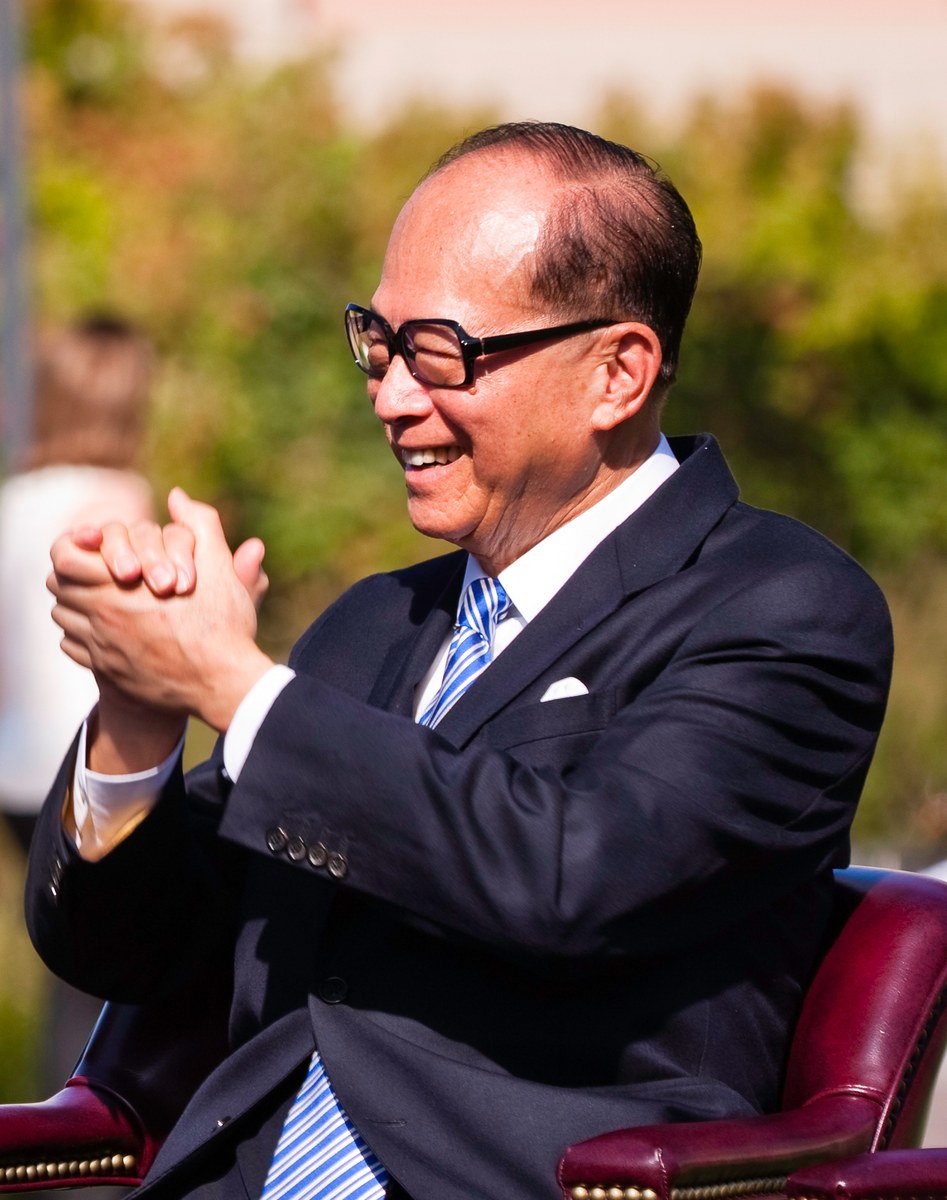
Photo: EdTech Stanford University School of Medicine, 2010, CC BY 2.0, resized from the original · Wikimedia Commons 'Li Ka Shing.jpg', imported from the Flickr account 'EdTech Stanford University School of Medicine' (photo IMG_5485, 29 September 2010) by the Flickr upload bot and licence-reviewed by a Commons reviewer; CC BY 2.0; the Flickr page itself currently shows the CC BY 2.0 licence. Original 1500 x 1900; downscaled once to 947 x 1200 (no upscaling). Identity: the Flickr title is only a file number, so identity rests on the Commons description and is corroborated by the date: Li Ka-shing attended the dedication of the Li Ka Shing Center at Stanford School of Medicine on 29 September 2010 (Stanford Medicine news; his own foundation), and the man pictured matches his documented appearance. A different file from the same shoot, 'Li Ka Shing 2010.jpg', has the same licence trail. · CC BY 2.0
entrepreneur · Contemporary
Li Ka-shing
b. 1928
Known For
Not yet included in personality matching — the documented evidence doesn't yet cover enough of the personality model. Everything else on this page is fully available.
Trait Constellation
Key Achievements
Founded Cheung Kong in 1950 as a plastics maker and built it into Hong Kong's leading private property developer by the late 1970s.
In 1979 bought a controlling interest in the British-founded trading house Hutchison Whampoa, which Britannica calls a first for a Chinese businessman, and expanded it into a conglomerate.
Under his leadership Hutchison became the world's largest independent port operator and expanded into mobile telecommunications, including the 1999 sale of its Orange stake to Mannesmann.
Moments That Reveal Them
In 1979 he quietly negotiated with the Hongkong and Shanghai Bank to buy its stake in Hutchison for less than half its book value, taking control of one of the colony's British-founded trading houses.
This episode is consistent with a developed sense for spotting underpriced opportunities. Opportunity Sensing
When he could not renew the lease on his plastics factory in the late 1950s, he bought the site itself, which Bloomberg describes as the start of his property career.
This is consistent with making use of whatever means were at hand to turn a setback into a new business line. Resourcefulness
Turning Points
In March 1997 he restructured his Hong Kong holdings, making Hutchison Whampoa the umbrella company for the group's infrastructure and telecommunications interests, and in 2015 reorganised the group into CK Hutchison Holdings and a separate property company.
These reorganisations are consistent with a deliberate, structure-minded approach to managing a very large group over decades. Planning Orientation
Similar People
People whose overall profiles resemble theirs.


Miriam Makeba

Jane Goodall

Yi Sun-sin

Che Guevara

Galileo Galilei
Sources
- Li Ka-shing (Q20151) -- verified live via the Wikidata API (2026-10-25): English label 'Li Ka-shing', description 'Hong Kong billionaire and entrepreneur', born 1928-06-13, no death date, P18 image 'Li Ka Shing.jpg'. Orientation only; not used as support for any row.
- Encyclopaedia Britannica (Britannica Money), 'Li Ka-shing', read in full: describes him as a Chinese entrepreneur and philanthropist, widely considered one of the most influential businessmen in Asia, with companies in real estate, ports and infrastructure; fled to Hong Kong in 1940; began as a salesman and founded a plastics company, Cheung Kong; artificial-flower exports in the 1950s; became Hong Kong's leading private developer by the late 1970s; in 1979 bought a controlling interest in Hutchison Whampoa; Hutchison became the world's largest independent port operator; the Orange mobile-phone sale for 8.83 billion pounds; characterises his approach as identifying promising technologies before they become lucrative, investing, and selling at peak value; also records criticism of his ties with officials and a backlash to a threat over a development. CANONICAL SIGNIFICANCE SOURCE. Reference-institution biography, retrospective; family and political passages deliberately not used.
- Bloomberg News wire profile reproduced by Money, 'The Richest Man in Hong Kong, an 89-Year-Old Wartime Refugee Worth $34 Billion, Is Retiring' (money.com, 2018), read in full: his retirement from CK Hutchison and CK Asset with son Victor taking over; Joseph Fan (Chinese University of Hong Kong, family-business researcher) on the retirement as the end of an era and on succession being prepared for decades; 'Superman' nickname and the portrait of him as both admired dealmaker and symbol of inequality and market dominance; teenage factory work of 16-hour days; plastic flowers first, then buying the site of his factory when the lease could not be renewed; buying Hong Kong property during the 1967 downturn; the 1979 purchase of Hutchison from HSBC at under half book value; the 15 billion dollar profit on selling Orange to Mannesmann in 1999; startup stakes in Facebook, Spotify and Siri; the 2015 restructuring into two companies and the 2017 Duet takeover. Business-wire journalism with a named academic and critical framing; mainland-government and Basic Law passages and family passages deliberately not used.
- 'Hutchison Whampoa Limited' company history (International Directory of Company Histories, reproduced on encyclopedia.com), read in full: Hutchison International and Hongkong and Whampoa Dock origins; the 1975 rescue by the Hongkong and Shanghai Bank and Wyllie's 1976-77 disposals and merger; the 1979 sale of the bank's 22.8 percent stake to Li's Cheung Kong at roughly half its worth and his chairmanship from 1981; later diversification into telecommunications, ports (Felixstowe), retail, utilities and energy; the Orange plc flotation in 1996; the March 1997 restructuring that made Hutchison the umbrella holding company; profits on the Mannesmann, Vodafone and VoiceStream stakes. Independent corporate-history account compiled from business press; reports setbacks as well as gains; Hong Kong-China transition passages not scored.
- Forbes profile page 'Li Ka-shing' (forbes.com/profile/li-ka-shing), read in full: nicknamed Superman and regarded as one of the most influential businessmen in Asia; retired as chairman of CK Hutchison and CK Asset in 2018 and remains senior adviser; the group has more than 300,000 employees in more than 50 nations; Cheung Kong Plastics started in 1950 with 6,500 dollars of savings and loans from relatives; the Li Ka Shing Foundation has donated more than 3.8 billion dollars with over 80 percent to Greater China; Li says it took him five minutes in 2007 to decide to invest in Facebook, and he also invested in Siri and Spotify. A magazine profile summary; the decision-time detail is his own account.
- South China Morning Post, 'Hutchison to sell stake in Orange for $113b' (scmp.com, 1999), read: Mannesmann buying the London-listed Orange for 19.8 billion pounds, paying Hutchison 16.29 pounds a share for its 44.81 percent stake, a 21.65 percent premium to the pre-talks closing price. Contemporaneous Hong Kong press report of the transaction terms; figures only.
- Hong Kong Free Press (AFP), 'Hong Kong billionaire Li Ka-Shing overhauls business by merging utilities firms' (hongkongfp.com, 8 September 2015), read in full: the January 2015 reorganisation into Cheung Kong Hutchison Holdings and CK Property, and the September 2015 offer of 11.6 billion dollars for the remaining shares of Power Assets by Cheung Kong Infrastructure to build a larger infrastructure platform, as the second reshuffle in a year; the company's statement of its stated rationale. Independent news-agency report of corporate actions.
- Radio Free Asia, 'Hong Kong Tycoon Li Ka-shing's China Withdrawal Highlights Broader Problems: Analysts' (rfa.org, 22 September 2015), read in full: reports that his group sold five office and shopping-mall projects in Shanghai, Beijing, Nanjing and Guangzhou in recent years and was selling assets on the mainland and in Hong Kong, a critical state-media editorial attacking him over it, and a Hong Kong academic's view that he had reasons for caution. A counter-voice: used only to corroborate the pattern of asset sales as business behaviour; its political framing is deliberately NOT scored.
- Stanford Medicine news, 'Li Ka-shing talks of Stanford's special place in his heart' (med.stanford.edu, September 2010), read in full: a Q&A with Li at the 29 September 2010 dedication of the Li Ka Shing Center for Learning and Knowledge: his pledge of one-third of his assets to philanthropy, more than 1.45 billion dollars given to projects worldwide by his foundation and other charities at that date, and his own account of valuing education. SELF MATERIAL from a university communications office: used only for the documented fact of the gifts and as identity context for the portrait photo; never as sole support for any row.
- Wikimedia Commons file page 'Li Ka Shing.jpg' (wikitext and API record) and the linked Flickr photo page, checked for the portrait: photograph IMG_5485 by the account 'EdTech Stanford University School of Medicine', 29 September 2010, uploaded to Commons by the Flickr upload bot on 20 January 2013 and licence-reviewed by a Commons reviewer, CC BY 2.0; the Flickr page itself shows 'Some rights reserved' with a CC BY 2.0 licence link today; original 1500 x 1900. Not used for any scoring.