Sequoyah
94% Profile Match
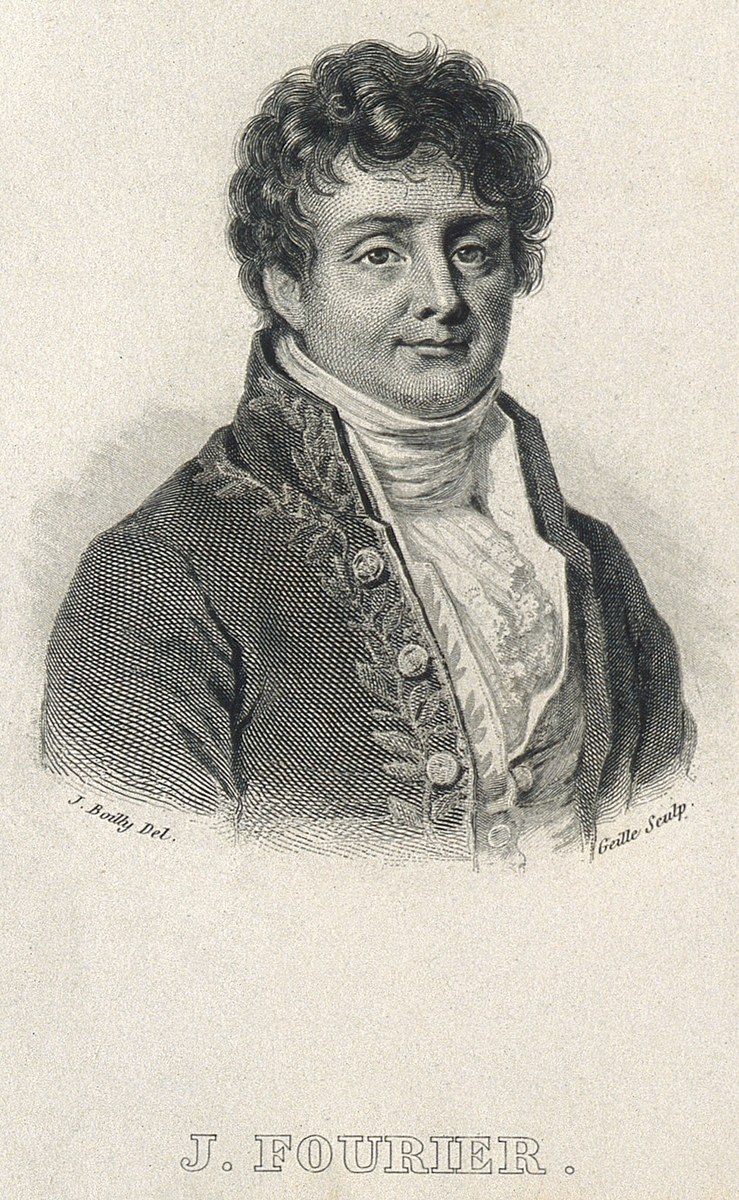
A.F.B. Geille after J. Boilly, 'J. Fourier', line engraving, Wellcome Collection, London (b4qh352u), public domain · Line engraving of Joseph Fourier by Amedee-Felix-Barthelemy Geille after a drawing by J. Boilly, lettered 'J. Boilly Del.', 'Geille Sculp.' and 'J. FOURIER.'; Wellcome Collection, London (work b4qh352u). The museum scan (2188 x 3328 pixels) was cropped to the plate and its caption and downscaled once to 739 x 1200 pixels; nothing was upscaled. Shown as a later engraving after another artist's likeness, not as a documented sitting. · Public domain (Wellcome Collection Public Domain Mark; engraving by an artist who died in 1843)
mathematician · 19th Century
1768–1830
Not yet included in personality matching — the documented evidence doesn't yet cover enough of the personality model. Everything else on this page is fully available.
In the Analytical Theory of Heat (1822) he showed how the conduction of heat in solid bodies can be analyzed with infinite series of sines and cosines, now called Fourier series.
He posed heat flow as a boundary-value problem in linear partial differential equations, a method that the Dictionary of Scientific Biography says extended rational mechanics and raised problems that drove mathematical analysis for the rest of the century.
He also developed a theory of units and dimensions for physical quantities and a method for counting the real roots of an equation, published after his death in 1831 as the Analysis of Determinate Equations.
When the Academy's 1811 prize jury crowned his heat memoir but said his analysis left something to be desired in rigour and generality, Fourier did not accept the verdict and, near the end of his life, had the memoir printed in the Academy's volumes without changing a word.
This episode is consistent with holding to his own account of the work against a jury of senior colleagues, at some cost to openness to criticism. Belief Updating
After the 1807 memoir went unpublished, he revised it with new analysis for the 1811 prize and then expanded it into the 1822 book, working, in Arago's words, from Grenoble, where his administrative duties hardly interrupted his research.
This is consistent with sustaining one research program over fifteen years despite non-publication and competing duties. Persistence
In 1815 he left his prefecture, came to Paris and, according to the Dictionary of Scientific Biography, tried to take up research full time after years in which it had been only a spare-time activity; he was elected to the Academy of Sciences in 1817 and became its perpetual secretary in 1822.
This is consistent with reorganizing his working life around research once the chance came. Persistence
People whose overall profiles resemble theirs.



Not a rival — a different profile shape worth a look.