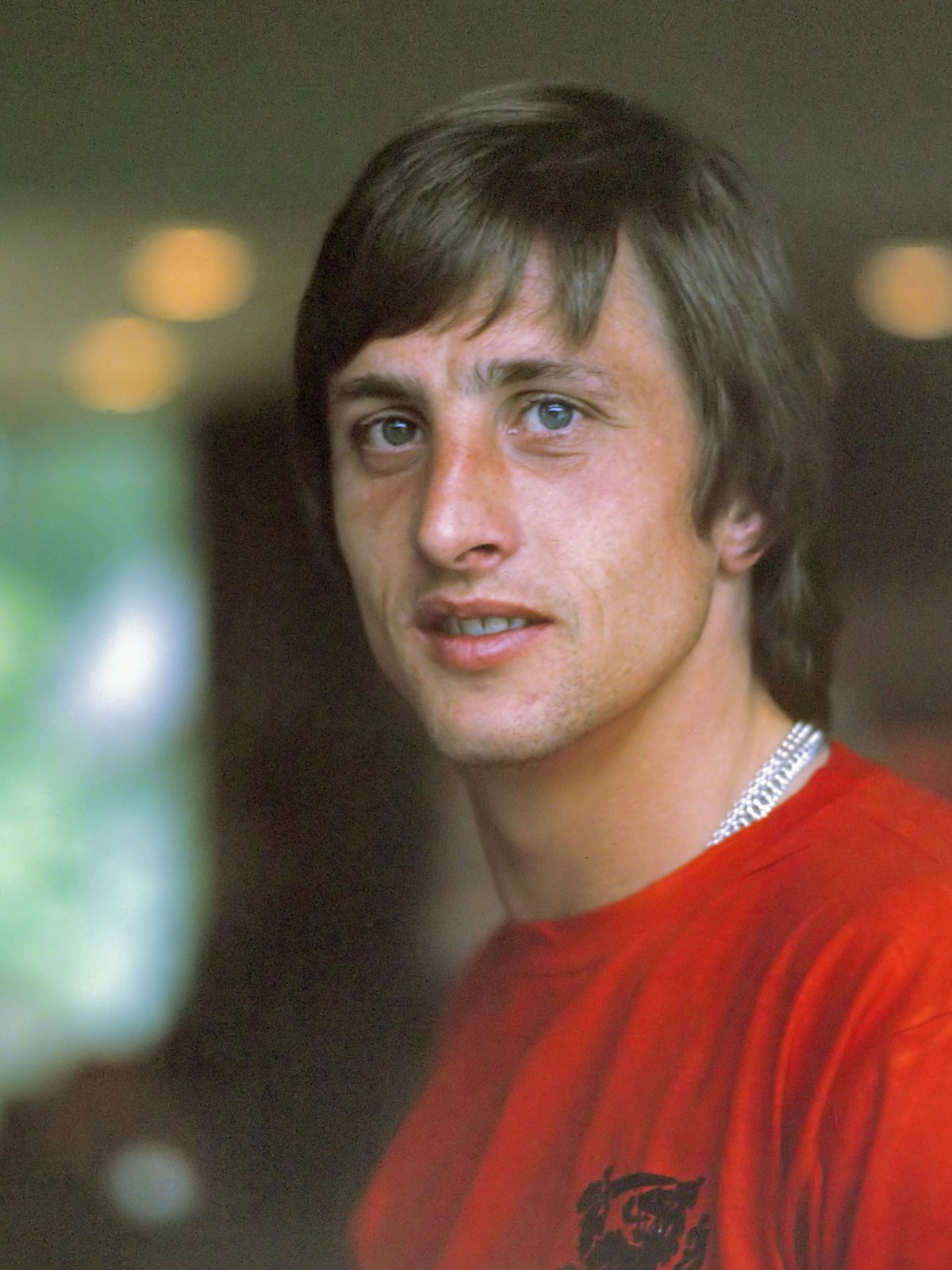

Rob Mieremet / Anefo, Nationaal Archief, 30 April 1974, CC0 1.0 (cropped from the archive photograph on Wikimedia Commons and resized) · Nationaal Archief (Fotocollectie Anefo, bestanddeelnr 254-9533), via Wikimedia Commons · CC0 1.0
Trait Constellation
Key Achievements
Cruyff coached Barcelona from 1988 to 1996. His teams won four consecutive La Liga titles between 1991 and 1994 and the 1992 European Cup, beating Sampdoria at Wembley, and the Guardian obituary counts eleven trophies in all.
As a player Cruyff won three consecutive European Cups with Ajax between 1971 and 1973 and moved to Barcelona in 1973. He played 48 times for Holland between 1966 and 1977 and was in the Dutch side that lost the 1974 World Cup final to West Germany.
Moments That Reveal Them
Before the 1974 World Cup, Cruyff persuaded coach Rinus Michels to take Jan Jongbloed as goalkeeper instead of Jan van Beveren, whom David Winner calls the nation's best shot-stopper and with whom he says Cruyff had a long-running feud. Winner writes that Cruyff had noticed Jongbloed was good with his feet and could roam far from goal, and that a goalkeeper acting almost as an extra defender would let Holland press higher up the pitch.
Choosing a goalkeeper for his footwork and range rather than his shot-stopping offers one example of the profile's creative-originality score; the reasoning comes from Winner's account alone. Creative Originality
In May 1989, at half-time of a friendly against a third-division side, Cruyff told the 18-year-old Pep Guardiola he was "slower than my granny" and did not let him play the second half. Guardiola later recalled that Cruyff pushed players hard and then protected them once they were in his team.
Blunt, unsolicited feedback of this kind is consistent with the profile's social-assertiveness score; Guardiola himself frames the bluntness as one half of a push-and-protect method. Social Assertiveness
Turning Points
In 1973 Ajax's players voted for Piet Keizer rather than Cruyff as captain, and within weeks Cruyff had left for Barcelona. Winner and Kuper both tie the move to the vote; in his own book, as quoted by Andy Bollen, Cruyff recalls the ballot and says he was still being accused of being too self-serving.
Accounts differ on how much the vote alone explains the departure; leaving rather than accepting the outcome is consistent with the profile's conflict-tolerance score. Conflict Tolerance
Similar People
People whose overall profiles resemble theirs.
Fela Kuti

Mark Twain

Aung San Suu Kyi

Elizabeth Cady Stanton

Hildegard of Bingen
Opposite Profile
Not a rival — a different profile shape worth a look.

Katherine Johnson
Sources
- Johan Cruyff -- English Wikipedia, orientation only (identity, dates, career spans such as Washington Diplomats 1980-81 and the 1982 Helmond penalty). Fetched and read in part; not used as support for any scored row.
- Johan Cruyff (Q17163) -- identity verified live via the Wikidata API: label 'Johan Cruyff', description 'Dutch footballer and manager (1947-2016)', citizenship Netherlands, born 1947-04-25, died 2016-03-24, sitelinks enwiki 'Johan Cruyff' and kowiki '요한 크라위프'; P18 lists 'Johan Cruijff (1974).jpg'. Orientation only.
- Julie Welch, 'Johan Cruyff obituary: Europe's first football superstar', The Guardian, 24 Mar 2016 -- staff-written obituary (independent secondary). Read in full: his 1985 return to Ajax without coaching badges under the title technical adviser, his practice of working individually with each player at Barcelona, the conversion of Guardiola from winger to midfield pivot, his 1996 dismissal by Nunez, and his forthright criticism of Holland's 2010 World Cup final tactics.
- David Winner, 'Johan Cruyff: father of modern game who also shaped Dutch culture', The Guardian, 25 Mar 2016 -- analytical essay by the author of Brilliant Orange (independent secondary). Read in full: his demands on the Dutch FA over player pay and travel insurance, the Jongbloed goalkeeper decision for the 1974 World Cup, in-match tactical changes, the 'conflict model', the 1973 captaincy vote, the 1983 Feyenoord move, the reorganised Ajax and Barcelona youth systems, and the 2011 Ajax change of leadership.
- Richard Williams, 'Johan Cruyff: the revolutionary who changed how the world saw football', The Guardian, 24 Mar 2016 -- tribute essay (independent secondary). Read in full: his role as leader of Ajax and Holland, his debut for the teenage Dennis Bergkamp as Ajax coach, the short 2008 Ajax technical-director spell, the removal from Barcelona's honorary presidency after four months, and his support for Spain over Holland in the 2010 World Cup final.
- Donald McRae, 'Pep Guardiola: I would not be here without Johan Cruyff. He was unique', The Guardian, 7 Oct 2016 -- interview in which Guardiola (a player under Cruyff at Barcelona, firsthand) describes the May 1989 half-time rebuke, Cruyff's push-then-protect handling of players, his training-ground methods, and the same patterns used from seven-year-olds to the first team. Read in full. Guardiola is a firsthand non-self voice; the interview is a Guardiola perspective, not Cruyff's.
- Donald McRae, 'Johan Cruyff: Maybe we were the real winners in 1974', The Guardian/Observer, 26 Mar 2016 -- account of a Sept 2014 interview with Cruyff himself. SELF perspective (Cruyff's own statements, including his description of how he explained defending to Guardiola and his belief in individual coaching); counted as one perspective together with his book quotations reproduced elsewhere. Read in full; not used as a sole support for any row.
- Andy Bollen, extract from Fierce Genius: Cruyff's Year at Feyenoord, The Guardian, 11 Feb 2021 -- book extract (independent secondary) on the 1983 dispute with Ajax and the move to Feyenoord; also reproduces Cruyff's own account from My Turn (self, one perspective) and Bollen's reading of his motives (interpretive). Read in full.
- Andy Bollen, 'Cruyff at 75: Remembering the Netherlands' favourite number 14', The Set Pieces, 25 Apr 2022 -- career retrospective by the author of Fierce Genius (same author as the Guardian extract, so ONE perspective with it). Read in full: Johnny Rep's recollection of Cruyff's constant instructions (quoted from Winner's Brilliant Orange), the 1985 refusal to take coaching badges, the individual work with Guardiola, the 2010 newspaper column and 2011 Ajax youth-plan dispute.
- 'Johan Cruyff: The player, the coach, the legacy', FourFourTwo, republished 24 Mar 2016 (standfirst credits Simon Kuper; the page byline shows FourFourTwo's Ben Clark; internal references show it was written around 2009). Long biographical profile with many dated behavioural anecdotes and the author's own interviews (independent secondary; anecdotes are largely single-sourced to this author). Read in full; the father, family, health and finance passages were deliberately not used.
- Steven Scragg, 'When Ajax didn't want Johan Cruyff he left for Feyenoord ... and won the double', These Football Times, 16 Dec 2019 -- season retrospective of 1983-84 (independent secondary). Read in full: the 1983 move and, on Cruyff's insistence, left-back Stanley Brard being played as a left winger.
- 'Johan Cruyff: The Tactical Masters', Coaches' Voice (unsigned in the fetched text; tactical analysis) -- description of his 1985-96 coaching model (triangles, 3-4-3/4-3-3, Laudrup as false nine). Read in full. Unsigned analysis, so used only as supporting evidence.
- Michael Laudrup, 'In my own words' column, fcbarcelona.com (Dec 2019) -- first-person recollection by a player Cruyff coached at Barcelona (firsthand non-self); hosted on the club's site, so treated as affiliated-hosted. Read in full: his account of Cruyff's training sessions and ability to explain a tactical situation in 10-15 seconds.
- Hristo Stoichkov, 'In my own words' column, fcbarcelona.com (May 2020) -- first-person recollection by a player Cruyff coached at Barcelona (firsthand non-self); club-hosted. Read in full: Cruyff's stated plan for him, his habit of saying things to rile him, and the calming talk he and Charly Rexach gave him after a clasico stamping incident.
- 'Ajax board of directors resign after disagreement with Johan Cruyff', The Guardian, 30 Mar 2011 -- unsigned agency-style news report: the board's resignation over a disagreement with Cruyff, who had returned in February 2011 to advise on technical issues and wanted the coach and former players given wider roles. Read in full; short, so used only as dated corroboration.
- 'Johan Cruyff set to leave Ajax after boardroom dispute', The Guardian, 29 Nov 2011 -- unsigned news report: the members' council called on the supervisory board (including Cruyff) to resign; Cruyff said he and ten club coaches would take legal action over three directors' appointments, on which he said he was not consulted. Read in full; short, used only as dated corroboration.