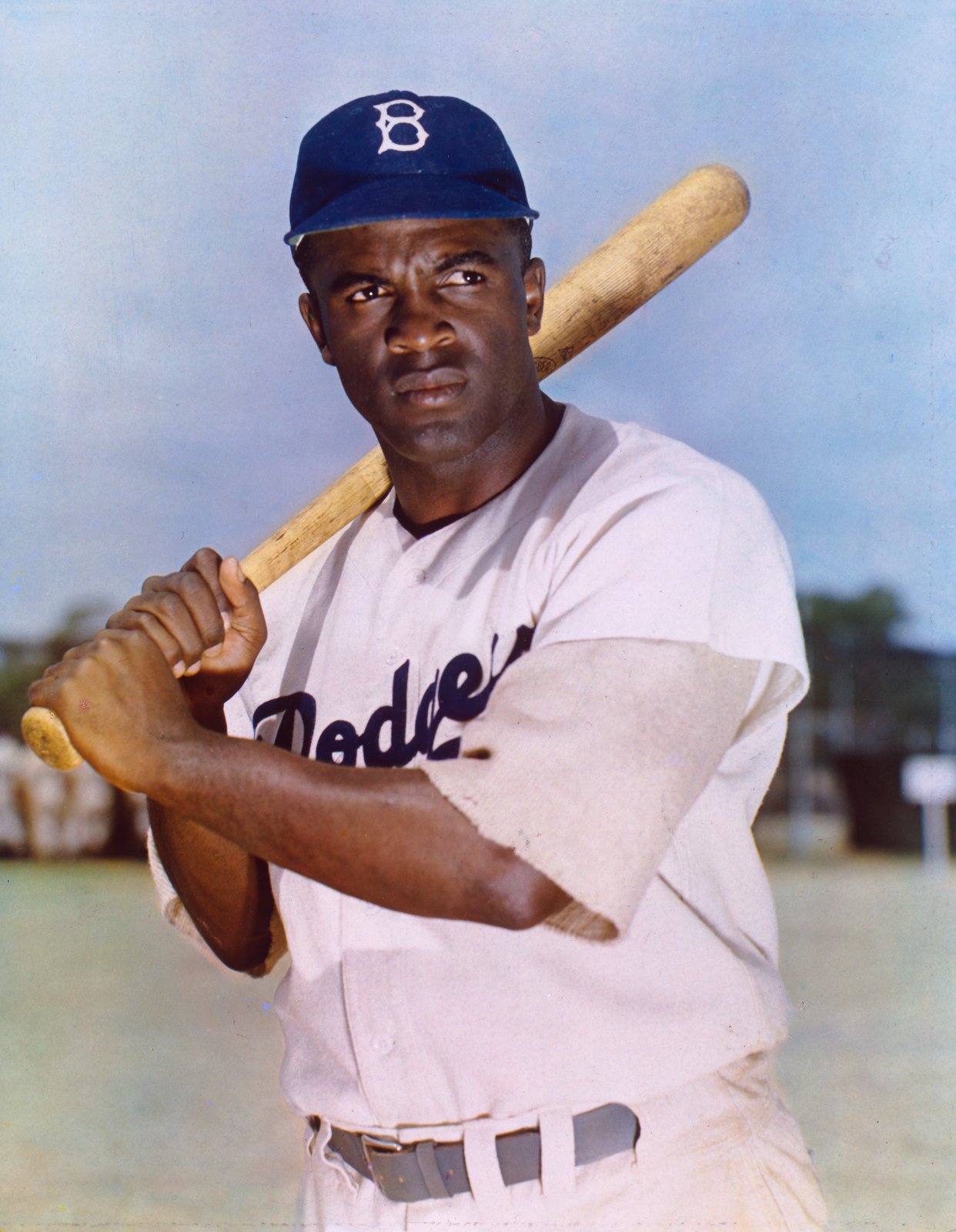

Harry Warnecke, with Robert F. Cranston, Frank Livia and Bill Klein, 'Jackie Robinson', color carbro print, 1949; National Portrait Gallery, Smithsonian Institution (NPG.97.135), CC0 · National Portrait Gallery, Smithsonian Institution (NPG.97.135), Smithsonian Open Access, via Wikimedia Commons · CC0 1.0
athlete · 20th Century
Jackie Robinson
1919–1972
Known For
Not yet included in personality matching — the documented evidence doesn't yet cover enough of the personality model. Everything else on this page is fully available.
Trait Constellation
Key Achievements
Robinson played his first game for the Brooklyn Dodgers on 15 April 1947, breaking the colour line that had kept Black players out of the modern major leagues. He was named Rookie of the Year that season and in 1949 won the National League batting title (.342) and its Most Valuable Player award.
In his ten seasons with Brooklyn (1947-56) the Dodgers won six National League pennants and the 1955 World Series, with Robinson playing first base, second base, third base and left field as the team required. He finished with a .311 career batting average and was elected to the Baseball Hall of Fame in 1962.
After retiring from baseball in January 1957 he became a vice president of the Chock full o'Nuts coffee and lunch-counter company. He later chaired the board of Freedom National Bank in Harlem, which was set up to lend to customers that established banks largely ignored.
Moments That Reveal Them
In Game One of the 1955 World Series at Yankee Stadium, with Brooklyn two runs behind in the eighth inning, Robinson stole home against pitcher Whitey Ford and catcher Yogi Berra. SABR researcher Bill Nowlin, working from contemporary reports, notes that Robinson and manager Walter Alston both said he ran on his own decision, and that Berra argued the call for the rest of his life. Nowlin counts 19 regular-season steals of home in Robinson's major-league career, and 12 attempts on which he was thrown out.
A steal of home with his team behind sits alongside the profile's high risk tolerance score. The dozen failed attempts are part of the same record, which is why that row is marked dual-edged. Risk Tolerance
At their August 1945 meeting Robinson had agreed with Dodgers president Branch Rickey not to respond to provocation during his first years in organized baseball. In a September 1947 cover story, Time reported that after Enos Slaughter of the Cardinals spiked him that August he 'set his teeth, and said nothing', and quoted him on the Phillies' bench abuse: 'I'd get mad. But I'd never let them know it.' When public criticism of the abuse led Phillies manager Ben Chapman to ask for a photograph together, Robinson agreed to pose with him.
Keeping to the agreement through two seasons is consistent with the profile's moderate discipline score. The restraint was a condition he had accepted rather than a plan of his own, so the score stays moderate. Discipline
Turning Points
In December 1956 Robinson agreed to join Chock full o'Nuts and had already sold the story of his retirement to Look magazine when the Dodgers traded him to the New York Giants. Because of the magazine contract he could not announce his decision until the story ran in January 1957. When Dodgers general manager Buzzie Bavasi suggested publicly that the article was a move for a better contract, Robinson turned down the Giants' offer; by his own later account, after that remark there was no way he would play again.
Standing by his decision in a public dispute with his old club offers one example behind the profile's conflict tolerance score. Historian Andy McCue's account shows the club had its own grievances, so this is one reading of a two-sided dispute. Conflict Tolerance
Similar People
People whose overall profiles resemble theirs.

Bette Davis

Miriam Makeba

Aung San Suu Kyi

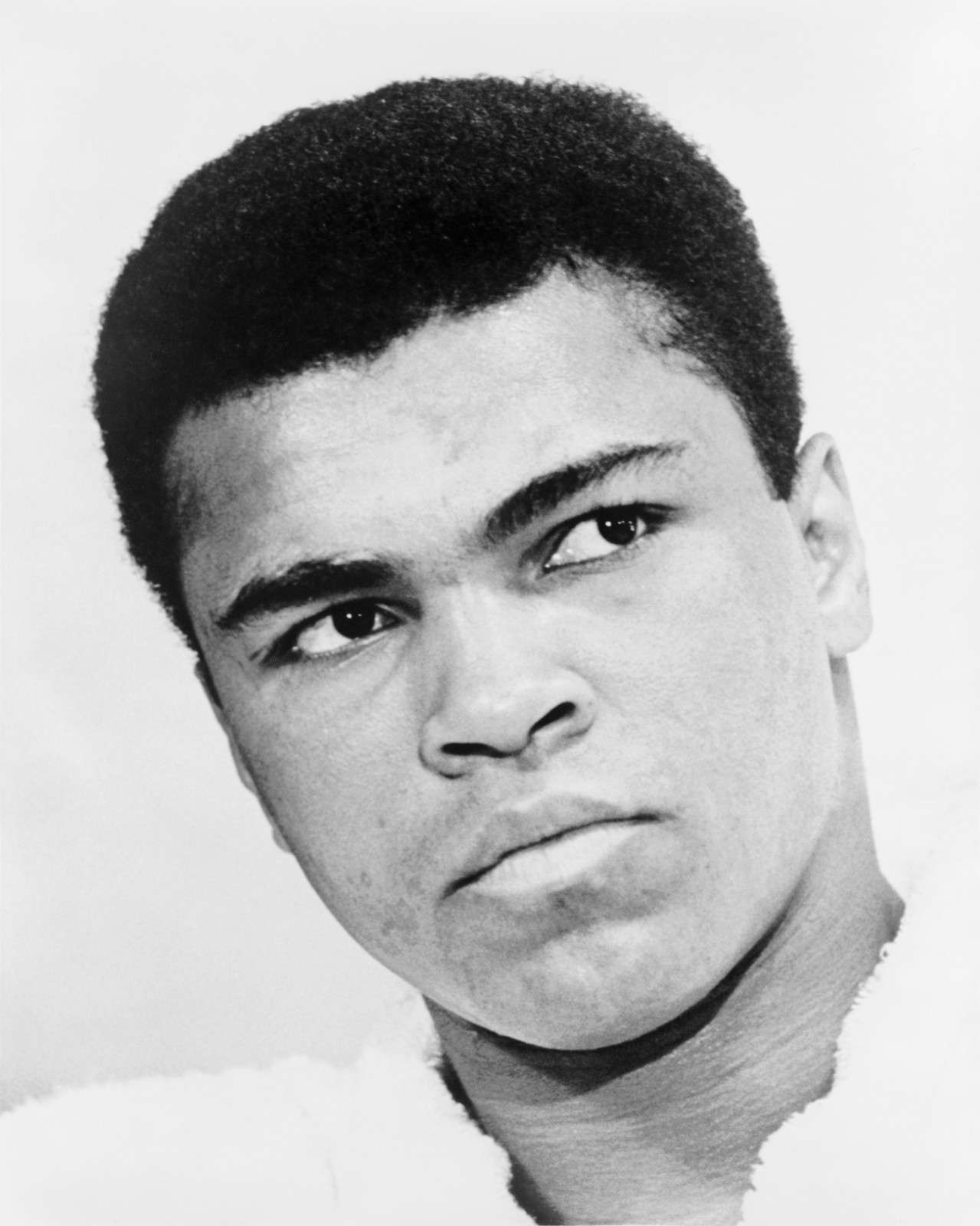
Muhammad Ali

Che Guevara
Sources
- Jackie Robinson (Q221048) -- identity verified live via the wbgetentities API (2026-09-26): label 'Jackie Robinson', description 'American baseball player (1919–1972)', P569 31 Jan 1919, P570 24 Oct 1972, citizenship United States (Q30), instance of human, en alias 'Jack Roosevelt "Jackie" Robinson', ko label '재키 로빈슨' (ko aliases '잭키 로빈슨', '재키로빈슨'), kowiki sitelink '재키 로빈슨', P18 'Jackie Robinson, NPG 97 135.jpg' and 'Jackie robinson abc sports announcer 1965.jpg'. Orientation only; not used as support for any row.
- Rick Swaine, 'Jackie Robinson', SABR Baseball Biography Project (posted 4 Jan 2012; adapted from Swaine, The Black Stars Who Made Baseball Whole, McFarland 2006) -- baseball historian's biography (non-self, secondary), citing contemporary papers (Pittsburgh Courier, Amsterdam News, Sporting News, Brooklyn Eagle), Tygiel, Kahn and Golenbock; carries Leo Durocher's and Bobby Bragan's recollections. Fetched with curl and read in full. Used: Fort Riley and Camp Hood 1943-44, the 1945 Monarchs season, the 18 Apr 1946 Montreal debut, 1947 conduct under the agreement with Rickey (Chapman, Slaughter), 1948 reporting out of shape, the 1953 position changes for Gilliam, the 1955 World Series steal of home, the 1956-57 trade and retirement, later business roles. Its 'most significant'/'first' rankings are not used.
- John Vernon (NARA archivist/historian), 'Jim Crow, Meet Lieutenant Robinson: A 1944 Court-Martial', Prologue (National Archives) vol. 40 no. 1, Spring 2008 -- archival study (non-self, scholar) built on Robinson's court-martial case file (RG 153), his personnel file (RG 319) and the Civilian Aide's records (RG 107); quotes Robinson's July 1944 handwritten letter to Truman Gibson (self), the Kimball-Buie telephone transcript and Lt. Col. Paul Bates's trial testimony. Used: Fort Riley PX telephone argument and refusal to play football (1943), the 6 Jul 1944 bus incident and guardhouse confrontation, the 2 Aug 1944 trial and acquittal on all charges, the later request for release. Also corrects later myths (the 758th transfer predated the incident; the 761st had not yet shipped). Fetched with curl and read in full.
- Jules Tygiel (historian, author of Baseball's Great Experiment), 'The Court-Martial of Jackie Robinson', American Heritage vol. 35 no. 5, Aug/Sep 1984 -- scholar's account (non-self) drawn from the trial transcript and interviews with fellow officers (Harry Duplessis, Ivan Harrison) and team-mate Pete Reiser's recollection of the Fort Riley baseball exclusion; quotes Robinson's letters to the NAACP (self). Used: Fort Riley PX call to the provost marshal (1943), refusal to play football, the 6 Jul 1944 bus and guardhouse events, the adversarial testimony of Captains Bear and Wigginton, the acquittal. Same episode as Vernon (one incident, two scholarly reconstructions). Fetched with curl and read in full.
- 'Sport: Rookie of the Year', Time magazine cover story, 22 Sep 1947 (time.com archive) -- CONTEMPORARY journalist's account (non-self) of the 1946-47 seasons; carries remarks by Branch Rickey and by Robinson (self), the Brooklyn committee's 'do's and don'ts' (no objecting to umpires, grin and bear insults), the Slaughter spiking and the Garagiola exchange, his move to first base, being 'cut loose' to steal without a signal, and his study of pitchers (Si Johnson's neck, timing Joe Beggs's windup before stealing home). Fetched with curl and read in full. Its descriptions of his home life and family are not used.
- Bill Nowlin, 'Jackie Robinson's Steals of Home', SABR Baseball Research Journal article (sabr.org/journal) -- researcher's game-by-game reconstruction (non-self) of every major-league attempt to steal home (19 successful regular-season steals, one in the World Series, 12 times caught), each sourced to the next day's New York Times, Brooklyn Daily Eagle, Boston Globe, Chicago Tribune or AP report; also the April 1946 Montreal debut, the Opening Day 1955 play in which he let a batted ball hit him to prevent a double play (New York Post), Rickey's 1946 instruction to run (via Rowan with Robinson, 1960), and the 28 Sep 1955 World Series steal with the Ford/Berra/Robinson reactions (AP). Fetched with curl and read in full.
- Andy McCue (historian; author of the Walter O'Malley biography Mover and Shaker, 2014), 'Jackie Robinson and Baseball Owners', SABR journal article (Dec 2021) -- scholar's account (non-self) of Robinson's relations with Branch Rickey and Walter O'Malley; carries Arthur Mann's firsthand note, Sam Lacy, Roger Kahn and O'Malley's own reported words (adversarial), plus Robinson's statements (self). Used: Rickey freeing him from the promise in 1949; Robinson raising segregated hotels on road trips; the disputed umpire-baiting fine and the press leak; O'Malley's 'prima donna' charge; the Dec 1956 Chock full o'Nuts agreement, Look contract, Giants trade and the Bavasi exchange. Its HUAC-testimony passage (political) is not used. Fetched with curl and read in full.
- Dave Anderson, 'Jackie Robinson, First Black in Major Leagues, Dies', New York Times obituary, 25 Oct 1972 (NYT Learning Network 'On This Day' reprint) -- sports columnist's obituary (non-self, contemporary journalist) carrying Robinson's own recollections (self) and remarks by Monte Irvin, Elston Howard, Bill Russell, Don Newcombe ('loud wrong'), Warren Giles and batboy Charlie DiGiovanna. Used: 1948 onward arguing with umpires and opponents after the rookie restraint; clubhouse debates; the 1954 Maglie/Davey Williams collision and Alvin Dark play (Robinson's own recollection with Reese's prompt); the 1957 Look/Bavasi sequence; later executive posts. Fetched with curl and read in full. Its passages on his health, his son's addiction and death, and his party politics are NOT used. NOTE: it says he stole home 11 times, which conflicts with Nowlin/SABR (19); the SABR count is used.