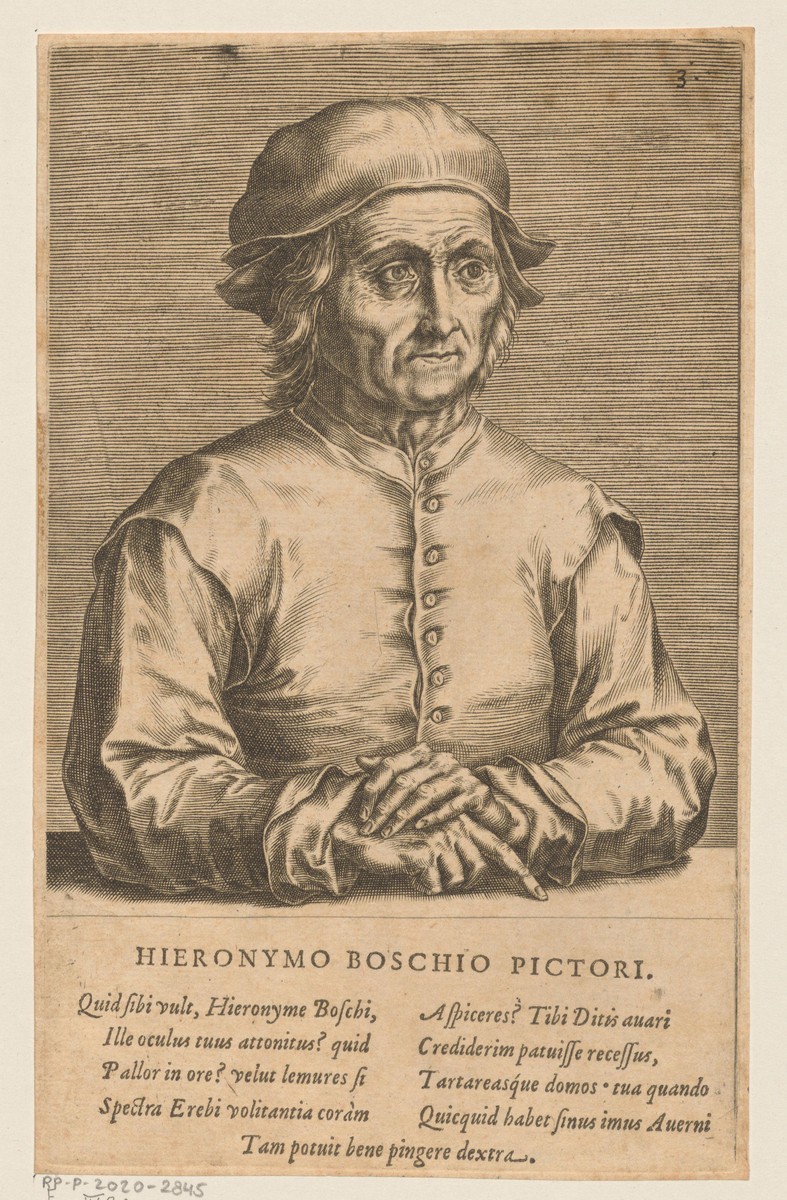

Cornelis Cort (printmaker), Dominicus Lampsonius (text), widow of Hieronymus Cock (publisher), 1572. Rijksmuseum, Amsterdam, RP-P-2020-2845 (https://id.rijksmuseum.nl/200777534) · Engraved portrait of Hieronymus Bosch, inscribed 'Hieronymo Boschio pictori', by Cornelis Cort, 1572, number 3 in the series of portraits of famous painters of the Low Countries (Pictorum aliquot celebrium Germaniae Inferioris effigies) with a Latin verse by Dominicus Lampsonius, published in Antwerp by the widow of Hieronymus Cock; Rijksmuseum, Amsterdam, object RP-P-2020-2845. Made decades after the painter's death. The file is the museum's 2438 x 3718 pixel scan downscaled to 787 x 1200 with no cropping and no upscaling; the scan shows the museum's object-number label at lower left. · Public domain (1572 engraving; the Rijksmuseum marks the image with the Public Domain Mark and releases the record data under CC0)
painter · Early Modern
Hieronymus Bosch
1450–1516
Known For
Not yet included in personality matching — the documented evidence doesn't yet cover enough of the personality model. Everything else on this page is fully available.
Trait Constellation
Key Achievements
Netherlandish painter from 's-Hertogenbosch (c. 1450-1516) known for an unusual, imaginative iconography of temptation, sin and hell in triptychs such as The Garden of Earthly Delights, the Haywain and the Temptation of St. Anthony.
His work was copied and sold under his name even in his lifetime, and Britannica credits his imagery with influencing Pieter Bruegel the Elder and the Surrealists; only about twenty-five panels are accepted as authentic.
He lived and worked all his life in 's-Hertogenbosch, in a family studio, where the Confraternity of Our Lady was an important client for whom he made works for its chapel and whom he advised on commissions.
Moments That Reveal Them
Infrared study for the Bosch Research and Conservation Project found overpaint and underdrawings showing that, in the project coordinator's words, Bosch often changed his mind as he worked.
This is consistent with a painter who revised his compositions during execution. Experimentation
For the Confraternity of Our Lady he made works for the redecoration of its chapel in Saint John's Cathedral, advised the brothers on commissions to other artists and craftsmen, and was sometimes called on to appraise submitted work.
This is consistent with an artist trusted by a local patron to guide and judge other makers' work. Collaboration
Turning Points
From 1486 Bosch appears in official records and on the register of the Brotherhood of Our Lady, and by the time of his death in 1516 he was acclaimed a distinguished painter and counted among the richest and most respected residents of his town.
This is consistent with a craftsman whose range of commissions and local standing grew over his career. Cross-Domain Range
Similar People
People whose overall profiles resemble theirs.

Franz Kafka

Mark Twain

Maya Angelou

Sequoyah

Leonardo da Vinci
Opposite Profile
Not a rival — a different profile shape worth a look.
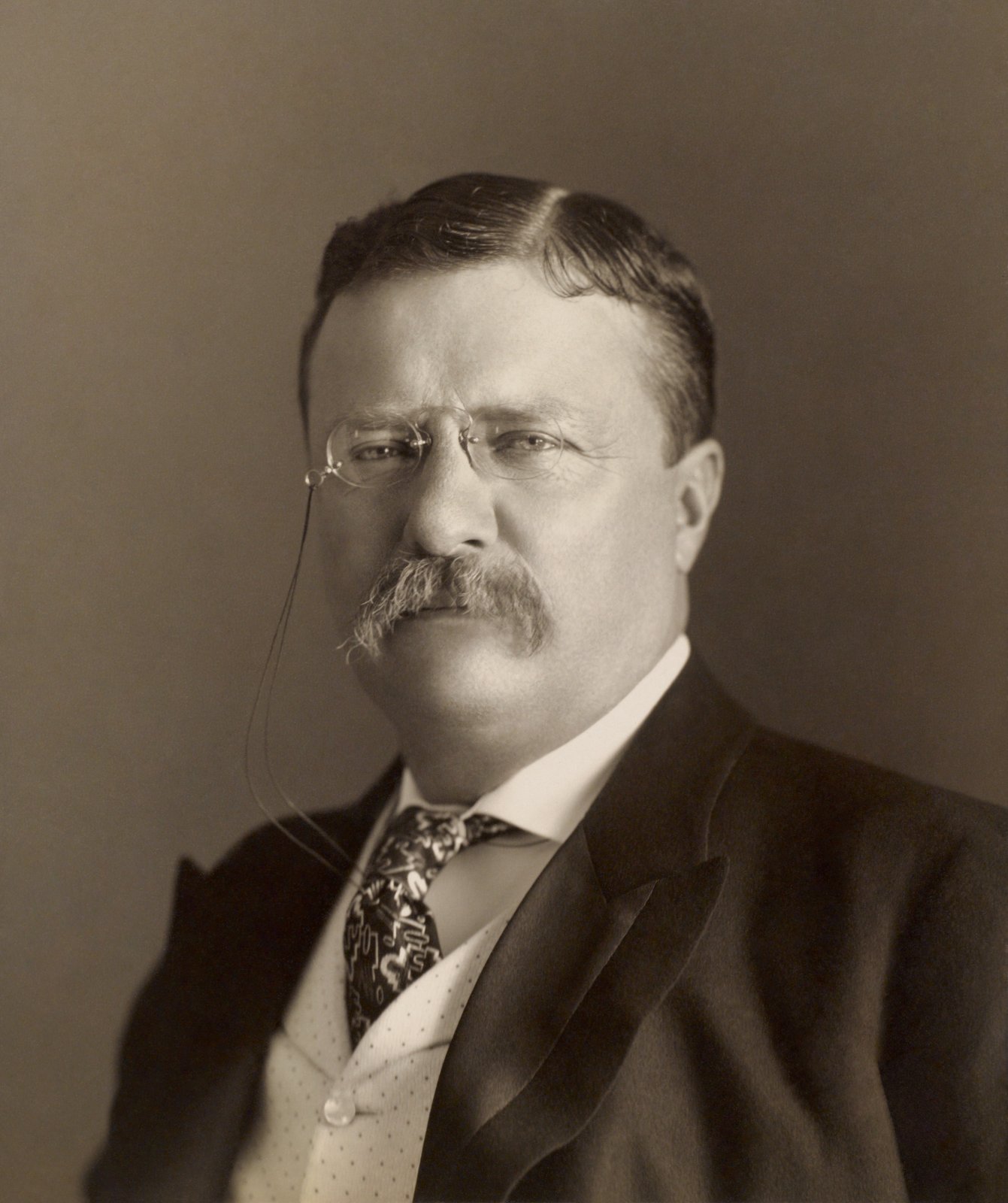
Theodore Roosevelt
Sources
- Hieronymus Bosch (Q130531), verified live via the Wikidata API (2026-11-04): English label 'Hieronymus Bosch', Korean label 히에로니무스 보스, Wikidata's description in the API response reads 'painters in art (1450-1516)', birth recorded only as 1450 (year precision), death 9 August 1516. Orientation only; not used as support for any row.
- Encyclopaedia Britannica, 'Hieronymus Bosch' (encyclopaedia biography by Kathleen Kuiper, fact-checked by the editors), read in full. CANONICAL SIGNIFICANCE SOURCE: innovative Netherlandish painter c. 1450-1516, born and buried in 's-Hertogenbosch, known for an unusual iconography and complex individual style, with devils, satire and moralizing meaning; of some 35 to 40 paintings then attributed to him only 7 are signed and none dated; little documentary information on his early life beyond being son and grandson of painters; his name is on the register of the Brotherhood of Our Lady and in official records from 1486 until his death, when he was acclaimed Insignis pictor; besides panel painting he undertook decorative works and altarpieces and made designs for stained glass; the great triptychs of his middle period include the Haywain, the Temptation of St. Anthony and The Garden of Earthly Delights; by his death he was among the richest and most respected residents of his town; widely imitated, influencing Pieter Bruegel the Elder and the Surrealists. Neutral encyclopaedia entry; the attribution counts are older than the 2016 research.
- Museum Boijmans Van Beuningen, 'Jheronimus Bosch' (artist page), read in full: probably born around 1450 in Den Bosch as Jheronimus van Aken, adopting the city's name when his fame had spread; an innovator of the medieval image tradition whose works are satirical but also witty and moving; around twenty-five works are known as originals; he lived and worked there all his life, from a family of painters whose studio stood on the market square (father, brother, a cousin and several uncles also worked in it); the Confraternity of Our Lady was an important client, for whom he made several works for the redecoration of its chapel in Saint John's Cathedral, advised the brothers on commissions to other artists and craftsmen, and was sometimes called upon to appraise submitted work; artists copied him even in his lifetime and some sold paintings under his name, and collectors were soon warned of forgeries; no more than about twenty-five panels are accepted as authentic; the page names 'Philip the Good' as the 1504 patron of a Last Judgment triptych, which cannot be right for a duke who died in 1467 and is not used here. Museum collection page; admiring in tone and not fully accurate on that point.
- New World Encyclopedia, 'Hieronymus Bosch' (encyclopaedia entry adapted from open sources), read in full: states that Bosch left no letters or diaries, that what is known comes from brief references in the municipal records of 's-Hertogenbosch and the account books of the Brotherhood of Our Lady, and that 'nothing is known of his personality or his thoughts on the meaning of his art'; gives him as grandson of the painter Jan van Aken and son of Anthonius van Aken, who advised the Brotherhood; first in the municipal record in 1474; joined the Brotherhood in 1488 (other sources say 1486/87); the Brotherhood's accounts record his funeral mass at Saint John's on 9 August 1516; fewer than 25 paintings can be attributed to him. Derivative encyclopaedia entry, used for what the records do and do not allow; the 1488 date conflicts with Britannica's 1486.
- Historians of Netherlandish Art Reviews, '2016 Publications on Hieronymus Bosch' (review essay of the Noordbrabants Museum and Prado exhibition catalogues and the Bosch Research and Conservation Project catalogue raisonne and technical studies, published November 2016), read in full: scholarly society review noting that new infrared examination shows underdrawing and preliminary layout as part of Bosch's working procedures, that he came from a multi-generational family of painters and 'surely had assistants', that the Dutch project secures a core group of authentic paintings and assigns very few to the workshop while the reviewer cautions against judging authenticity mainly from underdrawings and notes Fritz Koreny's different division of hands, and that the Vienna Last Judgment triptych shows multiple hands and was not studied in the exhibitions. Independent scholarly voice and the counter-voice on the size of the authentic corpus and the role of the workshop.
- Emily Sharpe, 'The story behind the reattributed drawing by Hieronymus Bosch', The Art Newspaper (23 December 2015), read in full: report on the Bosch Research and Conservation Project (a five-year study before the 2016 anniversary) upgrading the Infernal Landscape drawing from workshop to authentic after infrared reflectography and macro photography; the project coordinator Matthijs Ilsink says Bosch often changed his mind as he worked so that his paintings have a lot of overpaint and underdrawings, and that figures in the drawing match underdrawings beneath other works; the project also judged Christ Carrying the Cross in Ghent to be by a follower, which the museum says was not a surprise because the attribution had long been debated. Trade press report quoting one researcher; the 'changed his mind' remark is a single project member's statement.
- Rijksmuseum, Amsterdam, collection record RP-P-2020-2845 'Portret van Jheronimus Bosch' (linked-art record at id.rijksmuseum.nl/200777534), read: engraving of 1572 by Cornelis Cort (an attribution to Johannes Wierix is marked as rejected), text by Dominicus Lampsonius, published by the widow of Hieronymus Cock (Volcxken Diericx), Antwerp, number 3 in the series 'Pictorum aliquot celebrium Germaniae Inferioris effigies' (portraits of famous painters of the Low Countries), plate 196 x 122 mm; the image carries the Public Domain Mark and the record data CC0. Museum record used for the portrait, not as support for any row.