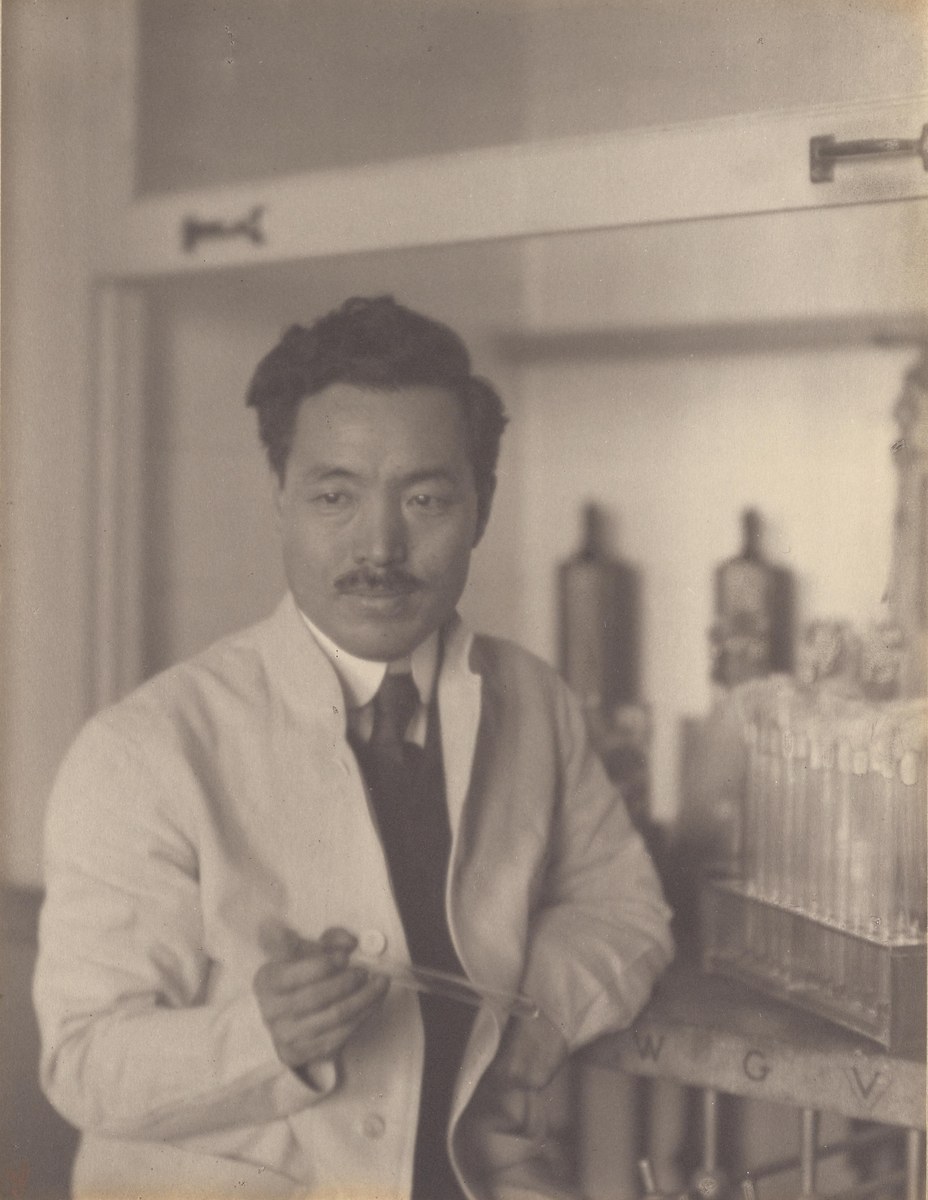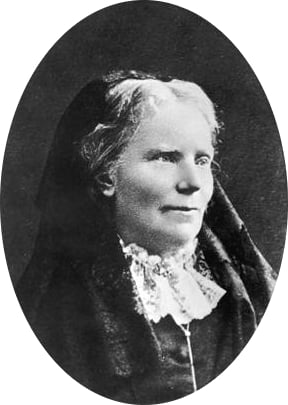

Doris Ulmann, Hideyo Noguchi, 1919, Doris Ulmann Photograph Collection, University of Oregon Libraries, Special Collections and University Archives. · Photographic portrait of Hideyo Noguchi in a laboratory with culture tubes, by Doris Ulmann (1882-1934), dated 1919 and inscribed by Noguchi, in the Doris Ulmann Photograph Collection, University of Oregon Libraries, Special Collections and University Archives. The Libraries' item record states photographer, date 1919, rights 'No Copyright - United States' and Public Domain Mark 1.0; the photographer died in 1934, so US copyright (life plus 70 years) has expired and the work is not a candidate for URAA restoration. The 6840 x 9320 pixel scan shows the whole mount, inscription and colour target; it was cropped to the photographic print only and downscaled to 928 x 1200, never upscaled. · Public domain (photographer died 1934; University of Oregon rights statement and Public Domain Mark 1.0)
scientist · 20th Century
Hideyo Noguchi
1876–1928
Known For
Not yet included in personality matching — the documented evidence doesn't yet cover enough of the personality model. Everything else on this page is fully available.
Trait Constellation
Key Achievements
At the Rockefeller Institute for Medical Research he detected the syphilis spirochete in the brains of patients with general paralysis in 1913, which a scholarly biography calls the one enduring accomplishment of his prolific syphilis period.
He isolated Bartonella bacilliformis and showed in animals that Oroya fever and verruga peruana are two forms of one disease.
From 1918 he reported Leptospira icteroides as the cause of yellow fever and a vaccine was made from it, but the claim was discredited by 1927 when the cause was shown to be a virus; he died of yellow fever in Accra in 1928.
Moments That Reveal Them
In Accra in 1927-28 he worked on the yellow fever virus question after the expedition's Adrian Stokes had died, and historians describe his laboratory as confused and his labelling and screening as careless.
This is consistent with a researcher whose laboratory practice was loose, as described by critical historians. Detail Orientation
In 1918 he reported a spirochete from patients in Ecuador, produced guinea pig infections without adequate controls, and the Rockefeller Institute distributed a vaccine made from it until 1926.
This is consistent with a fast, confident experimenter whose controls did not match the strength of his claim. Analytical Rigour
Turning Points
In December 1900 he arrived at Simon Flexner's University of Pennsylvania laboratory in Philadelphia with borrowed passage money, and in 1904 he joined the Rockefeller Institute under Flexner, where he stayed for the rest of his career.
This is consistent with a researcher who staked his career on moving abroad with very little support. Risk Tolerance
Similar People
People whose overall profiles resemble theirs.

Mustafa Kemal Atatürk

Benito Juarez

Aung San Suu Kyi

Anna Pavlova

Frederick the Great
Sources
- Hideyo Noguchi (Q356114) -- verified live via Wikidata (2026-10-30): English label 'Hideyo Noguchi', description 'Japanese bacteriologist (1876-1928)', Korean label '노구치 히데요', born 1876-11-09 (Wikidata value), died 1928-05-21, citizenship Japan, P18 image 'Noguchi Hideyo.jpg'. Orientation only; not used as support for any row.
- National Diet Library (Japan), 'Portraits of Modern Japanese Historical Figures: Noguchi Hideyo' (entry text, read in Japanese) and the site's usage notice. CANONICAL SIGNIFICANCE SOURCE: it describes him as a bacteriologist who went to the United States in 1900, in 1911 achieved a pure culture of the syphilis spirochete at the Rockefeller Institute for Medical Research, received the Imperial Academy prize in 1915 and Academy membership in 1923, and travelled to Central and South America and Africa to find the yellow fever pathogen, dying of the infection in Ghana in 1928. Brief institutional reference text written by library staff; it does not mention the later discrediting of his yellow fever work.
- 'Hideyo Noguchi' (Dictionary of Scientific Biography entry, Gale, reproduced on Encyclopedia.com), read in full: training and the passage to Philadelphia under Simon Flexner, the Rockefeller Institute career, the 1913 detection of the syphilis spirochete in the brains of paretics called the sole enduring accomplishment of the period, Oroya fever and verruga peruana shown to be one disease caused by Bartonella bacilliformis, the Leptospira icteroides yellow fever claim and its 1927 discrediting, the work at Accra and his death. Scholarly reference biography by a named historian of science that is openly critical of his technique and conclusions and of how his patrons minimised his faults; its speculation about his state of mind and the manner of his death is not used.
- Siang Yong Tan and Jill Furubayashi, 'Hideyo Noguchi (1876-1928): Distinguished bacteriologist' (Singapore Medical Journal 55(10), 2014, pp. 550-551), read in full: the Penn and Rockefeller career, the 1909 snake venom monograph, the complement-fixation and luetin tests, the 1913 isolation of the syphilis spirochete from the brains of paresis and tabes patients, Rocky Mountain spotted fever antiserum, Oroya fever and verruga peruana, and a 'dark side' section on the incorrect aetiologies, the Ecuador yellow fever claim with inadequate controls, criticism of his methods and record keeping, non-reproducible syphilis culture claims and criticism of luetin tests on children. Short modern medical-history profile by a physician and a student, citing Plesset and Kita; the sentences about his own health and mental state are explicitly speculative and are not used.
- J. Gordon Frierson, 'The Yellow Fever Vaccine: A History' (Yale Journal of Biology and Medicine, 2010), read for the Noguchi sections: his 1918 Ecuador work, the naming of Leptospira icteroides, the vaccine and antiserum made at the Rockefeller Institute and the 7,964 vaccinations he reported, the criticism of the sloppy trial statistics, the 1926 Theiler and Sellards result that his organism was serologically identical to the Weil's disease leptospire, the discontinued distribution, and his 1927-28 work in West Africa. Independent vaccine-history review by a physician-historian, critical of Noguchi's practice in Accra.
- S. S. Kantha, 'Hideyo Noguchi's research on yellow fever (1918-1928) in the pre-electron microscopic era' (Kitasato Archives of Experimental Medicine 62(1), 1989, pp. 1-9): only the PubMed abstract was readable. It describes the yellow fever investigations as one of the low points of his career, says his Leptospira icteroides claim was discredited in 1927, and says the paper assesses the causes of his erroneous interpretation. Used for that framing only.
- Joseph Luna, 'Hideyo Noguchi's Bust Is Back in Welch Hall' (Rockefeller University, Natural Selections), read in full: his arrival at Flexner's Philadelphia laboratory in 1900, the self-taught preparation for the Japanese medical exam, the syphilis spirochete culture work with filtered rabbit preparations, twenty-five Nobel nominations, the Ecuador yellow fever claim and its doubt when the African cases showed no leptospira, and his death in Accra in 1928. Admiring institutional feature from his own institution that nevertheless recommends the Kita biography for an honest account of his faults.
- University of Oregon Libraries, Special Collections, Doris Ulmann Photograph Collection: 'Hideyo Noguchi [001a] (recto)', photographer Doris Ulmann (1882-1934), 1919, rights statement 'No Copyright - United States' and Public Domain Mark 1.0, checked for the portrait only.