Duke Ellington
93% Profile Match
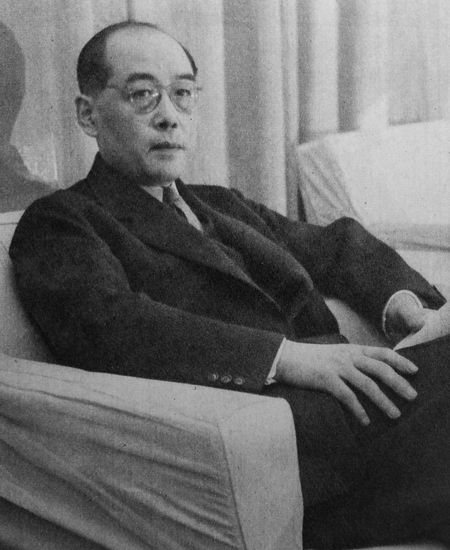
Asahi Shimbun company, Asahi Graph, 30 November 1955, public domain · Photograph of Hideki Yukawa from the Asahi Graph issue of 30 November 1955, credited to the Asahi Shimbun company, scanned and hosted on Wikimedia Commons as 'Yukawa Hideki.JPG'. Rights basis: published in Japan in 1955, before the end of 1956, so public domain in Japan under the Japanese copyright law transitional rule for old photographs and therefore in the public domain in the United States (public domain in the source country on the 1996 URAA date); Commons tags it as an old-photograph public-domain file. Saved at the Commons original size of 450 x 550, no resizing. Caveat: the individual photographer is not named, and the basis depends on the 1955 publication date given on the file page. · Public domain (Japan, published before 1956)
physicist · 20th Century
1907–1981
Not yet included in personality matching — the documented evidence doesn't yet cover enough of the personality model. Everything else on this page is fully available.
In 1935 he proposed that the force binding the atomic nucleus comes from the exchange of a new, heavier particle, and estimated its mass at about 200 times that of the electron; the particle came to be called the meson.
Cosmic-ray particles of about the predicted mass were found in 1937 and the pion was identified in 1947; he received the 1949 Nobel Prize in Physics, recorded as the first for a Japanese physicist.
With Sakata, Taketani and Kobayashi he developed meson theory further, and from 1953 he directed Kyoto University's Research Institute for Fundamental Physics while editing the journal Progress of Theoretical Physics.
In January 1937 he sent Nature a letter suggesting that anomalous cosmic-ray tracks might be mesons; it was rejected, and he published the same note in a Japanese society journal that July.
This is consistent with persisting with an idea after a setback rather than dropping it. Persistence
After the Tamm and Ivanenko calculations appeared in 1934 he resolved not to look among known particles for the quantum of the nuclear force, which led to the meson theory.
This is consistent with revising a working assumption when a competing approach hit a wall. Belief Updating
His 1935 paper was largely ignored for about two years, until 1937 cosmic-ray observations of particles of intermediate mass made him internationally known.
This is consistent with a career in which recognition came after an experimental confirmation rather than at first publication. Persistence
People whose overall profiles resemble theirs.



Not a rival — a different profile shape worth a look.