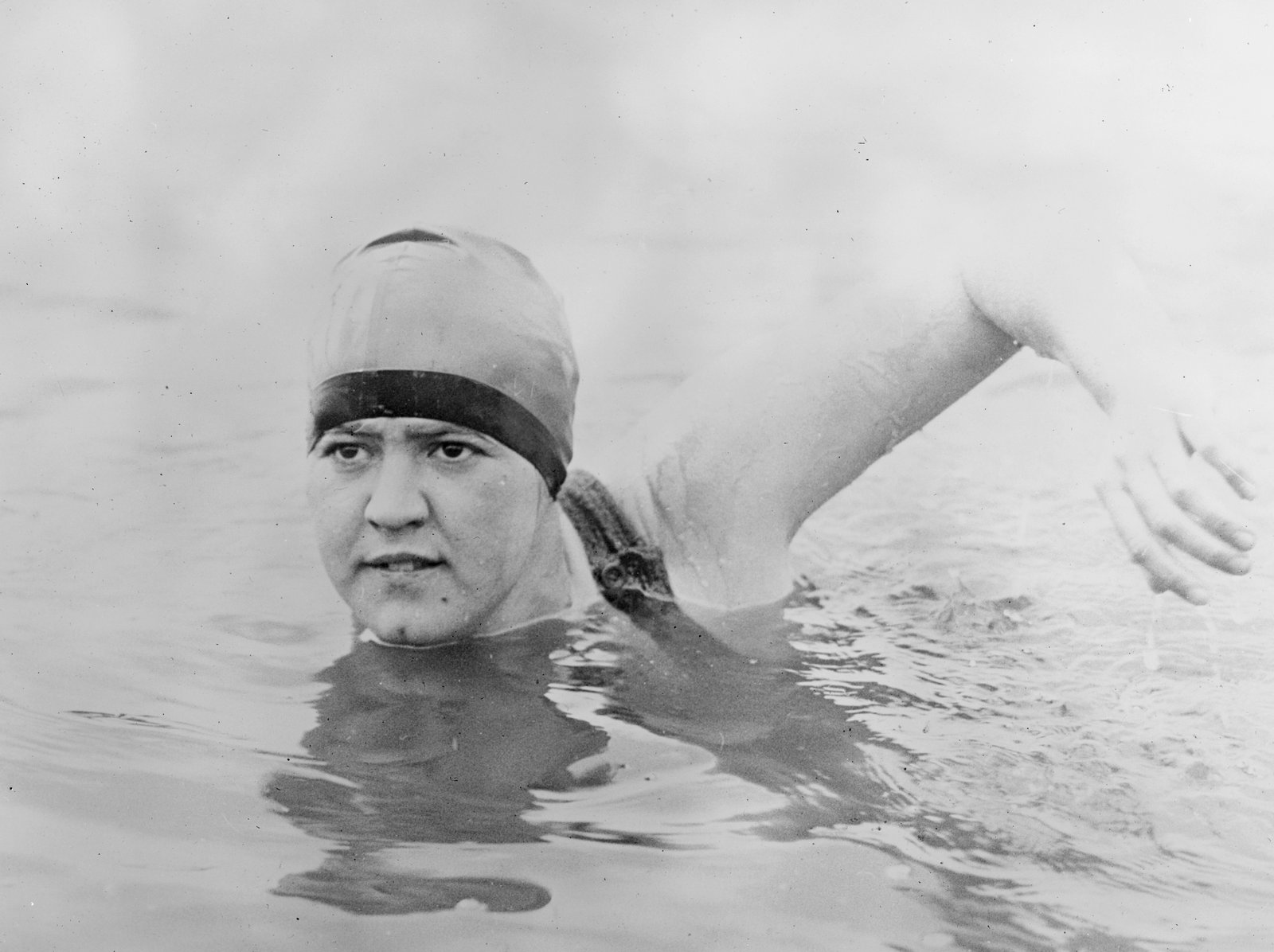

Bain News Service, 'Ederle', photograph, 1924 (catalogue date; negative annotated 7/9/26 for later publication); Library of Congress Prints and Photographs Division (LC-DIG-ggbain-37118), 'No known restrictions on publication' · Library of Congress Prints and Photographs Division, George Grantham Bain Collection, 'Ederle' (LC-DIG-ggbain-37118; hdl.loc.gov/loc.pnp/ggbain.37118), via Wikimedia Commons 'Gertrude Ederle.jpg' (downsized from 3618x2704) · Public domain
Trait Constellation
Key Achievements
On 6 August 1926 Ederle swam from Cape Gris-Nez in France to Kingsdown near Dover, becoming the first woman to swim the English Channel. Contemporary wire reports and Britannica give her time as 14 hours 31 minutes, nearly two hours faster than any of the five men who had crossed before her, over a course that rough water made about 35 miles long. A German swimmer, Ernst Vierkoetter, later crossed faster.
At the 1924 Paris Olympics Ederle won gold in the 4x100 m freestyle relay and bronze in the 100 m and 400 m freestyle. Olympedia records that in 1919, aged 12, she became the youngest woman to set a world swimming record, and that she set nine world records in all, seven of them in a single 500 m swim at Brighton Beach in 1922. Britannica counts 29 national and world amateur records between 1921 and 1925.
After the crossing Ederle was welcomed in New York with a ticker-tape parade that EBSCO's reference article puts at about two million people, and President Coolidge and Mayor Jimmy Walker praised the swim. The same article says her time, which beat the men's record, challenged assumptions about women's physical ability and that thousands of women went on to earn Red Cross swimming certificates; it also notes that the London Daily News and others dismissed the swim as an anomaly or a stunt.
Moments That Reveal Them
United Press reported that after about ten hours in the water on 6 August 1926 Ederle's trainer, Bill Burgess, advised her to give up because of the conditions, and that she called back that there was 'no reason why I should quit now.' EBSCO's reference article adds that she ignored his demands to stop as the evening storm worsened, and kept swimming after her left leg cramped.
Declining a trainer's advice to stop, twice in one swim, is consistent with persistence; both accounts come from the same tug-side reporting, so the evidence is one episode. Persistence
United Press reported on 7 August 1926 that before the swim Ederle had made her father promise not to take her out of the water until she was sinking for the second time. The report contrasts this with the previous year, when she had protested her trainer's order to pull her out, and quotes her father saying he had intended to catch her the first time he saw her sinking.
Setting her own limit for rescue, in open water, is consistent with a high tolerance for risk; the previous year's collapse shows the same stance could end an attempt. Risk Tolerance
Turning Points
On 18 August 1925 Ederle began her first Channel attempt from Cape Gris-Nez with trainer Jabez Wolffe. Wire reports say she collapsed after about nine hours and was brought aboard by the swimmer Ishak Helmy; later accounts say she disagreed with the decision. EBSCO's reference article says she then found another trainer, Bill Burgess, raised money, secured media sponsorships and trained at Cape Gris-Nez. She made the crossing in August 1926.
Replacing the trainer and arranging money and sponsors herself after the failure is consistent with proactive agency; the account of her motive comes from secondary sources. Proactive Agency
Similar People
People whose overall profiles resemble theirs.

Catherine the Great

Nellie Bly

Benito Juarez

Aung San Suu Kyi

Elizabeth Blackwell
Sources
- Gertrude Ederle (Q263287) -- verified live via wbgetentities (2026-10-05): en label 'Gertrude Ederle', description 'American swimmer (1905-2003)', P569 23 Oct 1905, P570 30 Nov 2003, citizenship United States, instance of human, place of birth New York City, P18 'Gertrude Ederle.jpg'. No Korean label on Wikidata. Orientation only; not used as support for any row.
- Gertrude Ederle -- Wikipedia article, read as orientation only; not used as support for any scored row.
- Olympedia (olympedia.org), 'Trudy Ederle' athlete biography and results page (read in full) -- the Olympic statistical reference: 1924 Paris results (gold 4x100 m freestyle relay, bronze 100 m and 400 m freestyle), nine world records including seven in one 500 m swim at Brighton Beach in 1922, youngest woman to set a world record (1919), 1925 professional swim from Lower Manhattan to Sandy Hook, the failed 1925 Channel attempt and the 1926 crossing, trainer Tom Burgess. Its text gives 14 h 34 min for the swim while its own records list gives 14:39; contemporary press and Britannica give 14 h 31 min.
- Encyclopaedia Britannica, 'Gertrude Ederle' biography (read in full) -- encyclopaedia overview: eight-beat crawl, 29 national and world amateur records 1921-1925, 1924 Olympic medals, the 1926 crossing from Cape Gris-Nez in 14 h 31 min (1 h 59 min inside the men's record) in a self-designed two-piece suit, the New York parade, the 1933 back injury, the 1939 Aquacade, instructing deaf children, Hall of Fame inductions.
- The Indianapolis Times, 7 August 1926, p. 1 and p. 3, 'Ederle to sail home on Aug. 21' / 'World acclaims Gertrude Ederle' (United Press dispatches from Dover and Boulogne), Library of Congress Chronicling America OCR text -- period wire reporting the day after the swim, written by reporters who followed the swim from a tug; OCR partly garbled but read in full for the parts used (her return to the water next day, her refusal to be taken out, her reply to Burgess after ten hours, the British press reaction).
- Daily Kennebec Journal (Augusta, Maine), 7 August 1926, p. 1, Associated Press report from Dover, 'Woman makes channel swim', and a congratulatory cable from Henry F. Sullivan, Library of Congress Chronicling America OCR text -- second, independent news service and a rival Channel swimmer's comment; read for the dated facts (start about 7 am from Cape Gris-Nez, landing at Kingsdown in the evening, 14 h 31 min, faster than the five men before her).
- New Britain Herald (New Britain, Connecticut), 18 August 1925, p. 1, Associated Press and North American Newspaper Alliance reports on Ederle's first Channel attempt, Library of Congress Chronicling America OCR text -- same-day wire account of the 1925 attempt (start, pace, companions swimming alongside, the collapse and recovery by Helmy); read for the first half of the article.
- South Bend News-Times (Indiana), 19 August 1925, p. 10, United News report 'Miss Ederle sinks unconscious when near British coast', Library of Congress Chronicling America OCR text -- a United News correspondent's account written aboard or from the tug, with her statements after the attempt; read in full. Distances from the English coast and times differ between wire reports of the same day (and from later summaries), so only the broad sequence is used.
- The Birmingham Age-Herald (Alabama), 19 August 1925, p. 7, 'Ederle fails to reach goal', Library of Congress Chronicling America OCR text -- a second newspaper's version of the same 1925 dispatches, used only to cross-check the sequence and not counted as a separate perspective.
- Outside Online, 'Gertrude Ederle, the First Woman to Brave the English Channel' (5 December 2017) -- magazine feature that interviews the sports historian Glenn Stout (author of Young Woman and the Sea) and the historian Susan Cahn; secondary retelling of the 1925-26 attempts, the 1924 disappointment, and later life. Anecdotes it repeats from Stout (e.g. the tea-poisoning belief about her first trainer) are not used.
- Elizabeth D. Schafer, 'Ederle Swims the English Channel', EBSCO Research Starters (History), 2021 -- scholarly reference article with a bibliography (Colwin, Smith, Unwin, Wennerberg, Woolum); gives the 1925 attempt, her change of trainer, the media sponsorships, the 1926 storm and her refusal to stop, the London Daily News dissent, and the aftermath including the later faster crossing by Ernst Vierkoetter.
- Library of Congress Prints and Photographs Division, George Grantham Bain Collection, 'Ederle' (LC-DIG-ggbain-37118) -- catalogue record for the portrait: 'No known restrictions on publication'; dated 1924 in the catalogue (the negative bears a later 1926 publication date).