Benjamin Franklin
91% Profile Match
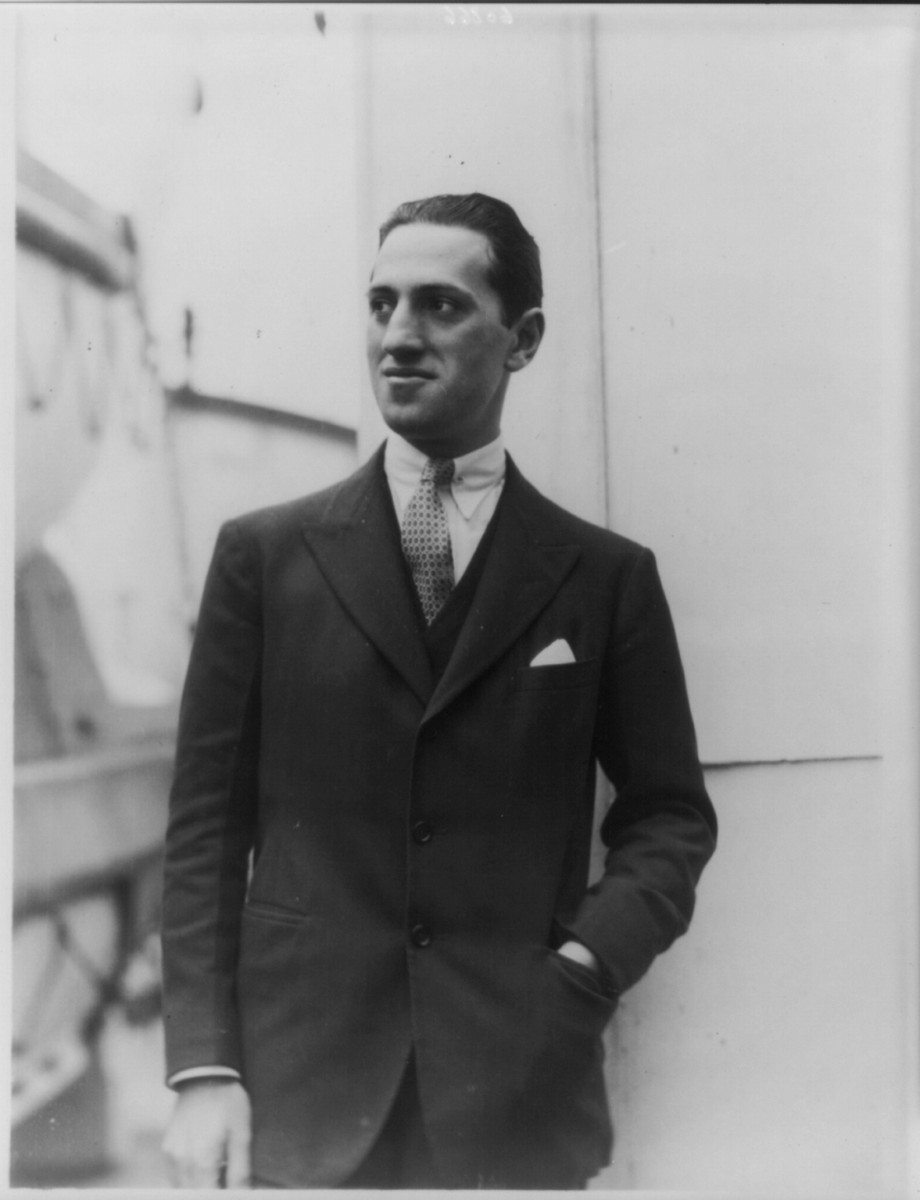
Photo: Bain News Service (photographer not named), undated, Library of Congress, Prints and Photographs Division (LC-USZ62-60866), downscaled from the original · Library of Congress, Prints and Photographs Division, George Grantham Bain Collection, item 2005678096 ('[George Gershwin, 1898-1937, half-length portrait, standing, facing left]', 1 photographic print, call number BIOG FILE [item] [P&P], reproduction number LC-USZ62-60866; 'Photo by Bain News Service'; undated -- the record gives no date and says it contains unverified, old data from caption card), taken from the Library's master TIFF (1177 x 1536 pixels, grayscale), the same pixel size as the Wikimedia Commons file 'George Gershwin, 1898-1937, half-length portrait, standing, facing left LCCN2005678096.jpg'. Rights: the item's Rights Advisory reads 'No known restrictions on publication', and the Library's Prints & Photographs rights statement for the Bain collection (last revised November 2015) reads 'There are no known copyright restrictions on the photographs in the George Grantham Bain Collection. Publicity rights may apply.' The photographer is not named (Bain News Service is the agency). The whole frame was kept (no crop) and downscaled once from 1177 x 1536 to 920 x 1200 (never upscaled); a handwritten negative number is visible at the top edge. · No known restrictions on publication
composer · 20th Century
1898–1937
Not yet included in personality matching — the documented evidence doesn't yet cover enough of the personality model. Everything else on this page is fully available.
Gershwin brought jazz idioms into the concert hall. Rhapsody in Blue premiered at Aeolian Hall on 12 February 1924 in Paul Whiteman's 'An Experiment in Modern Music', with Gershwin at the piano and Ferde Grofe orchestrating, and a Library of Congress essay calls it arguably the most famous piece of American classical music ever written. For Walter Damrosch's New York Symphony Society he then wrote and orchestrated the Concerto in F himself (Carnegie Hall, 3 December 1925), and An American in Paris followed in 1928.
Alongside the concert works, Gershwin was a leading Broadway songwriter. With his brother Ira and other lyricists he wrote songs such as 'I Got Rhythm', 'Embraceable You' and 'The Man I Love', and the Library of Congress curator says the brothers wrote many of the finest American popular songs. The University of Michigan, which is preparing the first critical edition of their works, lists scores for more than two dozen Broadway and Hollywood musicals that they wrote together.
Porgy and Bess (1935) is his opera on DuBose Heyward's story of a Black community in Charleston, with a libretto by DuBose and Dorothy Heyward and, the Michigan editors say, crucial contributions from Ira. Gershwin wrote it after fieldwork around Charleston in 1933 and 1934, including visits to the Gullah community of James Island, and orchestrated it himself. Critics were divided at its first run, it entered the Metropolitan Opera repertory in 1985, and its treatment of race has been debated from its first season, including in Duke Ellington's 1935 criticism of its music.
In early January 1924 the New York Tribune ran a small item announcing that Gershwin was writing a 'jazz concerto' for Paul Whiteman's concert of 12 February. Whiteman had asked him months earlier, and the commission had slipped his mind while he worked on a Broadway musical. He composed the piece as a two-piano score, and Whiteman's arranger Ferde Grofe orchestrated it page by page as each was finished.
This is consistent with composing quickly to a fixed deadline, though the orchestration was Grofe's and the essay says the commission had slipped Gershwin's mind, so the pace partly reflects a late start. Execution Speed
In June 1934 Gershwin went to Folly Island near Charleston to work on Porgy and Bess. DuBose Heyward, who had insisted on fieldwork, took him to the Gullah community on neighbouring James Island, where they visited schools and churches and listened to spirituals and to the dance called shouting. Heyward later wrote that for Gershwin it was more like a homecoming than an exploration.
This is consistent with a composer who studied the music he meant to draw on at first hand, though the trip was Heyward's condition for the collaboration and Duke Ellington criticised the finished opera in 1935 for not using the Negro musical idiom. Curiosity
In his earlier music Gershwin had supplied only the basic musical shape for singers, arrangers and producers to adapt, and Rhapsody in Blue had been orchestrated by Ferde Grofe. In April 1925 Walter Damrosch commissioned him to compose, orchestrate and perform a piano concerto for the New York Symphony Society. The Concerto in F, premiered at Carnegie Hall on 3 December 1925, was the first major work he orchestrated, as he did all his later concert works and Porgy and Bess.
This is consistent with a composer taking on a craft he had previously delegated, though the same editors find that his manuscripts show impatience with notating fine detail. Mastery Orientation
People whose overall profiles resemble theirs.




Not a rival — a different profile shape worth a look.