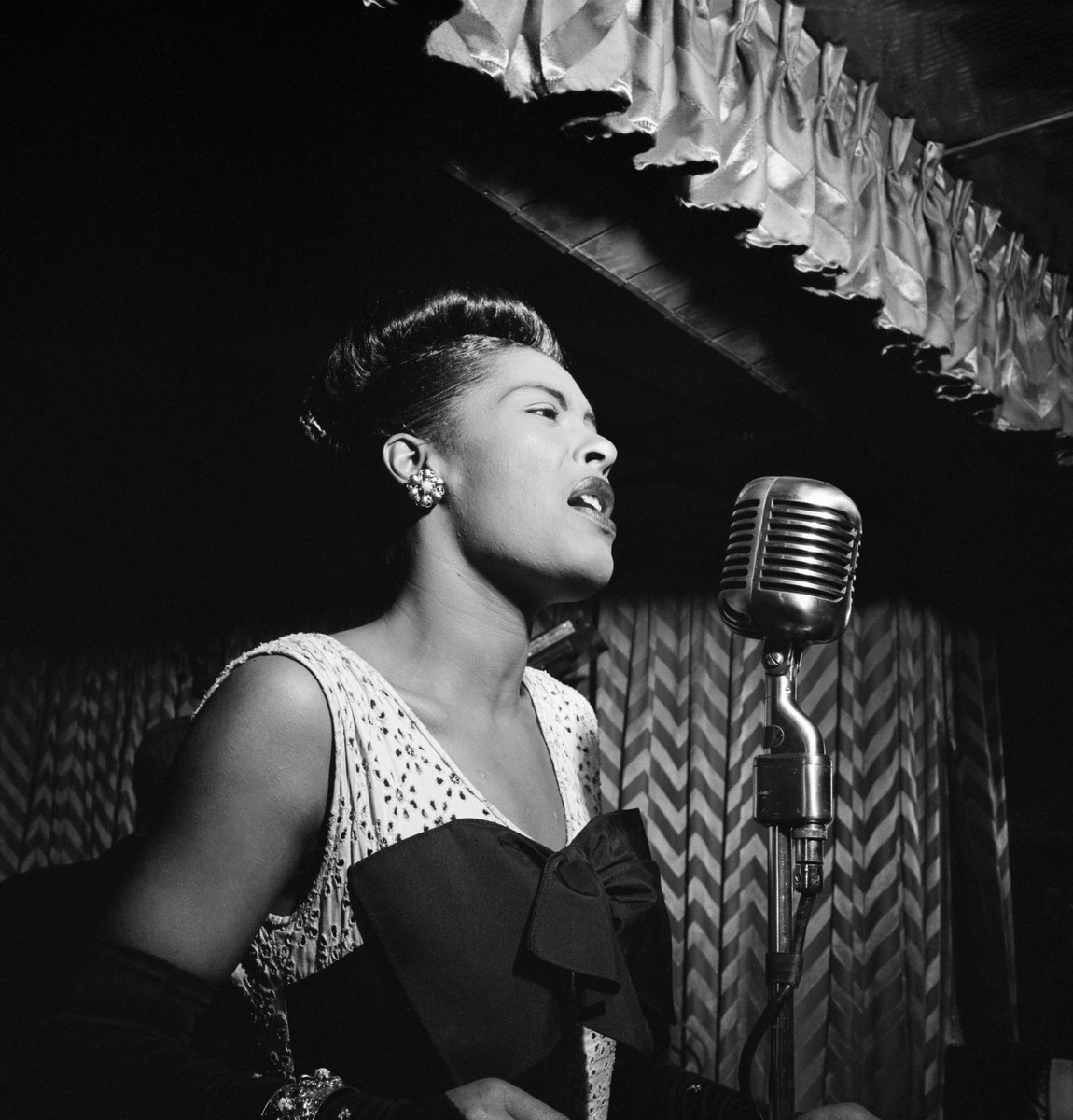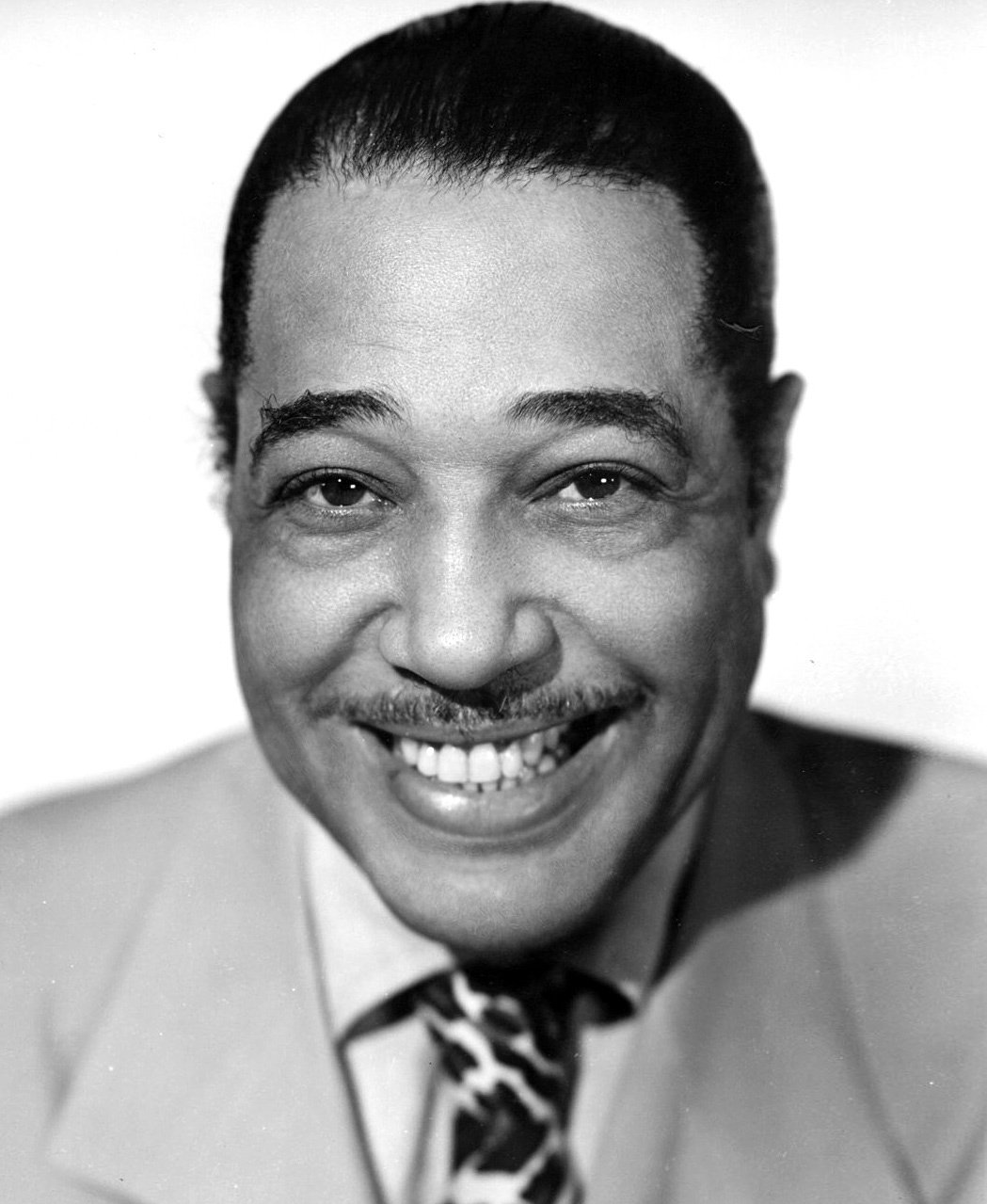

Photo: William P. Gottlieb, ca. 1947, Library of Congress Music Division, William P. Gottlieb Collection (public domain by the photographer's release; credit as a courtesy) · Wikimedia Commons, 'Billie Holiday, Downbeat, New York, N.Y., ca. Feb. 1947 (William P. Gottlieb 04251).jpg' -- photograph by William P. Gottlieb at the Downbeat club, New York, about February 1947, Library of Congress William P. Gottlieb Collection item gottlieb.04251 (Commons source field {{LOC-image|id=gottlieb.04251|division=music}}); uploaded to Commons 13 June 2018 (SHA-1 0dc1f0af matches the downloaded file). Original 4936 x 5152 pixels (6,235,422 bytes, grayscale); saved here downscaled once to 1150 x 1200 pixels, no crop, never upscaled. · Public domain: released by the photographer; Library of Congress Gottlieb Collection 'Rights and Access' page states that 'in accordance with the wishes of William Gottlieb, the photographs in this collection entered into the public domain on February 16, 2010, but rights of privacy and publicity may apply'
singer · 20th Century
Billie Holiday
1915–1959
Known For
Not yet included in personality matching — the documented evidence doesn't yet cover enough of the personality model. Everything else on this page is fully available.
Trait Constellation
Key Achievements
Her 1935 recordings with pianist Teddy Wilson and members of Count Basie's band launched her as the leading jazz singer of her time, Britannica says. Her 1936 to 1942 recordings, often with saxophonist Lester Young, were her peak years.
She sang like an instrumentalist, behind the beat, recomposing melodies to suit her range and style. A Smithsonian curator says she influenced other singers to make familiar songs their own.
Her 1939 Commodore recording of "Strange Fruit" became the best-selling record of her career and entered the Library of Congress National Recording Registry in 2002. "God Bless the Child" sold over a million copies, and she was inducted into the Rock & Roll Hall of Fame in 2000.
Moments That Reveal Them
In "Mean to Me", with Teddy Wilson, Lester Young and Buck Clayton, a Smithsonian curator describes her recomposing the melody of the first section, flattening parts of it, and singing the bridge with her own rhythm and phrasing.
Consistent with a singer whose originality lay in reshaping an existing song's melody and rhythm rather than in the material itself. Creative Originality
A critic says that in 1935, despite record-company pressure to imitate the prevailing women singers, she found a distinctive sound and learned to jam vocally with Teddy Wilson and Lester Young.
Consistent with a performer who held to her own approach under commercial pressure and thrived in close ensemble work, though this rests on one critic's account. Independent Thinking
Turning Points
In June 1935 John Hammond secured a Brunswick contract for monthly sessions built around Teddy Wilson; the resulting recordings with Wilson and members of Basie's band brought her wider recognition and launched her career as the leading jazz singer of her time.
Consistent with a career that took off through close studio collaboration with strong instrumentalists. Collaboration
Similar People
People whose overall profiles resemble theirs.


Sequoyah

Pablo Picasso

Wolfgang Amadeus Mozart

Elizabeth Cady Stanton

Ernest Hemingway
Opposite Profile
Not a rival — a different profile shape worth a look.
Alexander Hamilton
Sources
- Billie Holiday (Q104358) -- verified live via the Wikidata API (2026-10-22): English label 'Billie Holiday', description 'American jazz singer (1915-1959)', born 7 April 1915, died 17 July 1959, citizenship United States, Korean label present. Orientation only; not used as support for any row.
- Britannica, 'Billie Holiday' (encyclopedia biography) -- read in full: American jazz singer 'one of the greatest from the 1930s to the '50s'; no formal musical training but an instinctive sense of musical structure and a singing style that was 'deeply moving and individual'; first recordings in 1933 with Benny Goodman; the 1935 series with Teddy Wilson and members of Count Basie's band that brought wider recognition and 'launched her career as the leading jazz singer of her time'; touring with Basie and Artie Shaw in 1937-38; opening at Cafe Society in 1938; exclusive cabaret and concert work from about 1940; her 1936-1942 recordings as her peak years, often with Lester Young, whose interplay with her voice is described as among the best of vocal line and instrumental obbligato; the songs identified with her; and the 1956 autobiography Lady Sings the Blues. CANONICAL SIGNIFICANCE SOURCE (her primary historical contribution). The passages on parentage, arrests, addiction and health were read and not used.
- Smithsonian magazine, 'Happy Birthday, Billie!' -- a question-and-answer with John Edward Hasse, curator of American music at the Smithsonian's National Museum of American History, read in full: she 'made songs her own' with 'distinctive horn-like phrasing'; like Louis Armstrong she influenced other singers to take familiar songs and make them their own by changing melodies and rhythms; she 'practiced an instrumental approach to singing', ranging freely over the beat, flattening the melodic contours of tunes and 're-composing' songs to suit her range and style; her voice was 'physically limited' but she achieved nuance 'by sliding along the thin line separating speech and song'; a close reading of 'Mean to Me' (she recomposes the melody of the A section, flattens parts of it, sings the original bridge melody with her own rhythm and phrasing, leans on the beat and then catches up) within her partnership with Lester Young and Teddy Wilson; and the 'God Bless the Child' million-seller. Museum-curator interview, admiring but specific. The passages on her death and finances were not used.
- Library of Congress National Recording Registry essay '"Strange Fruit" -- Billie Holiday (1939), added to the National Registry 2002' by Cary O'Dell (loc.gov PDF) -- read in full: after Hammond introduced her to Benny Goodman she cut her first record on 27 November 1933; she played the Apollo in 1935 and toured with the Basie and Shaw bands and recorded for Brunswick; not everyone 'cottoned to the emotional, heavy-with-feeling delivery' and she was sometimes fired from clubs after one night; she booked a nine-month engagement at the new Cafe Society in December 1938; the 1939 Commodore recording of 'Strange Fruit' became the best-selling record of her career (number 16 on the charts); and later hits including 'God Bless the Child' and 'Lover Man'. Archive essay by a Library staff member; the song's subject matter, her protest role, and the essay's passages on her family, addiction and relationships were read and not scored.
- National Museum of African American History and Culture (Smithsonian), 'Billie Holiday' profile -- read in full: singer, songwriter and actress; her first record at eighteen with a studio group led by Benny Goodman; recordings with Teddy Wilson and a long partnership with Lester Young, who gave her the nickname Lady Day; Artie Shaw's 1938 invitation to headline his orchestra; the 1956 autobiography. Short museum profile; the claims it makes about 'first' status and her private life were not used.
- University of Wisconsin course site 'Learn the Legends: Musical Performers of the Early 20th Century', 'Billie Holiday' -- read in full: self-taught from records of Bessie Smith and Louis Armstrong; as a teenage club singer she would move from table to table improvising a different melody on each chorus; her recordings are said to 'sing like a jazz musician, singing behind the beat, recomposing melodies' and adding colours and inflections, often holding part of a phrase and catching up in the next beats; work with Basie, Shaw and Armstrong; and a quoted remark attributed to her ('If I'm going to sing like someone else, then I don't need to sing at all') that has no source on the page. University teaching page; the quotation is unsourced and is used only as flagged self-statement. The passages on her childhood, addiction and prison were not used.
- PopMatters, review of 'Billie Holiday: The Essential Brunswick Collection' (three-disc set of her 1935-1939 Brunswick recordings) -- read in full: calls the consensus of musical opinion that she is among the greatest singers while stating plainly that she did not have the largest range, sweetest timbre or most resonant vibrato; says in 1935 she 'discovers how to match her voice to the technology, how to sound distinctive (despite record company pressure to imitate the prevailing women singers), and how to jam vocally with great players such as pianist Teddy Wilson and tenor saxophonist Lester Young'; and that she made hit songs of the time her own with idiosyncratic intonation and precise phrasing. Critic's review, admiring but with an explicit limitation note; the reviewer's remarks about her later voice were not used.
- Jazz.com, note on 'Teddy Wilson (featuring Billie Holiday): What a Little Moonlight Can Do' (a liner-style paragraph) -- read in full: in June 1935 John Hammond secured Brunswick's 12-month contract for one session a month built around Teddy Wilson, produced for the coin-operated music-machine market; the first session assembled an all-star ensemble including Benny Goodman, after whose chalumeau chorus comes 'Billie's suave vocal'; Wilson later said of that session that it 'was never, never surpassed'. Short web liner note, used only for the 1935 session context and Wilson's quoted appraisal.