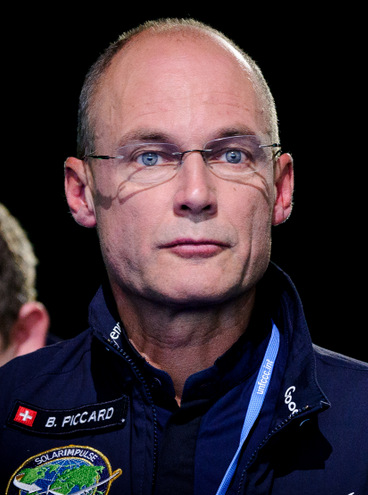

COP PARIS (COP21), 5 December 2015, CC0 · Official COP21 Flickr account (COP PARIS), 'Journee de l'Action ou Action Day - COP21', taken 5 December 2015 at Le Bourget, released under CC0 on the Flickr photo page; Wikimedia Commons file 'Bertrand Piccard 2015.jpg' (upload-wizard verified). Saved at its original 368 x 495 pixels, no resizing. · CC0 1.0
explorer · Contemporary
Bertrand Piccard
b. 1958
Known For
Not yet included in personality matching — the documented evidence doesn't yet cover enough of the personality model. Everything else on this page is fully available.
Trait Constellation
Key Achievements
In March 1999 he and Brian Jones flew Breitling Orbiter 3, the first balloon to fly around the world non-stop, in just under 20 days after two earlier attempts in 1997 and 1998.
With André Borschberg he co-founded Solar Impulse; the two took turns piloting Solar Impulse 2, which completed the first round-the-world flight by an aircraft using no liquid fuel in 2015-2016.
He framed Solar Impulse as a demonstration of clean technologies, and later led the World Alliance for Effective Solutions to identify technological solutions to protect the environment.
Moments That Reveal Them
During the 2015 Pacific crossing of Solar Impulse 2, with the autopilot alarm faulty, Piccard argued strongly for continuing while engineers urged stopping; Borschberg, who was flying, also favoured continuing.
This is consistent with a high tolerance for risk and a willingness to hold a position against technical colleagues. Risk Tolerance
Before the 1999 flight the team added four extra propane containers, and the balloon landed with under a quarter of its fuel left, after two earlier attempts had shaped the plan.
This is consistent with learning from earlier failures and adjusting the plan. Adaptability
Turning Points
In 2003 Piccard and Borschberg launched Solar Impulse, a project that took seven years to reach its first night flight in 2010 and ran for about 15 years in total.
This is consistent with a shift from record-setting adventure toward a long collaborative project with a clean-technology aim. Proactive Agency
Similar People
People whose overall profiles resemble theirs.


Mahatma Gandhi

Nellie Bly

Wangari Maathai

Malala Yousafzai

Jane Goodall
Opposite Profile
Not a rival — a different profile shape worth a look.

Leonardo da Vinci
Sources
- Bertrand Piccard (Q366255) -- verified live via the Wikidata API (2026-10-24): English label 'Bertrand Piccard', description 'Swiss balloonist and psychiatrist', born March 1958, no date of death, Korean label present, P18 image 'Bertrand Piccard 2015.jpg'. Orientation only; not used as support for any row.
- Smithsonian National Air and Space Museum, object record 'Gondola, Breitling Orbiter 3' (Gift of the Breitling Watch Company), read in full. CANONICAL SIGNIFICANCE SOURCE: describes Breitling Orbiter 3 as the first balloon to fly around the world non-stop, flown by Bertrand Piccard and Bryan (elsewhere Brian) Jones from Chateau d'Oex on 1 March 1999 to a landing in Egypt on 21 March, 19 days 21 hours 55 minutes; the two earlier attempts of 1997 and 1998 with Wim Verstraeten and the lessons that fed Orbiter 3; the extra propane containers added before take-off; the crew routine; and Piccard's use of self-hypnosis to fight depression and sleep. Museum text with a Breitling-donation credit line; admiring and partly built on Piccard's own post-flight quotes.
- Christina Nunez, 'Historic Solar Flight Shows Promise and Challenge of Clean Energy' (National Geographic, 26 July 2016), read in full: Solar Impulse 2's 17-month, 17-stop circumnavigation flown by Piccard and Andre Borschberg; Piccard's 2004 remark that clean energy lacked dynamic promotional marketing impetus (the plane as an airborne mascot); engineering expert Craig Steeves calls it an impressive technical achievement but says commercial solar flight is not feasible in his lifetime; ABB and Masdar speak for the technology; the ICCT's Dan Rutherford sees it as a good emissary for awareness. News report with named independent experts, partly critical of practicality.
- Zach Rosenberg, 'Solar Impulse 2 Finishes Its Epic Round-the-World Trip' (Smithsonian Air & Space magazine, 27 July 2016), read in full: first round-the-world flight by an electrically powered aircraft; a 15-year, 170 million dollar project meant to demonstrate the practicality of clean propulsion; about 23 days in the air over 17 months; a 117-hour leg from Japan to Hawaii followed by nine months grounded after severe battery damage; the author's view that it also shows how impractical electric flight still is at about 50 mph average, and that electric aircraft stay niche until battery energy density improves. COUNTER-VOICE source on practicality.
- Alan Boyle, ''Impossible Flight' reveals the turmoil and tech of solar plane's trek' (GeekWire, 31 January 2018), read in full: report on the NOVA documentary with direct quotes from Piccard, Borschberg and the filmmakers; the debate on whether to continue the Pacific crossing with a faulty autopilot monitoring system, Piccard arguing strongly to press on over engineers' objections, Borschberg also favouring continuing; battery overheating, a nine-month pause and Piccard's Hawaii-California leg in April 2016; the two pilots as co-founders who 'worked together like brothers'; Piccard's later World Alliance for Effective Solutions. Journalism relaying an insider documentary and interviews; much is Piccard's and Borschberg's own account.
- Fitz Cahall, 'Solar Pilots Andre Borschberg and Bertrand Piccard' (National Geographic Adventurers of the Year 2016, published 13 November 2015), read in full: account of the 118-hour Japan-to-Hawaii flight flown by Borschberg while Piccard supported from mission control in Monaco, the alarm malfunction and go/no-go decision, the battery damage found afterwards, and interview answers from both men in which Piccard credits Borschberg's record and describes the clean-technology aim. Magazine profile; interview material is self-report and admiring.
- swissinfo.ch, 'Solar "lab" flies through the night' (July 2010), read in full: first 26-hour day-and-night flight of Solar Impulse's first prototype flown by Borschberg, the seven-year, 100 million franc project with about 80 partners, mostly Swiss, Piccard's account of going to the United States for aircraft and solar expertise, and Piccard's caution that a two-seater non-stop round-the-world flight would need a huge technological leap. Swiss public-broadcaster news report; quotes from Piccard.
- Flickr photo page 'Journee de l'Action ou Action Day - COP21' by COP PARIS (the official COP21 account, taken 5 December 2015, licence shown on the page: CC0 / Public Domain Dedication) and the Wikimedia Commons file page 'Bertrand Piccard 2015.jpg' (verified by the upload wizard), checked for the portrait only.