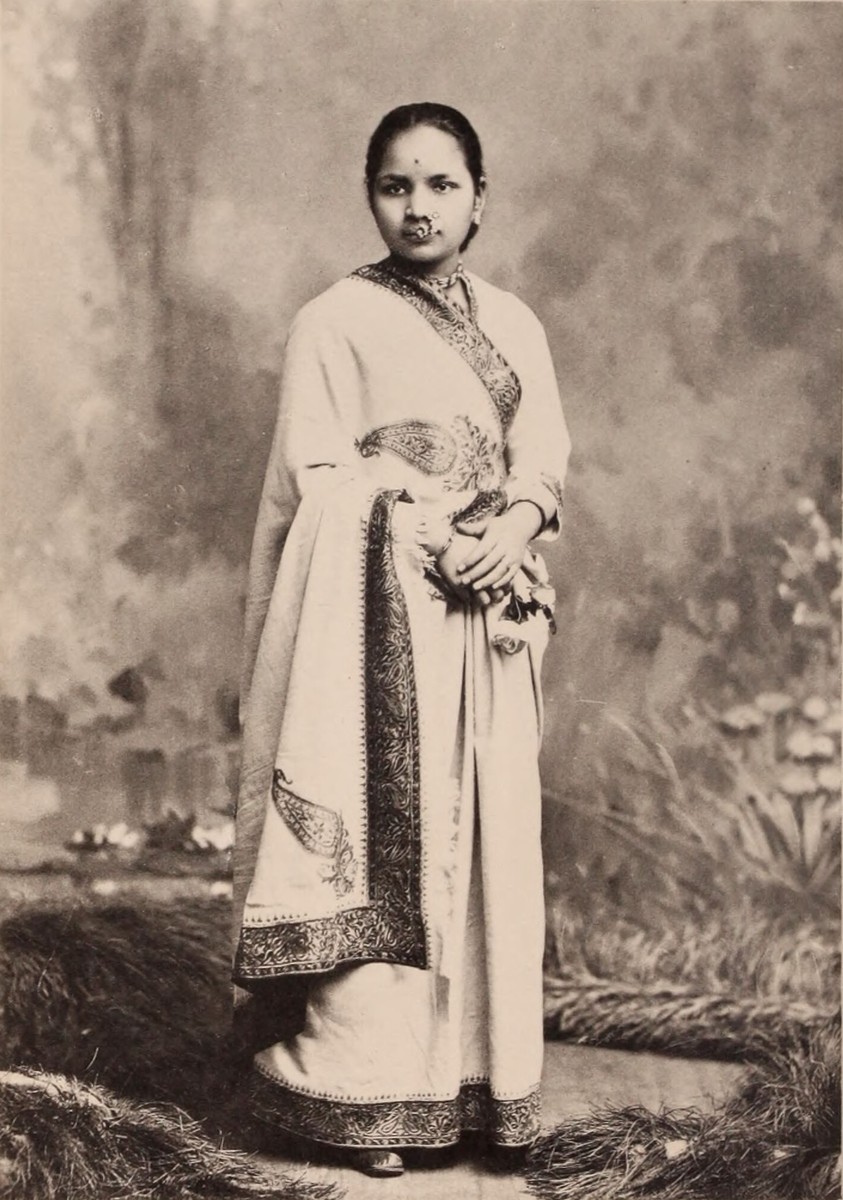
Studio photograph, photographer unknown, reproduced as the frontispiece of Caroline Healey Dall, The Life of Dr. Anandabai Joshee (Roberts Brothers, Boston, 1888); scan by the Princeton Theological Seminary Library, hosted by the Internet Archive (https://archive.org/details/lifeofdranandaba00dall_0) · Frontispiece photographic plate 'Full-length Portrait of Dr. Joshee in her Mahratta Dress' in Caroline Healey Dall, The Life of Dr. Anandabai Joshee (Boston: Roberts Brothers, 1888), from the Princeton Theological Seminary Library scan on the Internet Archive (page image 6 of the scan). The book's own list of illustrations names the plate; the plate carries no printed caption or lettering. It reproduces a studio photograph of her taken during her American years; the photographer is not named in the book. The file is the plate cropped from the library's 1547 x 2639 pixel page scan (1410 x 2006 pixels) and then reduced to 843 x 1200 pixels; no upscaling. · Public domain (the plate was published in the United States in 1888, before 1931; photographer not named in the book)
physician · 19th Century
Anandibai Joshi
1865–1887
Known For
Not yet included in personality matching — the documented evidence doesn't yet cover enough of the personality model. Everything else on this page is fully available.
Trait Constellation
Key Achievements
Indian woman from a high-caste Hindu family who graduated from the Woman's Medical College of Pennsylvania in March 1886 with a thesis on obstetrics among Hindu women; the college's archive describes her as the first high-caste Hindu woman to receive a medical degree.
After arguing publicly at Serampore in 1883 that India needed Hindu women doctors, she travelled alone to Philadelphia, matriculated that October, and in 1886 was engaged to take charge of the female ward at the Albert Edward Hospital in Kolhapur and teach a class of girls.
She sailed home in October 1886 and died of tuberculosis at Poona on 26 February 1887 before practising; her letters, printed by Caroline Dall in 1888 and studied by Meera Kosambi, are the main record of her own account of studying medicine abroad.
Moments That Reveal Them
In February 1883, at Serampore College, she gave a public address without notes explaining why she was going to America alone and why India needed Hindu women doctors, ending 'I volunteer to qualify myself for one'; a printed copy circulated in Bombay and a post-office director sent congratulations and a gift of 100 rupees.
This is consistent with a person who framed her own plan as a public purpose and was willing to argue for it in front of a sceptical audience. Impact Motivation
She was gravely ill with diphtheria in February 1884 in her first winter in Philadelphia and again weakened in her final year, yet she completed her five terms and received the degree in March 1886.
This is consistent with sustained effort through illness and an unfamiliar climate, helped by the dean and hostess families who cared for her. Persistence
Turning Points
In September 1883 she reached Philadelphia, was received by the college's dean, Rachel Bodley, and matriculated at the Woman's Medical College on 3 October 1883, having sold her marriage jewellery to pay for the passage.
This is consistent with a decision to commit fully to a plan that cut her off from the ordinary course of her community, taken with the support of a network of patrons. Risk Tolerance
Similar People
People whose overall profiles resemble theirs.

Nelson Mandela

Wangari Maathai

Nellie Bly

Jane Goodall

Elizabeth Blackwell
Sources
- Anandi Gopal Joshi (Q2845322), verified live via the Wikidata API (2026-11-05): English label 'Anandi Gopal Joshi', description 'Indian physician', born 31 March 1865, died 26 February 1887, occupation physician, no Korean label. Orientation only; not used as support for any row.
- Drexel University College of Medicine Legacy Center (successor archive of the Woman's Medical College of Pennsylvania), research guide 'Anandibai Joshee', read in full. CANONICAL SIGNIFICANCE SOURCE: the college's archive describes her as the 1886 graduate who was the first high-caste Hindu woman to receive a medical degree, and lists what the college holds on her: the dean's correspondence on her admission (1882-83), a letter from her asking the executive committee for financial aid, her grades and courses over five terms from October 1883 to her March 1886 graduation, the commencement papers, her 1886 thesis 'Obstetrics in the Aryan Hindoo', and the 1886 request that she take charge of the female ward of the Albert Edward Hospital at Kolhapur; it summarises her return to India in October 1886 and her death from tuberculosis at Poona on 26 February 1887. The guide credits no photographs; the site footer claims Drexel copyright.
- Caroline Healey Dall, The Life of Dr. Anandabai Joshee, a Kinswoman of the Pundita Ramabai (Boston: Roberts Brothers, 1888), full text from the Princeton Theological Seminary Library scan on the Internet Archive, read at length (the 1883 Serampore address, her American years, the thesis letters, the Kolhapur offer, the closing chapters). An admiring memoir by a friend and hostess that prints her letters and speeches; strongest as a record of what she wrote and did, weakest on motive; it also contains the biographer's frank remarks on her declining health and on her husband's conduct, which are not used here.
- Indian Academy of Sciences, illustrated story 'Anandibai Joshee' (Google Arts & Culture; text based on biographical notes by Meera Kosambi and Aban Mukherji), read in full: a short modern account of her admission, degree in two years in March 1886, poor health and the dean's personal care, the period when mastering English made her temporarily forget Marathi, her growing independence and public speaking, her view of why women needed women doctors, and the burial of her ashes in the Carpenter family lot in New York State.
- Niranjana G. and Bhuvaneswari, review of Meera Kosambi, A Fragmented Feminism: The Life and Letters of Anandibai Joshee (Routledge India, 2019), Rupkatha Journal on Interdisciplinary Studies in Humanities 12(6), 2020 (open access PDF, read in full, three pages): a scholarly-journal review of the most detailed modern study of her letters; it says earlier works made her husband the great reformer and obscured the politics of how she was represented, and that her letters show divided, 'fragmented' consciousness between Hindu and American ways of life. The review is brief and uneven in quality and the book itself was not opened.
- The Philadelphia Citizen, 'Anandibai Joshi', Philadelphia Women's History Month All-Star (undated, no byline), read: a short popular profile (born 1865, first Indian woman to earn an American medical degree per the site, thesis, Albert Edward Hospital appointment, tuberculosis and death). It cites no primary sources and some items are unsourced; used only as a cross-check of the basic outline, never for a row.
- Internet Archive item 'The life of Dr. Anandabai Joshee, a kinswoman of the Pundita Ramabai' (Boston: Roberts Brothers, 1888; scan by the Princeton Theological Seminary Library): the book's list of illustrations names the frontispiece 'Full-length Portrait of Dr. Joshee in her Mahratta Dress'. Opened for the portrait only.