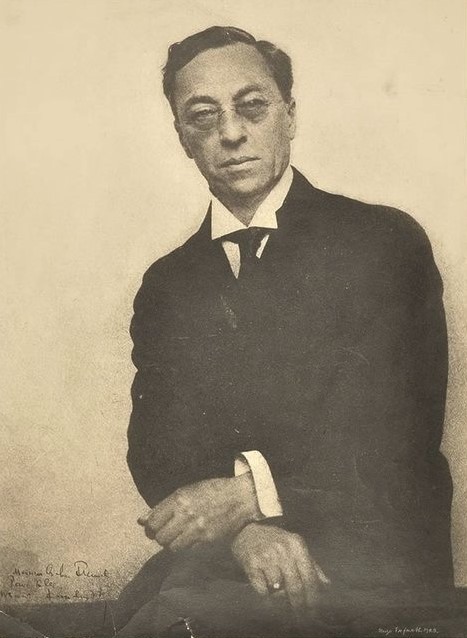

Photo: Hugo Erfurth, 1923, public domain · Wikimedia Commons, 'Wassily Kandinsky 1923 by Hugo Erfurth.jpg' -- photograph by Hugo Erfurth (1874-1948), 1923, bearing Kandinsky's handwritten dedication to Paul Klee; original 467 x 638 pixels, used unchanged and not resized or cropped. Rights basis: author died 1948 (life+70 expired end of 2018), 1923 work so also US public domain by the pre-1931 rule. The Centre Pompidou's own print record (AM 81-65-1094, inscribed 'HUGO ERFURTH 1923') names no copyright statement on the underlying photograph; its digital file was not used. · Public domain (author died 1948; Commons tag PD-old-auto-expired)
화가 · 20세기
바실리 칸딘스키
1866–1944
주요 업적 분야
아직 성격 매칭에 포함되지 않았습니다 — 기록된 근거가 성격 모델 전체를 다루기에는 충분하지 않습니다. 이 페이지의 다른 모든 내용은 자유롭게 확인하실 수 있습니다.
핵심 특성
주요 업적
그는 1908년경부터 1913년경 사이에 풍경화에서 알아볼 수 있는 대상이 없는 그림으로 나아갔고, 색과 선과 형태가 음악처럼 시각적 언어가 될 수 있다고 보았습니다. 브리태니커는 그를 순수 추상을 처음 시도한 화가 가운데 한 사람으로 꼽으면서도 유일한 창시자는 아니라고 덧붙입니다.
1911년 6월 그는 프란츠 마르크에게 "우리 현대 미술의 기록"이 될 연감을 만들자고 제안했습니다. 이 제안은 『청기사』 연감, 두 차례의 전시, 느슨한 예술가 모임으로 이어졌고, 연감에는 회화와 함께 음악, 연극, 민속 미술, 아동 미술, 민족지가 실렸습니다.
그는 『예술에서의 영적인 것에 대하여』에서 색과 형태에 관한 이론을 펼쳤고, 1922년부터 1933년까지 바우하우스에서 이를 가르쳤습니다. 바이마르에서 그가 실시한 설문은 빨강, 노랑, 파랑을 정사각형, 삼각형, 원에 짝짓는 바우하우스의 방식에 근거가 되었고, 『점·선·면』은 1926년에 나왔습니다.
삶의 장면들
1911년 1월 2일 뮌헨에서 쇤베르크의 연주회를 들은 그는 1월 18일 작곡가에게 먼저 편지를 썼습니다. 이후 쇤베르크에게 목판화 모음을 선물하고, 그를 청기사 회원으로 맞았으며, 상트페테르부르크 객원 연주를 주선했습니다.
존경하는 작업을 하는 사람에게 먼저 다가가 그 만남을 공동 작업으로 이어 간 면모와 부합합니다. 선제적 행동력
바이마르 바우하우스에서 그는 어떤 색이 어떤 형태와 어울리는지를 묻는 설문을 했고, 응답자 대다수가 그의 논거에 동의해 그 결과가 학교의 상징이 되었습니다. 다만 오스카 슐레머 같은 비판자도 있었고, 출처는 그가 과학적이라고 내세운 결론이 내면 성찰에서 나왔다고 설명합니다.
색과 형태에 대한 직관을 가르칠 수 있는 체계로 만들려는 성향과 부합하며, 그 체계의 한계는 당시에도 논쟁거리였습니다. 시스템적 사고
전환점
1896년, 서른 살을 앞둔 그는 법학·경제학을 공부하고 인쇄소에서 일한 뒤 도르파트 대학의 법학 교수 자리를 거절하고 화가가 되려고 뮌헨으로 갔습니다. 브리태니커는 이 대목에서 그의 후년 회고를 일부 활용합니다.
늦은 나이에 방향을 바꾸고 새 길을 이어 간 태도와 부합하지만, 근거의 일부는 그 자신의 회고에 있습니다. 끈기
비슷한 인물
전체적인 프로필이 이 사람과 닮은 사람들이에요.
출처
- Wassily Kandinsky (Q61064) -- verified live via the Wikidata API (2026-10-22): English label 'Wassily Kandinsky', description 'avant-garde painter of Russian origin (1866-1944)', born 1866 (4 December Julian / 22 November as recorded), died 13 December 1944, instance of human, citizenship Russia and others. Orientation only; not used as support for any row.
- Roy Donald McMullen, 'Wassily Kandinsky', Encyclopaedia Britannica (last updated 17 October 2026) -- reference biography. CANONICAL SIGNIFICANCE SOURCE. Read the freely served part (introduction, Early years, Munich period up to the founding of the Blue Rider); the later sections (Russian interlude, Bauhaus, Paris) are behind the subscription wall and were NOT read. Independent art-historian voice that also qualifies the 'founder of abstraction' claim.
- Museum of Modern Art, catalogue entry for 'Der Blaue Reiter (The Blue Rider)', 1912 almanac edited by Kandinsky and Franz Marc -- museum text on how the almanac was proposed (June 1911), what it contained, its publisher and its guarantor. Read in full.
- Centre Pompidou on Google Arts & Culture, 'Back to Russia' -- museum story on Kandinsky's 1914-1921 years in Switzerland and Moscow: his museum and institute posts, the 1920 INKhUK programme and the Constructivist opposition to it. Read in full via a web-fetch summary of the story text (the fetch tool would not reproduce the full text).
- Centre Pompidou on Google Arts & Culture, 'Kandinsky, Artist and Teacher' -- museum story on his Bauhaus teaching, lesson notes, the 1927 free-painting seminar with Paul Klee and his archive. Read in full via a web-fetch summary of the story text.
- Bauhaus Kooperation Berlin Dessau Weimar, 'Classes by Wassily Kandinsky' -- Bauhaus institutional account of his preliminary-course and colour teaching, the colour-form survey among Bauhaus members, the critics of that system (Oskar Schlemmer) and his free-painting classes. Read in full.
- Bauhaus Kooperation Berlin Dessau Weimar, biography entry 'Wassily Kandinsky' -- dated list of his Bauhaus posts (Weimar 1922, Dessau, Berlin), the 1926 Bauhaus book 'Point and Line to Plane', the Blue Four of 1924 and the 1933 closure. Read in full via a web-fetch summary.
- Adrian Glew, 'Every work of art is the child of its time, often it is the mother of our emotions', Tate Etc. issue 7, 1 May 2006 -- Tate magazine article on the British reception of 'Concerning the Spiritual in Art' (1912 English edition 1914), with early reviews by Edward Wadsworth and Wyndham Lewis and a visitor's 1912 account of Kandinsky at Murnau. Read in full via a web-fetch summary.
- Arnold Schoenberg Center Vienna, 'Schoenberg, Kandinsky, Blauer Reiter and the Russian Avantgarde' (Christian Meyer, exhibition concept) -- institutional account of Kandinsky's 1911 approach to Schoenberg, their exchange, the gifts and invitations that followed and the Weimar school suggestion. Read in full.
- Centre Pompidou, Musee national d'art moderne, catalogue record AM 81-65-1094 'Vassily Kandinsky' by Hugo Erfurth, 1923 (bequest of Nina Kandinsky, 1981) -- collection record for a print inscribed 'HUGO ERFURTH 1923' in the lower right of the image. Used only for portrait provenance, not as trait evidence. Read.