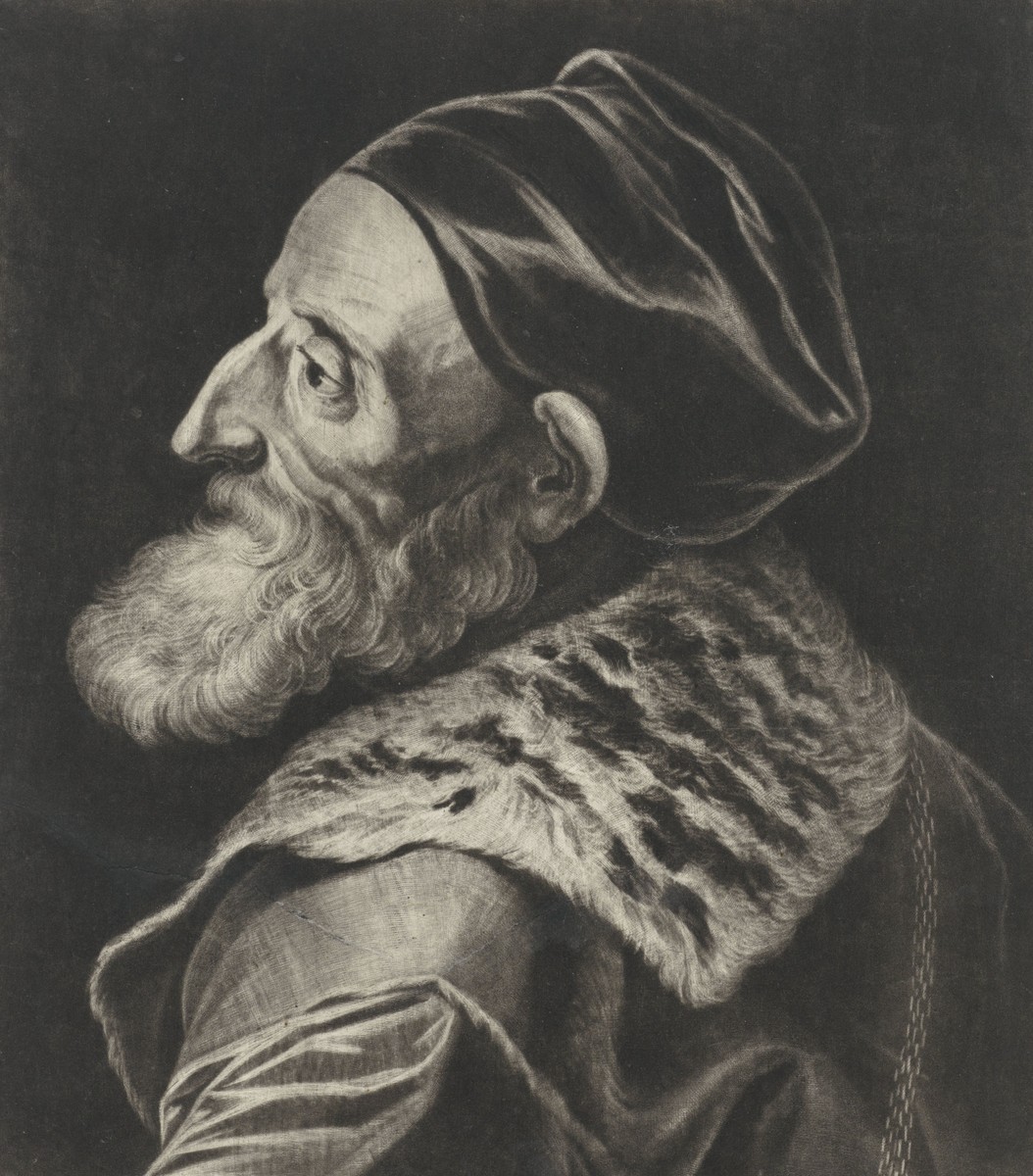
Jan Thomas, 1661, mezzotint after Titian; Rijksmuseum, Amsterdam (RP-P-1910-1486), Public Domain, cropped and downscaled from the original · Rijksmuseum, Amsterdam, collection record RP-P-1910-1486, 'Zelfportret van Titiaan' (Self-portrait of Titian): mezzotint and engraving by Jan Thomas (named on the print) after a painting by Titian, dated 30 March 1661 (inscribed 'Il vero ritratto del unico Titiano', dedicated to the Empress Eleonora, Vienna), plate 314 x 245 mm; the museum's record states 'Copyright: Public domain', and the Commons file of the museum's scan is tagged CC0 (original 5544 x 7108 pixels). The print was cropped to the plate image (the caption block and paper margins removed) and downscaled once to 1054 x 1200 (never upscaled). A later print after Titian's own self-portrait (a profile like the Prado's self-portrait, though the record does not name the painting copied), not a likeness drawn from life by the printmaker. · Public Domain (Rijksmuseum record states Public domain; CC0 digital file; mezzotint of 1661)
화가 · 근세
티치아노
1490–1576
주요 업적 분야
아직 성격 매칭에 포함되지 않았습니다 — 기록된 근거가 성격 모델 전체를 다루기에는 충분하지 않습니다. 이 페이지의 다른 모든 내용은 자유롭게 확인하실 수 있습니다.
핵심 특성
주요 업적
그는 베네치아 화단을 대표하는 화가로 자리 잡았다. 영국 내셔널 갤러리는 1518년 공개된 프라리 성당의 『성모 승천』이 베네치아 제단화 설계의 혁명적인 분수령이었다고 설명하며 그를 16세기 베네치아에서 가장 위대한 화가로 꼽는다. 워싱턴 내셔널 갤러리 오브 아트는 그가 생전부터 색채의 최고 거장으로 여겨졌다고 말한다.
영국 내셔널 갤러리는 그가 고객이 주로 국제적이었던 최초의 화가라고 설명한다. 그는 황제와 교황, 총독, 군주의 초상화를 그렸고, 1530년 카를 5세와 만난 뒤 그의 수석 화가가 되었으며, 페라라의 알폰소 데스테를 위해 신화화를 그렸다. 1551년경부터는 스페인의 펠리페 2세를 위해 '포에지(시)'라 부른 오비디우스 신화 연작 여섯 점을 그렸다.
말년의 수십 년 동안 그는 훨씬 자유로운 붓질을 발전시켰고, 영국 내셔널 갤러리는 『악타이온의 죽음』과 원래 자신의 무덤에 두려던 『피에타』 같은 작품에서 그가 회화를 추상의 가장자리까지 밀고 갔다고 설명한다. 워싱턴 내셔널 갤러리 오브 아트는 루벤스와 반 다이크, 벨라스케스가 그의 본보기에 깊이 빚지고 있다고 본다.
삶의 장면들
1559년 9월 22일 티치아노는 펠리페 2세에게 보낸 편지에서, 두 점의 『디아나』 그림에 3년이 넘게 걸린 것은 자신이 자신의 노력에 결코 만족하지 못하고 언제나 더 다듬고 끌어올리려 하기 때문이라고 설명했다. 그해 8월 베네치아 주재 스페인 대사는 왕에게 보낸 편지에서, 티치아노가 '남들은 알아차리지 못할 사소한 부분들'을 해결하고 싶어 20일 안에 두 그림을 완성할 것이라고 전했다.
그림이 스스로 정한 기준에 이를 때까지 거듭 손보는 태도와 일치한다. 완벽주의
현대 학자들은 베네치아에 가족 중심의 공방이 있었고, 조수들이 겨우 스케치만 된 캔버스를 완성하거나 티치아노의 성공작 구도를 복제했다고 설명한다. 안토니오 파올루치가 인용한 17세기 전기 작가 카를로 리돌피에 따르면 티치아노는 제자들이 가장 훌륭한 작품을 베낄 수 있도록 열쇠를 작업실에 두고 외출했고, 돌아와서는 그 복제품을 '자기 손으로' 마무리했다. 워싱턴 내셔널 갤러리 오브 아트는 이런 작업의 처음과 끝에 그가 관여해 직접 그린 것과 공방 작업을 가르기 어렵다고 설명한다.
반복되는 작업은 조수에게 맡기되 시작과 마무리에는 자신의 손길을 남긴 방식과 일치한다. 협업 성향
전환점
영국 내셔널 갤러리에 따르면 티치아노는 1550년대 후반부터 자신의 양식과 기법을 근본적으로 고쳐, 훨씬 자유로운 붓질과 덜 묘사적인 현실 표현을 발전시켰다. 1560년대 말에서 1570년대 초에는 예술을 추상의 가장자리까지 밀고 나갔다. 대부분 그가 여든 중반일 때 그려진 『악타이온의 죽음』에서는 때로는 손가락으로 문지른 덧칠을 더하고, 화면의 여러 부분을 서로 다른 완성 단계로 남겨 두었다.
말년에도 자신의 기법을 계속 바꾸려는 자세와 일치한다. 실험 성향
비슷한 인물
전체적인 프로필이 이 사람과 닮은 사람들이에요.
출처
- Titian (Q47551) -- verified live via the Wikidata API (2026-10-15): English label 'Titian', description 'Italian painter (c.1490-1576)', born c.1490 (several dates recorded, 1477-1490), died 1576 (27 August in most sources), citizenship Republic of Venice, birthplace Pieve di Cadore, Korean label present. Orientation only; not used as support for any row.
- The National Gallery, London, artist page 'Titian' -- CANONICAL SIGNIFICANCE SOURCE: the Gallery's overview calling him the greatest painter of 16th-century Venice and the first with a mainly international clientele; his training under the Bellini and Giorgione, the Assunta (displayed 1518) and Pala Pesaro for the Frari, the mythologies for Alfonso d'Este, the 1530 meeting with Charles V and the court of Philip II (the 'poesie'), his only Roman trip in 1545-46, and a freer late brushwork pushed to the edge of abstraction in the Death of Actaeon and the Pieta, left for his own tomb. Honouring institutional tone. Read in full.
- National Gallery of Art, Washington, artist biography 'Titian (Vecellio, Tiziano), Venetian, 1488/1490-1576' -- scholarly institutional biography and CANONICAL SIGNIFICANCE SOURCE alongside the London Gallery's page: one of the towering figures of Italian Renaissance art who dominated painting in Venice from the death of Giovanni Bellini in 1516 until his own death, with a career exceptionally well documented in his middle and later years but contradictory evidence for his birth date; his early career and the Giorgione question; the Assunta (completed 1518) and the Pesaro altarpiece for the Frari, the Ferrara mythologies for Alfonso d'Este, the patronage of Charles V (visits to Augsburg in 1548 and 1551) and above all Philip II of Spain; his portraiture; and, on his working practice, that his fame led to a demand he could meet only by employing assistants to produce replicas and variants (sometimes manifestly inferior, but with his own involvement in the initial and final stages making autograph and workshop hard to separate), that technical examination shows extensive pentimenti in his own and his collaborators' works, that he left many works unfinished in his studio at death for his assistants to complete, and that he began paintings on the sketchiest underdrawing and evolved them freely with radical revisions, his handling becoming broader and looser over time, with Rubens, Van Dyck and Velazquez deeply indebted to him. Institutional scholarly account, admiring in tone but candid about attribution problems; the bibliography and the lists of works in the Gallery's collection were not used. Read in full.
- The National Gallery, London, research paper 'Titian's Diana and Actaeon' (online in-depth research pages: The commission; Subject; Date and working practice; History of ownership; Provenance) -- the Gallery's account of the commission of six large mythologies (the 'poesie') for Philip II of Spain, 1549-62, for which Titian was allowed exceptional freedom in choosing the subjects and which stimulated the most ambitious works of his career, and of the documents for Diana and Actaeon and Diana and Callisto: his letters of 19 June and 22 September 1559 to Philip (the works finished, then said to have occupied him for more than three years, the delay attributed to his 'ardent desire' to do things worthy of the king, 'from which it follows that I am never satisfied with my efforts, but seek always with all my industry to polish and enhance' them) and a letter from the Spanish ambassador in Venice (that Titian would 'bring to perfection' the two paintings within twenty days because he wanted to resolve 'a few little things that others wouldn't notice'); his many visible revisions beneath loose, confident brushwork. Institutional research account that includes the ambassador's contemporary report and Titian's own letter (self); the ownership and provenance pages were skimmed and not used. Read in full.
- The National Gallery, London, teachers' notes 'Prince and painter' (art historian Karly Allen) and the Gallery's 'Paintings in depth: Diana and Actaeon' pages -- institutional account of Titian's relationship with Prince (later King) Philip of Spain: the meeting through Charles V in 1548 and the 1550 portrait; the freedom Titian enjoyed to choose subjects from Ovid, the surviving letters, the poesie that 'appear to have evolved piecemeal over more than 10 years', patron and painter 'overlooking any mention of fees and contracts'; his 1559 letter comparing the relationship to that of Alexander and Apelles (the notes call it exceptional for an artist to raise himself so in his own words); the Gallery's statement that he took three years over the two Diana pictures and wrote an 'unapologetic letter' about the delay; the Death of Actaeon remaining in his studio at his death. Institutional educational account, admiring in tone; the passages on later display and ownership were not used. Read in full.
- Giorgio Vasari, 'Description of the Works of Tiziano da Cadore, Painter', Lives of the Most Eminent Painters, Sculptors and Architects, vol. 9 (translated by Gaston du C. de Vere, 1912-15), Project Gutenberg ebook 32362 -- the 1568 biography by a LATER, Florentine and partisan writer (a believer in drawing first, who met Titian in Rome in 1546 and in Venice in 1566) and therefore one perspective only: Titian's training under Bellini and the influence of Giorgione, the Fondaco de' Tedeschi frescoes, his offices and commissions at Venice, Ferrara, Mantua, Urbino, Rome, Augsburg and for Charles V and Philip II, his friendship with Pietro Aretino, who made him known to princes (Aretino's advice that an altarpiece be sent as a gift to Charles V, who rewarded it with two thousand crowns), his late manner of bold strokes that look rough near but perfect from a distance and are 'painted over and over again', the disputes with friars over a repainted altarpiece, his use of 'his young men' for some altarpieces and the many unfinished pictures in his house, the pupil Paris Bordone's judgement that he was not ready to teach and his taking over a commission from him, his support for the mosaicists of San Marco, and Michelangelo's remark that Venetians did not learn to draw. Later partisan biography, admiring but with a Florentine critical edge (and a courtly flattering tone toward the living Titian); not independent evidence of motive. Read in full from the beginning of the Life to its end (the lives of the other artists in the volume were not used).
- Fondazione Centro Studi Tiziano e Cadore, web page 'Le botteghe di Tiziano (Titian's ateliers)' reproducing two reviews of the 2009-10 scholarly volume of that name by Giorgio Tagliaferro, Bernard Aikema and others: Enrico Castelnuovo, 'A Holding called Titian' (Il Sole 24 Ore, 2010) and Antonio Paolucci, 'The Titian Firm' (L'Osservatore Romano, 9 July 2010) -- modern art-historical accounts of how Titian's workshops were run: the Biri Grande house-atelier as residence, workshop, display space and office; the involvement of his family (his brother Francesco, his son Orazio, his cousins Cesare and Marco) and of long-serving assistants such as Girolamo Dente and, later, foreign painters; 'virtual ateliers' at Augsburg and for Philip II's commissions; helpers who completed barely sketched canvases and replicated successful compositions and portraits; a private room where Titian withdrew to paint apart from the collective work of the atelier; the 'Titian system' of a 'factory of images' and 'company' run with the trust of a mountain man mainly in family; his astute investment of earnings and commercial interests; and the seventeenth-century biographer Carlo Ridolfi's anecdote (quoted by Paolucci) that Titian left the keys out so that disciples could make copies which he then finished 'by his hand'. Two independent modern scholars' reviews of a scholarly book, admiring and interpretive in tone, with Ridolfi seen only as quoted; the pages on the book's price, ordering and the unrelated catalogue entries were not used. Read in full.
- The National Gallery, London, collection page 'The Death of Actaeon' (NG6420, about 1559-75; overview and in-depth text and audio description) -- the Gallery's account of the sequel to Diana and Actaeon: conceived about 1559 and probably the picture Titian mentioned in a June 1559 letter to Philip II as 'Actaeon torn apart by his hounds', but mostly painted when he was in his mid-eighties, never sent to Spain and possibly left in his studio at his death in 1576; the debate over whether it is finished; his much bolder and freer late technique that exploited the textures of paint and canvas, left parts in different states of completion, and added scumbled touches sometimes applied with his fingers. Institutional account, authoritative on the picture and cautious about whether it is finished; the provenance, frame and exhibition-history tabs were not used. Read in full.
- Alasdair Palmer, 'Exhibitions: Tiziano', The Spectator, 25 May 2013 (review of the exhibition at the Scuderie del Quirinale, Rome) -- independent critic's review: Delacroix's remark on the fire of life in Titian's eyes, the individuality Titian wrung out of the dull genre of the official portrait of Venetian doges he was obliged to paint under the terms of his state pension, Charles V as the least successful portrait, and Titian's old-age style in which form dissolves into colour, with obvious brushstrokes and contemporaries' observation that he painted more with his fingers than with brushes, influential on Rubens, Rembrandt, Velazquez and later painters. Short press review, admiring in tone but with a dissenting judgement of one portrait; its remark that Titian was the first to use female models in his studio was not used because no source read supports it. Read in full.
- Joseph Archer Crowe and Giovanni Battista Cavalcaselle, 'Titian: His Life and Times, with some account of his family, chiefly from new and unpublished records', 2 vols (London: John Murray, 1877), Internet Archive scans -- the standard nineteenth-century archival biography, itself a later and secondary scholarly account that prints the Venetian state decrees and Aretino's and Titian's letters; passages read: vol. 1, chapter 5 (the 1513 grant and the December 1516 broker's patent, the Fondaco de' Tedeschi office, the Doge's portraits) and the resolution of the Venetian Council on 23 June 1537 that Titian, who had drawn the salary of the patent for about twenty years without painting the battle picture in the Hall of the Great Council, must refund what he had received for the time he had not worked; vol. 2, chapter 1 (the council's decree, the rival commission to Pordenone, and Titian's completing the battle picture afterwards, 'a tardy atonement'), with the passages quoting Aretino's letters of 1537 and 1543 to Titian and of 1546 to Duke Cosimo, and the opening of Titian's 1550 letter to Aretino from Augsburg on his reception by Charles V. Nineteenth-century scholarly narrative with a strong authorial voice (the rest of the two volumes was skimmed through targeted searches and not read in full).
- Museo Nacional del Prado, collection entry 'Self-portrait' (Titian, ca. 1562, oil on canvas, P000407; catalogue text drawn from Miguel Falomir, 'El retrato del Renacimiento', 2008, p. 492), read from the Internet Archive's copy of the page dated 15 April 2023 because the live page returns HTTP 403 -- the Prado's curatorial account of Titian's self-presentation: that he painted his first self-portrait before going to Rome in 1545 and, after the Roman stay, took the most interest in circulating his image 'in a context of intense rivalry with Michelangelo', with self-portraits acquired by Paolo Giovio (1549), sent to Charles V (1550, corresponding to Giovanni Britto's print) and received by Philip II (1552), only two surviving; that the Prado picture is a profile (an exceptional format for a self-portrait) that can be identified with the portrait Vasari saw in his studio in 1566; and that the golden chain of a Knight of the Golden Spur and the brush express the motto PICTOR ET EQUES, his image being 'carefully considered'. Also checked for the portrait: the page offers its image only through separate 'Personal use' and 'Commercial use' download options, a museum reproduction regime that a public-domain tag on a 16th-century painting does not override, so the Prado photograph was not used. Curatorial catalogue text, authoritative on the picture's history and dating (other sources date it between 1562 and 1570); the page's bibliography and video links were not used. Read in full.
- Rijksmuseum, Amsterdam, collection record RP-P-1910-1486, 'Zelfportret van Titiaan' (Self-portrait of Titian), mezzotint and engraving by Jan Thomas (named on the print) after a painting by Titian, dated 30 March 1661, plate 314 x 245 mm, subject Titian in profile, with the rights statement 'Copyright: Public domain' -- checked for the portrait's licence and attribution (the print's own inscription calls it the true portrait of Titian and dedicates it to the Empress Eleonora, Vienna, 1661). The record does not name the painting copied. Not used for any scoring.
- Wikimedia Commons file page 'Zelfportret van Titiaan, RP-P-1910-1486.jpg' -- the Rijksmuseum digital file of the 1661 mezzotint, tagged CC0 (zero) and filed under portraits of Titian and prints after Titian; original JPEG 5544 x 7108 pixels, with the museum's record as its source. Checked for the file and licence; not used for any scoring.
- The National Gallery, London, collection page 'Bacchus and Ariadne' (overview and in-depth text) -- the Gallery's account of the painting made for Alfonso d'Este's Camerino d'Alabastro at Ferrara (begun in Venice in 1520 or 1522 and finished at Ferrara early in 1523): that the Duke sent canvases of the right size so that the pictures would fit the room, that Titian calculated the landscape, composition and direction in relation to the other paintings in the room, that it was a substitute for a picture the Duke had commissioned from Raphael, who died in 1520, and that Titian 'self-consciously attempted to emulate, and perhaps outdo, Raphael'; and its technical account of his colour (the finest pigments in their purest form, mixed only with white, used separately in large areas at full strength, with oil-rich glazes) and of his growing interest in the textural possibilities of paint, culminating in late works such as The Death of Actaeon. Institutional account, admiring in tone, with the emulation of Raphael given as the Gallery's interpretation; the audio description was not used. Read in full.